
You finish the course. You get a certificate. You frame it, or you put it in a folder.
Then you sit in an interview. The interviewer asks one question. “Show me something you have built.”
And you have nothing to show. The certificate is on the wall. The work is not.
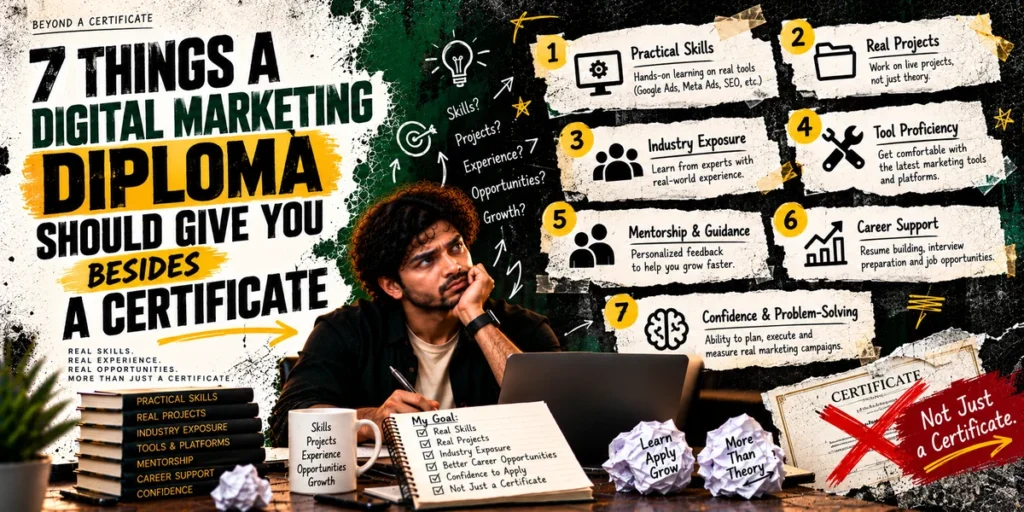
This is the gap that a good digital marketing diploma should close. A certificate proves you attended. It does not prove you can do the job. Here are seven things a diploma should give you besides the paper, and how to check each one before you pay.
The short answer
A good diploma gives you proof of work, not proof of attendance.
The certificate is a receipt. The portfolio is the product. Everything else on this list supports the portfolio, because that is what gets you interviews and confidence.
Why the certificate alone is not enough
A certificate is easy to issue. Any institute can print one. It says you completed a course. It does not say what you can do.
Recruiters know this. That is why most marketing interviews focus on two things. What have you built, and can you explain it?
If your diploma gives you only a certificate, you are paying for the weakest form of proof. The seven things below are the stronger forms.
The 7 things a diploma should give you
Here is the list. Tick each one during your demo class or counselling call.
1. A portfolio with real projects
This is the most important item on the list.
A portfolio should include at least a website, a campaign, and an SEO audit. Not screenshots from class. Your own work, built on your own accounts.
Ask the trainer directly. “What will I have built by week four, and by the end?” If the answer is vague, the portfolio is vague.
2. Practice with real tools
A diploma should put real tools in your hands. GA4. Google Ads. Meta Ads Manager. Search Console. Canva.
Not screenshots. Not demos. Real accounts, with real data, even if the data is small.
Ask to see a live tool in the demo class. A trainer who opens a real account is teaching the job. A trainer who shows slides is teaching the brochure.
3. A clear AI workflow
For an AI powered marketing course, AI should be inside the work, not beside it.
You should learn where AI helps (drafting ad variations, summarising reports, grouping feedback) and where it fails (wrong facts, misread attribution). Ask for one task done with AI and one without. The difference teaches you more than any slide.
4. Live reviews of your work
A diploma should include someone reviewing your work, in real time, and telling you what is wrong.
Marks are not reviews. A review is a conversation. “This campaign report is missing the reason the numbers dropped. Fix that.”
Ask how often reviews happen, and who gives them.
5. Interview practice
The first job will ask you to explain your work out loud. That is a skill, and it needs practice.
A good diploma includes mock interviews or presentation practice. You stand up, explain a project, and get feedback. It feels uncomfortable. That is the point.
Ask whether interview practice is included, and how many times.
6. A habit of feedback
Good courses teach you how to ask for feedback, not just how to receive it.
That means knowing what question to ask. “What is the weakest part of this report?” gets a better answer than “Is this okay?”
Ask the trainer how they teach students to ask better questions. The answer tells you a lot about the course.
7. A path to your first role
A diploma should not promise a job. It should give you a path.
That means a portfolio, a resume, a LinkedIn profile, and a list of roles that match your skills. It means knowing what to apply for, and how to talk about your work.
Ask what support you get after the course ends. A good answer is specific. A bad answer is “lifetime support” with no details.
The diploma quiz: certificate or real proof?
Three short scenes. Pick your move before you scroll. Then read the answer.
Scene one. The brochure says “certificate included.” Nothing about projects. What do you ask?
A. “Is the certificate recognised?”
B. “What will I have built by the end of the course?”
C. “How much is the fee?”
The smart move: B. A certificate is paper. Projects are proof. Ask what you will build. A is a fair question, but it misses the point. C comes later.
Scene two. The trainer shows a slide of GA4 but will not open a live account. What do you think?
A. It is fine. The slide explains it.
B. Ask to see a live account for five minutes.
C. Assume the course is fake.
The smart move: B. A live account proves the trainer uses the tool. A accepts a picture. C is too fast.
Scene three. The course includes mock interviews. You feel nervous. What do you do?
A. Skip them and focus on the certificate.
B. Join them and treat each one as practice, even if you are nervous.
C. Ask for a refund.
The smart move: B. Mock interviews are exactly where confidence is built. Skipping them wastes the best part of the course.
Do you see the pattern? In every scene, the smart move is the same. Ask for proof of work, not proof of attendance.
A real story about a certificate and a portfolio
A composite story, based on many real cases. A student, call him Vivek, finished a diploma with good marks and a certificate. He applied to ten roles. He got one interview.
The interviewer asked the same question. “Show me something you built.”
Vivek had class assignments, but they were on the institute’s accounts. He could not access them. He had no portfolio of his own.
He did not get the role. He told me later, “Certificate tha, par kaam nahi tha.” I had the certificate, but not the work.
Six months later, he rebuilt three projects on his own accounts. He started getting interviews. Same person, same certificate, different proof.
That is the whole lesson. The certificate opened a door. The portfolio walked through it.
How to check a diploma before you pay
Use this simple table when you compare courses.
| What to check | Weak diploma | Strong diploma |
|---|---|---|
| Portfolio | Mentioned at the end | Named projects, with weeks |
| Tools | Slides and screenshots | Live accounts |
| AI | One slide | Real tasks, with review |
| Reviews | Marks only | Live feedback on work |
| Interview practice | Not included | Included and practised |
| Feedback habit | Not taught | Taught with examples |
| Path to first role | Generic promises | Portfolio, resume, roles |
Before you enrol, spend twenty minutes on Google’s Search Essentials and the GA4 documentation. Both are free. They will help you judge whether a diploma is teaching real skills or just issuing paper.
Common mistakes students make
- Choosing a diploma because the certificate looks impressive. Paper does not get you hired.
- Not asking what you will build. Projects are the proof that matters.
- Accepting slides instead of live tools. A live account tells you more.
- Skipping mock interviews. They are the fastest way to build confidence.
- Believing “lifetime support” without details. Ask what it actually includes.
What no diploma can promise
No diploma can promise a job. Hiring depends on your portfolio, your interview, and the market.
Svidya’s numbers are examples, not guarantees. 200+ students taught. A highest package of 9.8 LPA. Three free demo classes. The highest package is one person’s result. It is not a forecast for you.
What a good diploma can do is give you the seven things above. The certificate comes with them. It should not be the only thing.
Your action checklist
Print this. Use it for every diploma you compare.
- Ask what you will build by week four and by the end.
- Ask to see a live tool in the demo class.
- Ask where AI fits, with one task shown live.
- Ask how often your work gets reviewed.
- Ask whether mock interviews are included.
- Ask how the course teaches you to ask for feedback.
- Ask what support you get after the course ends.
- Book the demo. At Svidya you get three free demo classes for the AI-Powered Marketing Course. Attend all three before you decide.
- Decide on proof of work, not on the certificate.
Final words and your next step
A digital marketing diploma should give you more than a certificate. It should give you proof.
A portfolio. Real tools. A clear AI workflow. Live reviews. Interview practice. The habit of asking for feedback. A path to your first role.
The certificate is the receipt. The proof is the product. Choose a diploma that gives you both.
If you are in Delhi and comparing options, start with a free demo class at Svidya’s AI-Powered Marketing Course. Bring the checklist. Ask the awkward questions. Then decide, with proof in your hand and no pressure from anyone.
About the author
Shubhankar Vashist is the founder of SVidya, based in Delhi. He has 6+ years of marketing experience across healthcare, pharma, cosmetics, e-commerce and agencies. He teaches digital marketing by making students build real assets.
FAQ
Is a digital marketing diploma certificate enough to get a job?
A certificate alone is rarely enough. Recruiters want to see what you have built and whether you can explain it. A portfolio with real projects matters more than the paper.
What should a good digital marketing diploma include?
It should include a portfolio with real projects, practice with live tools, a clear AI workflow, live reviews, interview practice, and a path to your first role. The certificate should come with these, not instead of them.
How do I check if a diploma gives real projects?
Ask what you will build by week four and by the end. Ask to see a past student’s project, names removed. If the answer is vague, the projects are probably thin.
Are mock interviews really important?
Yes. The first job will ask you to explain your work out loud, under pressure. Mock interviews are the fastest way to build that confidence before it counts.
Can I build a portfolio without a diploma?
Yes. You can build one with free resources and practice. A good diploma helps by giving you structure, feedback, and reviews. But the portfolio is yours to build either way.