
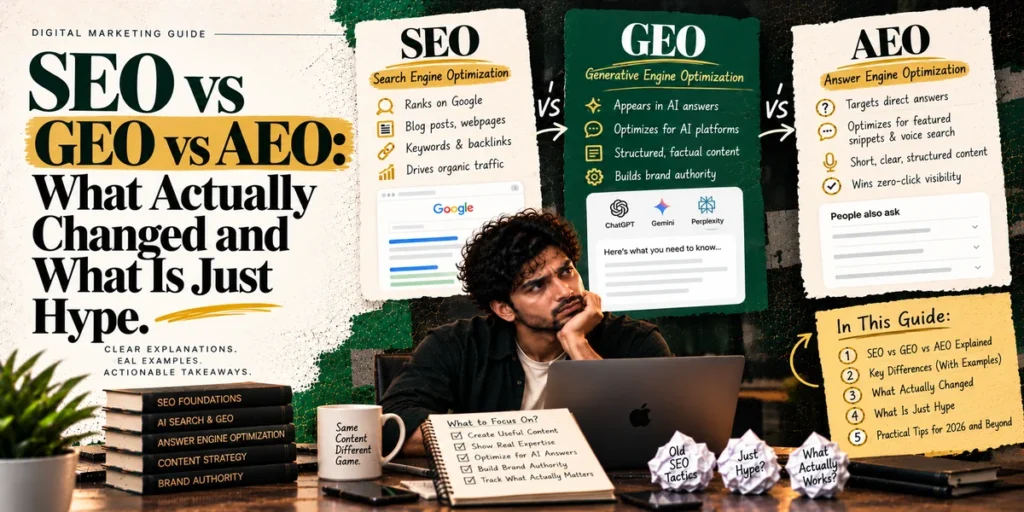
Three new terms are floating around. SEO. GEO. AEO. Everyone says they are the future. Everyone has a course about them. Half the advice contradicts the other half.
You want to know one thing. What actually changed, and what is just a new label on the same old work.
Here is the honest breakdown.
Direct Answer
SEO is still the base. It is about making your site clear and useful so search engines can find and rank it. AEO is about structuring your content so it can be pulled as a direct answer. GEO is about making your brand legible to AI systems that generate answers. None of them replaces SEO. They are extensions of it.
1. SEO Is Still the Base
SEO has not changed at its core. It is still about three things.
First, can search engines crawl and index your site. That means clean technical setup, fast loading, mobile-friendly pages, and a clear structure.
Second, is your content actually the best answer to what someone is searching. That means covering the topic properly, from real experience, with real detail.
Third, does your site earn trust. That means real backlinks, real reviews, real signals that you are a legitimate source.
Everything else, the rankings, the traffic, the AI citations, flows from those three. If the base is broken, nothing else works.
The tools have changed. The interface has changed. The core has not.
2. AEO Is Structure, Not a New Discipline
AEO stands for Answer Engine Optimization. It is about structuring your content so that a search engine or an AI tool can pull a clean, direct answer from it.
This is not new. Featured snippets have existed for years. Voice search has existed for years. AEO is the same idea, applied more broadly.
What AEO actually requires:
- A direct, plain answer at the top of the page. Often 40 to 60 words.
- Question-style headings that match what people actually type.
- FAQ sections with short answers.
- Tables and lists that a machine can lift cleanly.
- Clear definitions of terms.
None of this contradicts SEO. It is just better structure.
3. GEO Is Newer, and Half of It Is Hype
GEO stands for Generative Engine Optimization. It is about making your brand appear and be cited correctly inside AI-generated answers, like the ones from ChatGPT, Perplexity, Gemini, or Google’s AI Overviews.
GEO is the newest of the three. And it is also the one with the most hype.
Here is what actually works for GEO today:
- Consistent brand names and entity signals across the web.
- Clear, verifiable information on your site.
- Author credibility. Named authors with real credentials are cited more often.
- Content that answers a question in a way that is clean to quote.
- Being mentioned by other trusted sites.
Here is what does not work:
- Paying for GEO services that promise AI visibility.
- Adding fake schema markup that claims things that are not true.
- Chasing an AI citation score that no one can actually verify.
- Writing generic content hoping an AI will pick it up.
GEO is mostly SEO with an emphasis on clarity and brand consistency. The fundamentals did not change.
4. What Actually Changed
Three real shifts.
Answers are being generated, not just linked. People sometimes get their answer directly on the search page or in the AI tool, without clicking through. This means fewer clicks for the same amount of search.
Brand consistency matters more. When AI systems summarise information, they check whether multiple sources agree. A brand with consistent naming and clear information gets cited more often.
Structure matters more than ever. Clean headings, direct answers, and clear tables are more likely to be pulled into an answer box. Messy pages lose.
5. What Did Not Change
Content quality still wins. AI systems and search engines are both looking for the same thing. The best answer to a real question.
Real experience still matters. A page written by someone who actually did the work is preferred over a page written from general knowledge.
Links and trust still matter. Even in a world of AI answers, authority signals still drive which sources get pulled.
Rankings still matter. Getting cited by AI often starts with ranking well in search. Same fundamentals.
6. Why the Hype Exists
Every few years, the industry renames the same work. In the early 2000s, it was “search engine optimization”. Then “content marketing”. Then “inbound marketing”. Now “AEO”, “GEO”, “AIO”, “LLMO”.
The renaming is not always dishonest. Sometimes it points to a real shift. But often it is a marketing move. New labels sell new courses, new tools, and new services.
The test is simple. Ask whether the new term describes something you were not already doing. If the answer is yes, it is a real shift. If the answer is no, it is a rebrand.
7. What You Should Actually Do
Ignore the labels. Focus on the work.
- Write clear content that answers one question well.
- Put the direct answer at the top of the page.
- Use question-style headings.
- Keep your brand name consistent everywhere.
- Add real author names and credentials.
- Earn mentions on trusted sites.
- Keep your site fast and clean on mobile.
- Update your top pages every few months.
That list covers SEO, AEO, and GEO. Not three lists. One.
Comparison Table
| Aspect | SEO | AEO | GEO |
|---|---|---|---|
| Core focus | Ranking in search results | Being pulled as a direct answer | Being cited in AI-generated answers |
| What it needs | Clean site, good content, trust | Direct answers, clear structure | Consistent brand, verifiable info |
| How old | Decades | Years | Very new |
| Real change level | Base of everything | Structure upgrade | Extension of SEO |
| Biggest hype | None | Answer engine branding | AI visibility services |
| What to ignore | Old black-hat tactics | Tricks to force snippets | Paid GEO guarantee offers |
What I Actually Did
When I started learning SEO, none of these terms existed. There was only SEO. You built clean pages, wrote useful content, earned links, and ranked.
The shift I noticed first was structural. Pages with a clear direct answer at the top started showing up in featured snippets. That was the AEO shift. Nothing mysterious. Just better structure.
The second shift was brand consistency. When AI tools started summarising information, they needed to know which entity was which. I started seeing brands with consistent naming get mentioned more often in AI outputs. That is GEO in practice. Still not a new game. Just cleaner signals.
The third shift was patience. AI answers moved some search traffic away from websites. Rankings still matter. Direct clicks are less guaranteed than they used to be. But the way to earn both is the same. Be the clearest, most useful, most trustworthy source.
That is how I now teach it. Not as three separate disciplines with three different courses. As one discipline, with three layers of attention.
Mistakes to Avoid
Treating AEO and GEO as entirely new disciplines. They are extensions of SEO. You cannot skip the base.
Paying for AI visibility guarantees. No one can guarantee that an AI system will cite you. Anyone promising this is selling hope.
Loading your site with schema markup for things that are not true. AI systems and search engines both flag this.
Writing generic content and hoping AI picks it up. Generic content gets ignored by both search engines and AI.
Ignoring old SEO fundamentals. Speed, mobile, clean structure. These still drive everything.
Chasing every new term. SEO, AEO, GEO, AIO, LLMO. The names change. The fundamentals do not.
Checklist for 2026
- ☐ My site loads fast and works on mobile.
- ☐ Every page answers one clear question.
- ☐ The direct answer appears in the first 60 words.
- ☐ My headings are written as real questions.
- ☐ I have FAQ sections with short, clean answers.
- ☐ My brand name is spelled consistently everywhere online.
- ☐ Named authors with real information appear on my content.
- ☐ I have real backlinks from relevant sites.
- ☐ I do not rely on paid AI visibility services.
- ☐ I update my top pages every few months.
- ☐ I focus on clarity, not on chasing new acronyms.
FAQ
Q: Do I need separate strategies for SEO and GEO?
A: No. GEO is mostly SEO with more attention to brand consistency and clear, quotable content. One strategy covers both.
Q: Can I guarantee an AI system will cite my site?
A: No. No one can. AI systems choose their sources. You can only make your content easier to cite by being clear, consistent, and useful.
Q: Is AEO just featured snippets with a new name?
A: In practice, yes. AEO is the same idea, applied to more types of answer boxes and AI tools.
Q: Should I stop doing SEO and focus on GEO instead?
A: No. Without strong SEO, there is no GEO. The base still has to work.
Q: What is the most important thing for GEO?
A: Brand consistency and real credibility. If your brand is spelled differently everywhere and your content is generic, AI systems cannot trust it.
Q: Do I need to hire a GEO specialist?
A: Not yet. In most cases, a good SEO practitioner already covers the work that matters for GEO. Be cautious of anyone selling GEO as a distinct premium service.
End CTA
If you want to learn SEO, AEO, and GEO as one practical discipline, applied to a real project, look at the SVidya homepage. These topics run across multiple weeks in the 22-week live program. Every student works on a real site with real search goals. Read the curriculum and check whether it fits your goals. If it does not, that is fine too. The important thing is that you stop treating the new acronyms as new games, and start building the fundamentals that make all three work.
Author Box
Shubhankar Vashist is the founder of SVidya, based in Delhi. He has 6+ years of marketing experience across healthcare, pharma, cosmetics, e-commerce and agencies. He teaches digital marketing by making students build real assets.