
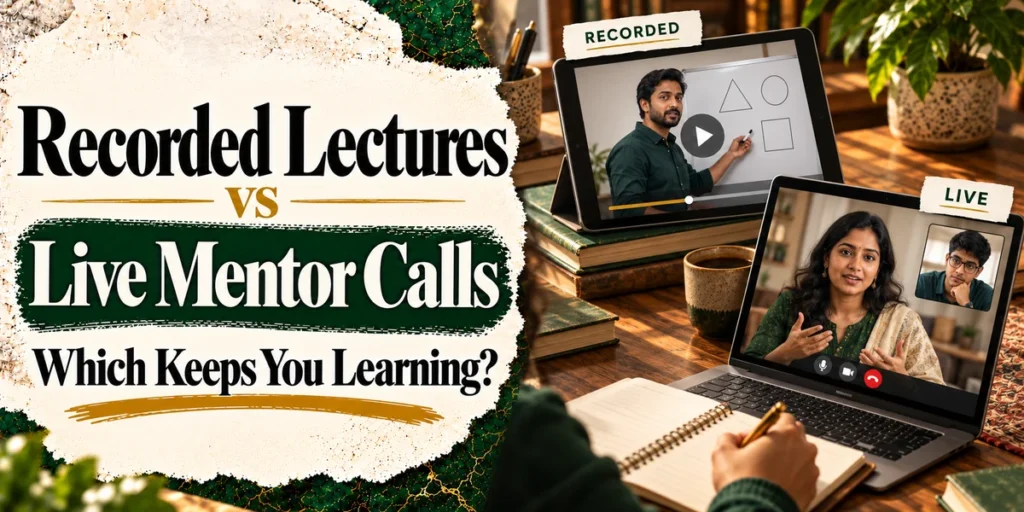
You finish a recorded lecture. You feel good. You understood everything. Then a week passes, and you cannot remember the last thing you learned.
Now picture a live call. Your mentor asks you to share your screen. You have to explain your campaign, right now, out loud. You are nervous, but you learn.
So which one actually keeps you learning? Recorded lectures vs live classes is not a simple question. The honest answer is that each one does a different job, and the best courses use both, in the right balance.
This post explains what each one does well, where each one fails, and how to check the mix before you pay.
The short answer
Recorded lectures are good for information. Live mentor calls are good for skill.
You can watch a recorded lecture on what a campaign is. You cannot learn to run one without someone reviewing your work. That is the difference that matters, and most students find out too late.
What recorded lectures do well
Recorded lectures get a bad reputation, but they are useful. Here is why.
- You can pause and rewind. If a concept is hard, you can watch it again. Live classes do not wait for you.
- You can learn at your own speed. Some days you have two hours, some days twenty minutes.
- The quality can be high. A well-made recording has clean audio and clear slides. A live class can have a bad microphone day.
- You can revise. Before an interview, you can go back to the module on GA4. That is genuinely useful.
So recorded lectures are not the enemy. They are a tool. The problem starts when a course uses only recordings and calls it teaching.
Where recorded lectures fail
Here is the honest part. Recordings fail at the things that actually build skill.
1. No one sees your work. You can watch a campaign lesson, but nobody checks whether your campaign is right. Mistakes go unnoticed for months.
2. No questions in real time. You cannot raise your hand. You write the question in a notes app and forget it.
3. No pressure. Nobody is waiting for you to explain your work. So you practise less, and you practise later.
4. No accountability. It is easy to skip a week. Then another. Then the recordings pile up, and you stop opening them.
5. They go stale. A recording from three years ago teaches an old interface and old tools. Marketing moves faster than that.
Recordings are a starting point. They are not a training method on their own.
What live mentor calls do well
Live calls are harder, and that is exactly why they work.
- You have to be present. Someone knows your name, and someone expects you to show your work.
- You get feedback in real time. A mentor can look at your campaign and say, “this is wrong, here is why.” That single moment teaches more than a slide.
- You practise explaining. You describe your work out loud, which is exactly what a client or manager will ask you to do.
- You build a habit. A fixed class time keeps you moving, even on days you feel lazy.
- You learn from other students’ mistakes. Someone else’s failed campaign is a free lesson.
Live calls cost more to run, because a trainer’s time costs money. That is why low-cost courses lean on recordings. It is a budget choice, not a teaching choice.
Where live calls fail
Live calls are not perfect either. Be honest about the downsides.
- You cannot pause. If you miss a step, you may lose the next ten minutes.
- The pace may not fit you. Fast learners get bored. Slow learners get left behind.
- Quality depends on the trainer. A live call with a weak trainer is worse than a good recording.
- You can hide. Some students sit quietly and never speak. Live is only useful if you participate.
So live calls need a good trainer and an active student. Without both, they become a lecture with a webcam.
The real answer: a mix, with one rule
The best courses use both, with a clear rule. Recordings for concepts, live calls for practice.
Here is what that mix looks like in practice.
- Before class. Watch a short recording on the concept. Fifteen to twenty minutes.
- In class. Do the work. Build the campaign, read the dashboard, fix the problem.
- After class. Get a review, then revise with the recording if needed.
This mix saves time and keeps the live call focused on skill, not on slides. A trainer reading slides on a live call is wasting everyone’s time.
The comparison quiz: recording or live?
Three short scenes. Pick your move before you scroll. Then read the answer.
Scene one. A course is entirely recorded. No live calls. The fee is low. What do you do?
A. Pay now. The fee is low and the videos look good.
B. Ask whether any live review is included, and if not, look at other options.
C. Assume live calls are not needed.
The smart move: B. Recordings alone rarely build skill, because nobody reviews your work. Ask about live review before you pay. A is how students end up with notes and no portfolio. C is a guess.
Scene two. A course has live calls, but the trainer only reads slides. What is your question?
A. “Will we build something live in class?”
B. “Is the fee negotiable?”
C. “How many students are in the batch?”
The smart move: A. A live call should be used for practice, not for reading slides. If nothing is built live, the call is just a recording with a pulse. B and C are different conversations.
Scene three. A course mixes recordings and live reviews. You are shy about speaking on calls. What do you do?
A. Skip the live calls and watch the recordings only.
B. Join the live calls and force yourself to present at least once a week.
C. Ask for a refund.
The smart move: B. The live call is where the real learning happens, even if it feels uncomfortable. A avoids the useful part. C is too fast.
Do you see the pattern? In every scene, the smart move is the same. Choose the mix, then use the live part fully.
A real story about the mix
A composite story, based on many real cases. A student, call her Divya, joined a course with a good mix. Short recordings before class. Live calls for practice. Weekly reviews.
For the first two weeks, she watched the recordings and skipped the live calls. She told herself she would join next week. The recordings were comfortable. The live calls felt scary.
By week three, she was behind. The live class had moved to campaigns, and she had not built one yet.
Her mentor noticed and sent a short message. “Join Thursday. Just listen. You do not have to speak.”
She joined. She listened. Then she presented a small campaign the following week. It was messy. Her mentor fixed three things in ten minutes.
Divya told me later, “Recording se samajh aaya. Live call se kaam aaya.” The recording helped me understand. The live call made it work.
That is the mix in one line. Understanding and doing are two different steps, and you need both.
How to check the mix before you pay
Use this simple table when you compare courses.
| What to check | Weak mix | Strong mix |
|---|---|---|
| Recordings | The whole course | Short, concept-only |
| Live calls | Slides read aloud | Live building and review |
| Feedback | Marks only | Mentor reviews your work |
| Revision | Re-watch recordings | Recordings plus notes |
| Batch size | Too large to speak | Small enough to participate |
| AI tasks | One slide | Shown live, with review |
Before you pay, spend twenty minutes on Google’s Search Essentials and the GA4 documentation. Both are free. Both will help you judge whether the live part of a course is real or just a slide show.
Common mistakes students make
- Choosing recordings only because they feel easy. Easy now, hard later.
- Skipping live calls because of shyness. The live part is the useful part.
- Not asking what happens in a live call. Some are practice, some are lectures.
- Ignoring batch size. A live call with sixty students is not a conversation.
- Never revising. A recording is only useful if you go back to it.
What no format can promise
No format can promise you a job. Recordings and live calls are tools. What matters is whether you build real work, get real feedback, and finish with a portfolio.
Svidya’s numbers are examples, not guarantees. 200+ students taught. A highest package of 9.8 LPA. Three free demo classes. The highest package is one person’s result. It is not a forecast for you.
Ask better questions. What happens in a live call? Who reviews my work? How big is the batch? A trainer who answers plainly is more useful than a polished recording.
Your action checklist
Print this. Use it for every course.
- Ask what percentage of the course is recorded vs live.
- Ask what happens in a live call. Practice, review, or slides?
- Ask who reviews your work, and how often.
- Ask the batch size for live calls.
- Book the demo. At Svidya you get three free demo classes for the AI-Powered Marketing Course. Attend all three before you decide.
- In the demo, watch whether anything is built live.
- Commit to attending live calls, even when you feel shy.
- Decide on the mix, not on the fee alone.
Final words and your next step
Recorded lectures vs live classes is not a battle. It is a balance.
Recordings help you understand. Live calls help you do. A course with only recordings leaves you with notes. A course with only live calls can move too fast to absorb.
Choose the mix. Then use the live part fully, even when it feels uncomfortable. That is where the real learning happens.
If you are in Delhi and comparing options, start with a free demo class at Svidya’s AI-Powered Marketing Course. Bring the checklist. Ask what happens in a live call. Then decide, with proof in your hand and no pressure from anyone.
About the author
Shubhankar Vashist is the founder of SVidya, based in Delhi. He has 6+ years of marketing experience across healthcare, pharma, cosmetics, e-commerce and agencies. He teaches digital marketing by making students build real assets.
FAQ
Are recorded lectures enough to learn digital marketing?
Recordings are good for concepts, but they rarely build skill on their own. Nobody reviews your work, so mistakes go unnoticed. Use recordings for understanding and live calls for practice and feedback.
Why are live mentor calls more useful than recordings?
Live calls give you real-time feedback, force you to explain your work, and keep you accountable. That is closer to the first job, where you present your work to a client or manager.
What is the best mix of recordings and live classes?
Short recordings before class for concepts, then live calls for building and review. This saves time and keeps the live part focused on practice, not on slides.
I am shy. Should I avoid live calls?
No. Join and listen first, then present small pieces of work. The live part is where most learning happens, even if it feels uncomfortable at first.
How do I check if a course uses live calls properly?
Ask what happens in a live call. If the answer is “we build and review work,” that is a good sign. If the answer is “the trainer explains topics,” it is closer to a recorded lecture with a webcam.