
Most institutes publish a syllabus once and never touch it again. It looks stable. It also goes stale.
Tools change. AI workflows change. What a client asks for in an interview changes. A syllabus that stays the same for three years is not stable. It is out of date.
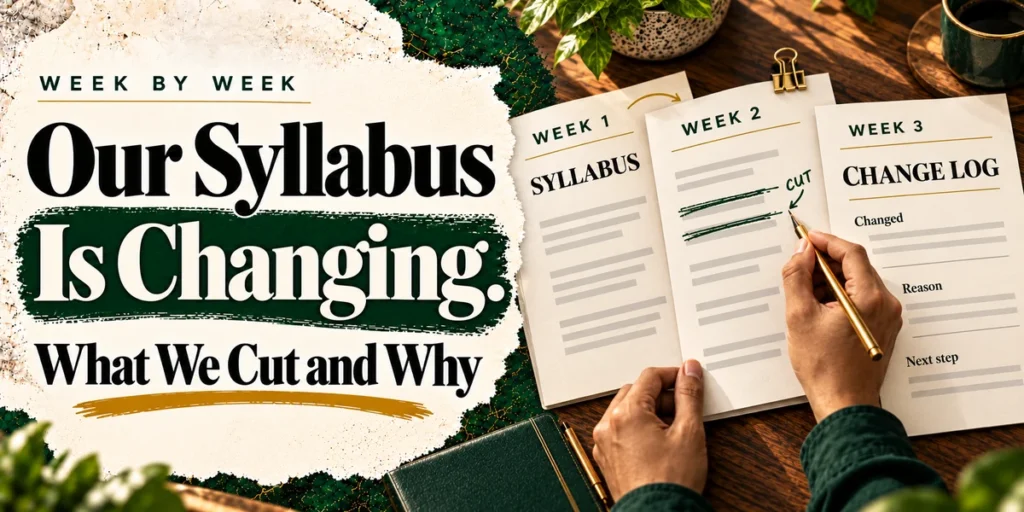
So we decided to do something different. We publish our course syllabus changes week by week, and we say what we cut and why. This post explains that process. It also gives you, the student, a way to tell an honest update from a messy one.
Why we publish changes instead of hiding them
Hiding changes is easier. You update the syllabus quietly, and nobody notices. But quiet updates create a problem.
A student who enrolled based on an old syllabus expects what they saw. If the course changed, they deserve to know. And a student comparing institutes deserves to see how often a syllabus actually moves.
Publishing changes does three things. It keeps trust. It shows the course is alive. And it makes us explain our choices, which keeps the syllabus honest.
The syllabus changes in one line
A good syllabus is a living document, updated on purpose, and explained openly.
A bad syllabus is a PDF that nobody has opened in two years.
That is the whole idea. Updates are not a sign of a broken course. Silence is.
What we cut, and why
Here is the honest list. These are the kinds of changes that happen in a real marketing syllabus, and the reasoning behind each one.
1. We cut old platform features
Ad platforms change their interfaces regularly. A lesson on a button that no longer exists wastes a class.
We cut those lessons and replaced them with the current workflow. The skill did not change. The screen did.
2. We cut theory-only sessions
A session that explains a concept without a live example feels safe. It also teaches very little.
We moved those ideas into live tasks. Same concept, shown inside a real campaign. Fewer slides, more screens.
3. We cut duplicate modules
Over time, a syllabus can grow two modules that teach almost the same thing. One on social ads, one on paid social. Students notice the repetition, and they lose interest.
We merged them. The result is shorter and deeper.
4. We cut a tool that clients stopped asking for
Tools fall out of use. Keeping a dead tool in the syllabus makes the course look busy but not useful.
We replaced it with a tool that appears in current job descriptions. The reasoning was simple. Teach what the job asks for.
5. We cut assessment by test only
A test checks memory. A campaign checks skill. We moved more weight to campaign work and reports.
This one was uncomfortable, because tests are easier to run. But easier is not the same as better.
What we added, and why
Cutting is only half the story. Here is what came in.
- More AI inside real tasks. Not a separate module. AI used in drafting, reporting, and feedback, with review.
- One messy project. Missing data, a vague brief, a tight deadline. Closer to the first job.
- More live reviews. You explain your work out loud, like a client call.
- Portfolio checkpoints. By week four, week eight, and the end, you should have something to show.
Every addition came from the same question. What does the first job actually ask for?
How to update a syllabus without breaking trust
Updating is easy. Updating well is not. Here is the process we use.
- Collect signals. Student questions, trainer notes, interview feedback, and job descriptions.
- Decide the change. Add, cut, or merge. One clear decision per week.
- Explain it in one line. Why this change, in plain words. No jargon.
- Publish it. Where students can see it. Not buried in a login.
- Tell current students. A short message. “This week we changed X, because Y.”
- Check the effect. Did it help? Ask students. Ask trainers.
- Keep the old version. So anyone can compare what changed.
Seven steps, small effort. The result is a syllabus that stays honest and current.
The syllabus quiz: honest update or messy change?
Three short scenes. Pick your move before you scroll. Then read the answer.
Scene one. A syllabus changes every week with no explanation. What do you think?
A. Great, the course is always improving.
B. It might be improving, but without explanations, it is hard to trust.
C. The course is broken.
The smart move: B. Change is good only when it is explained. A is too generous. C is too harsh. B is fair.
Scene two. You enrolled based on a syllabus. A module you wanted is cut. What should the institute do?
A. Say nothing. Changes happen.
B. Tell you directly, explain why, and show what replaced it.
C. Offer a refund and end the conversation.
The smart move: B. Direct communication and a clear reason build trust. A hides the problem. C is an overreaction before a conversation.
Scene three. An institute has not updated its syllabus in three years. What does that tell you?
A. It is stable and reliable.
B. It may be out of date, so ask what has changed.
C. It is the best course in the city.
The smart move: B. Marketing tools move fast. A three-year-old syllabus needs questions, not applause. A and C assume too much.
Do you see the pattern? In every scene, the smart move is the same. Ask what changed and why.
A real story about a syllabus change
A composite story, based on many real cases. A student, call her Sneha, enrolled in a marketing course because of one module. It was on a tool she had read about online.
Two weeks in, the trainer announced that the module was being replaced. The old tool was fading, and a newer one was appearing in job listings.
Sneha was annoyed at first. She had signed up for the old module. Then the trainer did something simple. He showed the class two job descriptions, one old and one new. The new one asked for the replacement tool.
Sneha told me later, “Pehle bura laga. Phir samajh aaya.” At first it felt bad. Then I understood.
That is what an honest change looks like. It is explained, it is shown with evidence, and it respects the student enough to say why.
What a good syllabus page should show
If you are comparing institutes, here is what to look for on the syllabus page.
| What to check | Weak sign | Strong sign |
|---|---|---|
| Update history | Nothing listed | Changes dated and explained |
| Cuts | Hidden | Named with reasons |
| Additions | Vague | Tied to real job needs |
| Assessment | Test only | Campaign plus report |
| AI | One slide | Real tasks, with review |
| Student notice | None | Current students informed |
Before you enrol, spend twenty minutes on Google’s Search Essentials and the GA4 documentation. Both are free. They will help you judge whether a syllabus is current or just well-worded.
Common mistakes institutes make with syllabus changes
- Changing quietly, then denying it when a student notices.
- Adding modules without cutting anything, so the course becomes bloated.
- Changing for a trend, not for a job need.
- Forgetting to tell current students.
- Hiding the update history, which makes every change look suspicious.
What syllabus changes cannot promise
A changing syllabus does not guarantee a better course. It only shows the course is being maintained. The teaching still matters more than the document.
No course can guarantee a job. Svidya’s numbers are examples, not guarantees. 200+ students taught. A highest package of 9.8 LPA. Three free demo classes. The highest package is one person’s result. It is not a forecast for you.
Ask better questions. What changed this year, and why? What did you cut? What did you add? A trainer who answers plainly is more useful than a beautiful, static PDF.
Your action checklist
Print this. Use it for every institute.
- Ask for the syllabus update history. When was it last changed?
- Ask what was cut in the last year, and why.
- Ask what was added, and which job need it answers.
- Check whether current students were told about the changes.
- Look at the assessment style. Campaign plus report beats test only.
- Book the demo. At Svidya you get three free demo classes for the AI-Powered Marketing Course. Attend all three before you decide.
- Ask the trainer what week one, week four, and week eight will cover.
- Decide on the plan and the reasons, not on the PDF design.
Final words and your next step
A syllabus is not a monument. It is a working document. The question is not whether it changes. The question is whether the changes are explained.
We publish our course syllabus changes week by week because we think students deserve to see the reasoning. Cut old features. Add real tasks. Explain each change in one line. Tell current students. That is the whole process.
You do not have to guess. Ask any institute what changed this year. Their answer tells you more than the brochure.
If you are in Delhi and comparing options, start with a free demo class at Svidya’s AI-Powered Marketing Course. Bring the checklist. Ask the awkward questions. Then decide, with proof in your hand and no pressure from anyone.
About the author
Shubhankar Vashist is the founder of SVidya, based in Delhi. He has 6+ years of marketing experience across healthcare, pharma, cosmetics, e-commerce and agencies. He teaches digital marketing by making students build real assets.
FAQ
Why does a course syllabus change so often?
Because marketing tools and job needs change fast. Ad platforms update, AI workflows shift, and clients ask for new skills. A syllabus that never changes usually falls behind the job market.
Is a changing syllabus a sign of a bad course?
Not by itself. Change is healthy if it is explained and tied to real job needs. A changing syllabus without reasons is messy. A stable syllabus with no updates is likely out of date.
What should an institute do when it cuts a module?
It should tell current students directly, explain why the change was made, and show what replaced it. Hiding the change damages trust more than the change itself.
How can I tell if a syllabus is current?
Ask when it was last updated and what changed in the last year. Look for named tools, live projects, AI used inside real tasks, and campaign-based assessment. Vague answers are a warning.
Should I avoid a course with an old syllabus?
Ask first. An old syllabus may still be good if the trainer is strong and the projects are real. But ask what has changed and why. If the answer is vague, look at other options.