
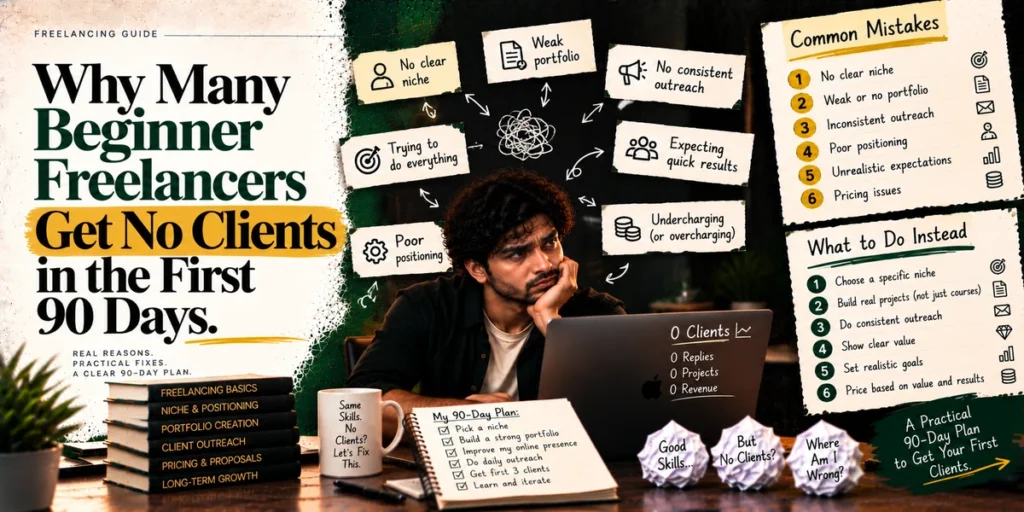
You started freelancing. You set up a profile. You posted on LinkedIn. You told your friends. You have skill. You have some projects.
Ninety days later, nothing. No client has paid you. A few people asked questions. Nobody bought.
You assume the market is too crowded. Or you are not good enough. Or you need more certifications.
The real reason is usually simpler. And it is almost always fixable in the next 30 days.
Direct Answer
Most beginner freelancers get no clients in the first 90 days because they wait for clients to come to them, describe what they do instead of the problem they solve, and never make direct offers to real people. Fix those three things and the first paying client usually arrives faster than expected.
1. They Wait for Inbound
You post content. You update your profile. You hope someone reaches out.
This almost never happens in the first 90 days. Not because content does not work, but because it takes months to build an audience. Beginners do not have months.
Fix: Go outbound. Send direct messages to people who might need what you do. Not spam. Specific, thoughtful messages to specific people. This is uncomfortable and it works. Every freelancer I know got their first client through direct contact, not through inbound.
2. They Describe What They Do, Not the Problem They Solve
“I am a digital marketer.”
That means nothing. Everyone is a digital marketer. The client does not care about your job title. They care about their problem.
“I help small clinics get more patients from Google.”
Now the client understands. Now they can decide if it applies to them.
Fix: Rewrite your description. Do not say what you are. Say what you solve, and for whom. Be specific. “Small clinics” is specific. “Businesses” is not.
3. They Never Make a Direct Offer
You talked to someone. They said “interesting”. They said “let me think about it”. Then nothing.
You thought you were building a relationship. You were not. You were having a conversation with no next step.
Fix: Every conversation should end with a specific next step. “If you want, I can put together a small proposal for this week.” “Should we set up a 20-minute call to go through your current setup?” Something they can say yes or no to. Silence is not a maybe. Silence is a no.
4. They Charge Too Little or Not at All
You are scared to charge. So you offer to work free. Or you quote something so low the client does not take you seriously.
Free work attracts people who were never going to pay. Low pricing signals low confidence. Neither builds a business.
Fix: Charge something. Even small. A modest fee is better than free. If you have no proof, charge small but charge. Free is for building your first portfolio piece. After that, you get paid.
5. They Wait for the Right Client
You want the perfect client. A big brand. A serious project. So you turn down small jobs while waiting.
The perfect client is a myth for beginners. The first client is often small, quick, and unglamorous. That is fine. The first client is not the goal. The first proof is the goal.
Fix: Take small projects. A Rs 3,000 job that gives you a testimonial and a case study is worth more than six months of waiting for a Rs 30,000 job that never comes.
6. They Do Not Follow Up
You sent one message. No reply. You moved on.
The client did not say no. They were busy. They forgot. They meant to reply and did not.
Fix: Follow up. Once, twice, maybe three times over two weeks. Keep it polite and short. “Just checking if this is still on your radar.” Most responses come from the second or third message, not the first.
7. They Have No Proof of Work
You have skills. You have no portfolio. Nothing to show.
Fix: Build one project. For yourself. For a friend. For a small business, free of charge, in exchange for a testimonial. One real project beats ten certificates. Build it, screenshot it, write it up, and use it.
Comparison Table
| Mistake | What It Looks Like | Fix |
|---|---|---|
| Waiting for inbound | Posting and hoping | Direct outreach to specific people |
| Vague description | “I am a digital marketer” | “I help clinics get more patients” |
| No direct offer | Conversations with no next step | End every chat with a clear ask |
| Too cheap or free | Working for nothing | Charge something, even small |
| Waiting for ideal client | Turning down small jobs | Take small jobs for proof |
| No follow-up | One message, then stop | Two or three polite follow-ups |
| No proof | No portfolio | One real project, written up |
What I Actually Did
When I tried to build my own marketing venture, I made most of these mistakes. I waited for people to come to me. I described what I did in vague terms. I never made direct offers. I said yes to anything that came my way, but nothing came my way because nobody knew what I actually did.
The shift came when I stopped describing myself and started describing outcomes. Not “I do marketing”, but “I can help you get more leads from your existing website”. Then I started reaching out directly. Not to hundreds of people, but to specific ones. I asked for small projects. I charged small amounts. I built proof.
The first client came from that work. Not from content. Not from a profile. From a direct message to a person I had met once, offering a specific thing I could do for them.
Everything after that was easier, because the second client came from the first. And the third from the second.
Mistakes to Avoid
Only doing inbound. For beginners, outbound is the fastest route. Use it.
Pitching general services. Specific services get hired. General services get ignored.
Not asking for the sale. The conversation should end with a clear next step, always.
Working for free indefinitely. One free project to build proof. Then charge.
Turning down small jobs. Small jobs are how you get testimonials, which is how you get bigger jobs.
Sending one message and stopping. Follow-ups are not annoying. They are expected.
Hiding behind a logo or brand name. Clients hire people. Be a person.
Practical Checklist for the Next 30 Days
- ☐ I have picked one specific service for one specific audience.
- ☐ My description says what problem I solve, not what I am.
- ☐ I have a list of 20 real people or businesses I could reach out to.
- ☐ I have sent at least 10 direct messages with a specific offer.
- ☐ Every conversation ends with a clear next step.
- ☐ I have one real project to show, even if small.
- ☐ I am charging something, not working for free.
- ☐ I follow up at least twice before dropping a lead.
- ☐ I am willing to take a small project to build proof.
- ☐ I have not waited for a perfect client to appear.
FAQ
Q: How many messages should I send before getting a client?
A: There is no fixed number. Some people get a client from ten messages. Most take thirty to fifty. What matters is consistency, not a single message.
Q: Should I work for free to get my first client?
A: One free project for a testimonial and case study is fine. After that, charge. Free work past the first project attracts people who will never pay.
Q: What if I get no replies at all?
A: Check your message. Is it specific? Is it short? Does it clearly say what you can do for them? If not, rewrite it. Most non-replies come from a vague or long pitch.
Q: How do I handle the fear of reaching out?
A: Send ten messages with the expectation of zero replies. You will get a few. The first reply removes most of the fear.
Q: What if I only have one skill?
A: One skill is enough. Clients hire specialists. Do not wait until you know ten things. Pick one and get good at it.
Q: How small is too small for a first project?
A: Almost nothing is too small. If it gives you a testimonial, a case study, or a referral, it counts. The first project is proof, not profit.
End CTA
If you want to learn how to get your first freelancing client with real projects, real offers, and real feedback, look at the SVidya homepage. Freelance and client work is covered through the 22-week live program, with real project work and sales training. Read the curriculum and check whether it fits your goals. If it does not, that is fine too. The important thing is that you stop waiting and start offering.
Author Box
Shubhankar Vashist is the founder of SVidya, based in Delhi. He has 6+ years of marketing experience across healthcare, pharma, cosmetics, e-commerce and agencies. He teaches digital marketing by making students build real assets.