
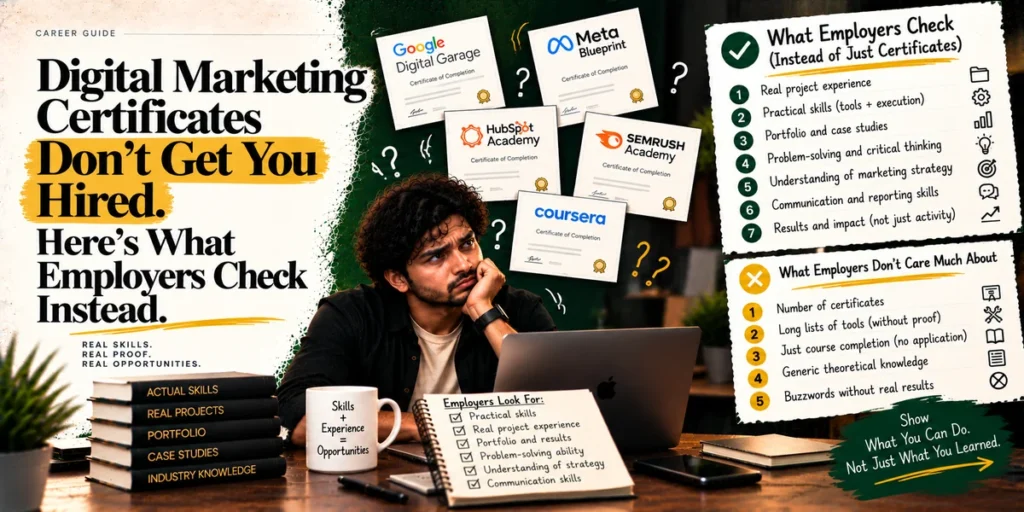
You have certificates. Maybe five. Maybe ten. You finished the courses. You passed the quizzes. You added them to your LinkedIn profile.
You apply for jobs. You get one interview. They ask one question. “Walk me through a campaign you ran.”
You freeze. Not because you do not know the theory. Because you never ran one.
The interview ends politely. The rejection email arrives three days later. It says they were “looking for someone with more hands-on experience”. You read it as unfair. What they meant is simpler. They were looking for proof.
Digital marketing certificates don’t get you hired. Proof does. Here are 7 things employers actually check in an interview, and what to build instead.
What Certificates Actually Prove
Let me be fair first. Certificates are not useless.
They prove you can finish something structured. They prove you can learn a topic on your own. They give you a starting vocabulary. These are not nothing.
But they do not prove you can execute. They do not prove you can make decisions under pressure. They do not prove you can look at a real business and figure out what it needs.
That gap is exactly what the interview is designed to test. And it is exactly where certificate holders fall apart.
1. They Check Whether You Can Explain Your Decisions
The first thing an interviewer looks for is judgment. Not knowledge. Judgment.
They will ask a simple question. “Why did you choose that audience?” Or “Why did you use that headline instead of another?”
A certificate holder often answers with general principles. “Because that audience has the highest intent.” Or “Because short headlines usually work better.”
A marketer who has actually run campaigns answers with specifics. “Because I tested three audiences, and this one had the lowest cost per lead over five days. Here is the number.”
That is the difference. One answer is theory. The other is proof.
How to build this: Before any campaign, write down why you are making each major decision. Not what you are doing. Why. Do this for five campaigns and your judgment becomes visible in conversation.
2. They Check Whether You Understand the Tools, Not Just Their Names
You can name every tool. Meta Ads Manager. Google Ads. Google Analytics 4. Search Console. You can list them.
The interviewer will then ask a specific question. “What do you do when a conversion event stops firing?” Or “Why would a keyword show impressions but zero clicks?”
These are not definition questions. They are behaviour questions. The answer requires you to have used the tool and hit a problem.
How to build this: You have to actually break things. Run a small campaign. Install tracking. Then deliberately change a setting and observe what happens. Tool fluency comes from friction, not from tutorials.
3. They Check Whether You Can Read the Numbers
A certificate teaches you what CTR, CPC, CPM, and ROAS stand for.
An interviewer wants to know if you can read a report. They will show you a dashboard or describe a scenario. “Your cost per lead doubled overnight. What do you check first?”
The right answer involves a sequence. Check whether the audience changed. Check whether the creative is fatiguing. Check whether tracking broke. Check whether the placement shifted. The exact order matters less than the logic behind it.
How to build this: After every campaign, open your own report and answer three questions. What worked. What did not. What I would change next time. Write the answers down. This practice alone separates you from every certificate-only candidate.
4. They Check Whether You Know What Broke
This is the question most beginners fail. Every real campaign breaks somewhere. Tracking fails. An event does not fire. A creative stops performing. An audience stops converting.
The interviewer asks, “Tell me about something that went wrong.” They are not looking for a failure. They are looking for whether you diagnosed the problem or waited for someone else to fix it.
How to build this: Keep a short log of problems you hit and how you solved them. Every real marketer has this log. It is one of the most valuable assets in a portfolio.
5. They Check Whether You Can Take Feedback
This sounds soft. It is not. It is one of the strongest signals in an interview.
The interviewer will offer a criticism. “I think your approach here missed the mark.” They are watching how you react.
A certificate holder often defends the theory. “But the best practice says…” A marketer with real experience says, “That is a fair point. In that campaign, I did not have enough data to test that hypothesis. Here is what I would do differently next time.”
How to build this: Submit your work for real feedback. Not from a course. From a peer, a mentor, or a client. Practise receiving criticism and responding without defence.
6. They Check Whether You Have Proof You Can Show
This is where portfolios matter. You can talk about campaigns. But can you show one?
A portfolio screenshot is worth ten minutes of conversation. Interviewers trust visible evidence more than claimed experience.
How to build this: Finish one real project, even a small one. Screenshot everything. Write a one-page case study. Put it on a simple website. That single page is more useful than any certificate.
7. They Check Whether You Can Explain the Business Outcome
The final question is always about outcomes. What did the campaign achieve. What changed for the business.
Certificate holders often answer with metrics that sound technical. “The CTR was 2.3 percent and the CPC was Rs 12.” These numbers mean nothing without context.
A marketer with real experience answers with business language. “The campaign generated 40 leads in two weeks, and 12 became paying customers. That covered the ad spend three times over.”
How to build this: Learn to translate marketing numbers into business numbers. Leads. Sales. Revenue. Cost per customer. This is the language executives and hiring managers actually speak.
Comparison Table
| What a Certificate Shows | What an Employer Actually Wants |
| You finished a course | You built something real |
| You know the definitions | You can explain your decisions |
| You studied the tools | You used the tools and hit problems |
| You watched examples | You ran your own campaigns |
| You learned the process | You can adapt when the process breaks |
| You have proof of study | You have proof of work |
What To Build Instead of Another Certificate
Three things. That is all.
One real project with real money. Even a tiny budget. Run a live campaign. Track it. Report on it.
One honest case study. One page. Goal. Decisions. What broke. What you changed. The outcome.
One public proof. A link, a screenshot, a video walkthrough. Something an interviewer can see without asking you.
Three of these, done properly, will outcompete a stack of certificates every time.
What I Actually Did
When I was applying for marketing roles, I had no certificate to lean on. I had a job loss and no budget.
What I built instead was a small website for a real business. Not perfect. Not impressive. But live. Real people could visit it. It had a real problem to solve.
When I started applying, that one project did more for me than any certificate ever could. Interviewers did not ask what I studied. They asked what I built, what broke, and what I changed.
Since then, I have kept this habit. Every project gets a short write-up. Every campaign gets a one-page case study. The write-ups force me to think about what worked and what did not. That thinking is what interviewers actually want to see.
Checklist Before Your Next Interview
- ☐ I have at least one real project I can talk about.
- ☐ I can explain why I made each major decision in that project.
- ☐ I can name one thing that broke and how I fixed it.
- ☐ I can read the key numbers from that project without notes.
- ☐ I have a written one-page case study for that project.
- ☐ I have a public link or screenshot the interviewer can see.
- ☐ I have practised explaining the project in under two minutes.
- ☐ I am applying to roles that match what I have actually built.
FAQ
Q: Do certificates have zero value?
A: No. Certificates help you get past some automated filters and give you a starting vocabulary. They are just not the thing that gets you hired. The interview is where the decision is made, and it is made on evidence.
Q: How many projects do I need before applying?
A: One real project with a strong write-up is often enough to start applying. Three gives you options. More than three and the marginal benefit drops fast.
Q: Can I build a portfolio without a client?
A: Yes. Use your own small project, a friend’s shop, or a page you own. The portfolio needs real decisions, not a real client.
Q: What if the interviewer asks about theory?
A: Answer briefly, then connect it to a project. Theory alone is weak. Theory plus a real example is strong.
Q: Should I mention my certificates on my resume?
A: Yes, but keep it short. One line, not a list. The rest of the resume should describe what you built and what changed.
End CTA
If you want a route that forces you to build real projects every week, with feedback on your work, the SVidya homepage explains how the live sessions work. Read it carefully and check whether it fits your goals. If it does not, that is fine too. The one thing that matters is that you have one real project to talk about in your next interview.
Author Box
Shubhankar Vashist is the founder of SVidya, based in Delhi. He has 6+ years of marketing experience across healthcare, pharma, cosmetics, e-commerce and agencies. He teaches digital marketing by making students build real assets.