
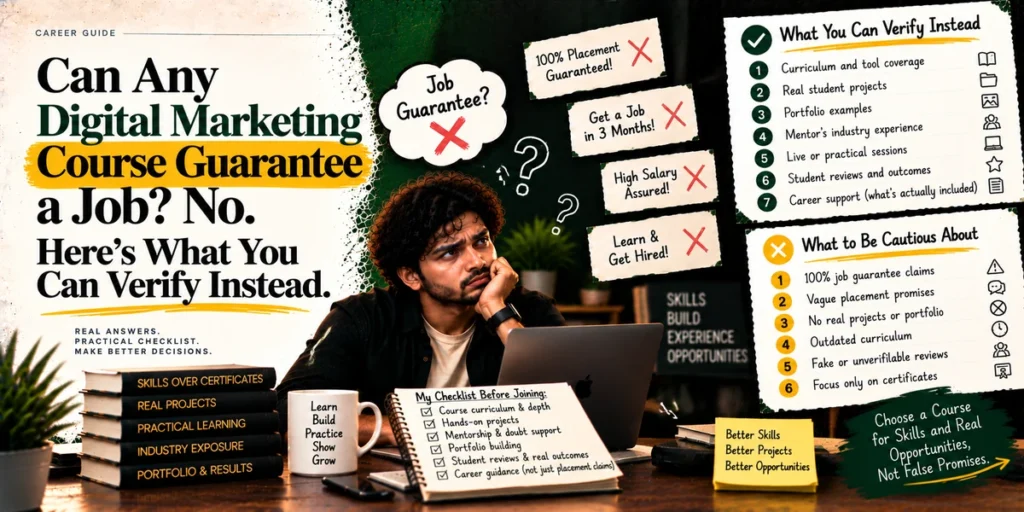
You are standing in front of a course brochure. It says 100% placement guarantee. The fee is high. The promise is loud.
You want to believe it. Because you have spent months learning, and the only thing missing is the job.
No digital marketing course can guarantee a job. Not one. Not the biggest brand. Not the smallest. Nobody can guarantee an outcome that depends on an employer deciding to hire you.
What you can do is verify what a course actually offers. Not the promise. The mechanics. Here is what to check before you pay.
Direct Answer
No digital marketing course can guarantee a job, because the hiring decision belongs to the employer. What you can verify is whether a course prepares you properly: real projects you build, feedback on your work, portfolio support, interview practice, and honest language about what it does and does not do. Those are the things that actually improve your chances.
Why No Course Can Guarantee a Job
The hiring decision depends on the employer. Not the course. The employer decides based on their needs, their budget, their timeline, and their interview process.
A course can prepare you. It cannot place you. These are different things.
Any course that says guaranteed placement is either redefining the word, or offering a conditional arrangement with fine print that removes their responsibility.
Ask one question. “What happens if I do not get placed?” The answer tells you how the guarantee actually works.
1. Real Projects You Will Build
Not topics you will learn. Projects you will actually build. Ask for a specific list. A website. A store. An ad campaign. An SEO project. An automation. A capstone.
If they cannot name the outputs by week, they cannot promise the outcome. Every strong program can list what you build.
2. Feedback on Your Work
Ask who reviews your assignments and how often. If the answer is vague, you will submit work into a void.
Feedback is what separates a course from a playlist. Without it, you do not know if you are improving or just repeating mistakes.
3. Portfolio Support
Ask how the portfolio is built. Do they help you structure it. Do they review it. Do they guide you on how to present each project.
A portfolio is not a deliverable you produce at the end. It is a running output that grows with every assignment. Ask to see what a graduate’s portfolio looks like.
4. Interview Practice
Ask whether there is mock interview practice. Ask how many, and on what schedule.
Real programs build interview practice into the calendar. Not a one-day workshop. Multiple sessions with feedback and improvement between them. Because interviews are a skill and skills need repetitions.
5. Honest Language About Outcomes
Look at how they describe the outcome. If they say placement guarantee, that is a warning. If they say interview preparation, that is honest.
The honest phrase is: “We prepare you. We do not place you.” Any provider that uses this language is worth listening to. Anyone who promises a job is not.
6. Refund and Exit Terms
Ask what happens if you drop out. Ask what happens if you fall behind. Ask whether there is a real refund window.
A provider confident in their own product will have a clear, written policy. A provider who dodges this question is not confident.
7. Batch Size and Instructor Access
Ask how many students are in a batch. Ask whether the instructor is present live. Ask how doubts are answered during sessions.
A live session with two hundred students is not mentorship. It is a broadcast. Personal feedback and doubt clearing only work in small batches.
What You Actually Get From a Good Course
Here is what a serious program actually delivers. Not a job. A set of assets and skills that improve your odds.
A portfolio of real work. Three or more projects that you can show in an interview.
Feedback on your work. Repeated reviews so you know what is working and what is not.
Interview practice. Mock interviews with feedback and improvement targets.
A resume and LinkedIn that reflect real work. Not a list of certificates.
A way of thinking about problems. Not just knowledge. Judgment.
That is the real output. It does not guarantee a job. It gives you a much better chance of one.
Comparison Table
| What Providers Promise | What You Can Actually Verify |
|---|---|
| 100% placement guarantee | What happens if you are not placed |
| Industry certification | Which projects you will build |
| Job assistance | Who reviews your assignments |
| Interview training | How many mock interviews, on what schedule |
| Lifetime support | What that means in writing |
| Top hiring partners | What a graduate actually does now |
What I Actually Did
I did not go through a course that promised a job. I learned from free resources and built real projects. The first thing I had that mattered was not a certificate. It was a working website for a real business.
When I started teaching, I looked at how other programs marketed. The ones that promised jobs usually had the vaguest programs. The ones that were honest about outcomes usually had the most rigorous structure.
I chose the honest model. Every week has an output. Assignments are reviewed. Portfolio is built in parallel. Interview practice is scheduled at set milestones. Nothing is guaranteed. Everything is designed to improve your odds.
The result is not a job guarantee. It is a set of real assets that give you something to show an employer. That has always been the only honest offer in this industry.
Mistakes to Avoid
Choosing a course because of the word guarantee. It is a marketing word. It does not change the hiring decision.
Ignoring the fine print. A placement guarantee often means we will send your resume to companies. That is not placement.
Assuming a bigger brand is a better course. Big brands have big marketing budgets. That is not the same as better teaching.
Skipping the portfolio question. If the course cannot show you a graduate portfolio, ask why.
Not asking about interviews. Practice is what prepares you. A one-hour session is not practice.
Paying without checking the refund policy. A real provider offers a clear window. If not, walk away.
Practical Checklist Before You Pay
- ☐ I have a specific list of the projects I will build.
- ☐ I know who reviews my work and how often.
- ☐ I have seen an example of a graduate portfolio.
- ☐ I know how many mock interviews are scheduled.
- ☐ The provider uses the phrase interview preparation, not placement guarantee.
- ☐ I have the refund policy in writing.
- ☐ I have asked what happens if I fall behind.
- ☐ I know the batch size and the schedule.
- ☐ I have spoken to a past student, or read an honest review outside the provider’s website.
- ☐ I have decided based on what I will build, not on what I am promised.
FAQ
Q: Are placement guarantees ever real?
A: In rare cases, a provider might offer a refund if you are not placed within a certain period. But even then, the terms are usually narrow. Read the fine print carefully.
Q: What should a digital marketing course actually promise?
A: Real projects, feedback, portfolio support, and interview preparation. Not a job.
Q: How important is the course provider’s brand?
A: Less than you think. What matters is what you build and who reviews your work. A small program with real feedback beats a big brand with recorded videos.
Q: Can I get a job without any course?
A: Yes. A portfolio of real projects and interview preparation can be built without a course. A course helps by giving structure and feedback, but it is not strictly required.
Q: How many mock interviews should a course include?
A: At least three to five, spaced out over the program, with feedback between each. One mock interview is not practice.
Q: What is the strongest signal an employer looks for?
A: Proof of work. Real projects, real outcomes, and the ability to explain your decisions. Not certificates.
End CTA
If you want a program that is honest about outcomes, focused on real projects, and structured to improve your odds without promising a job, look at the SVidya homepage. The 22-week live program includes real projects, reviewed assignments, a portfolio, a capstone, and an interview accelerator with mock interviews. Read the curriculum and check whether it fits your goals. If it does not, that is fine too. The important thing is that you verify what a course actually delivers before you pay for a promise nobody can keep.
Author Box
Shubhankar Vashist is the founder of SVidya, based in Delhi. He has 6+ years of marketing experience across healthcare, pharma, cosmetics, e-commerce and agencies. He teaches digital marketing by making students build real assets.