
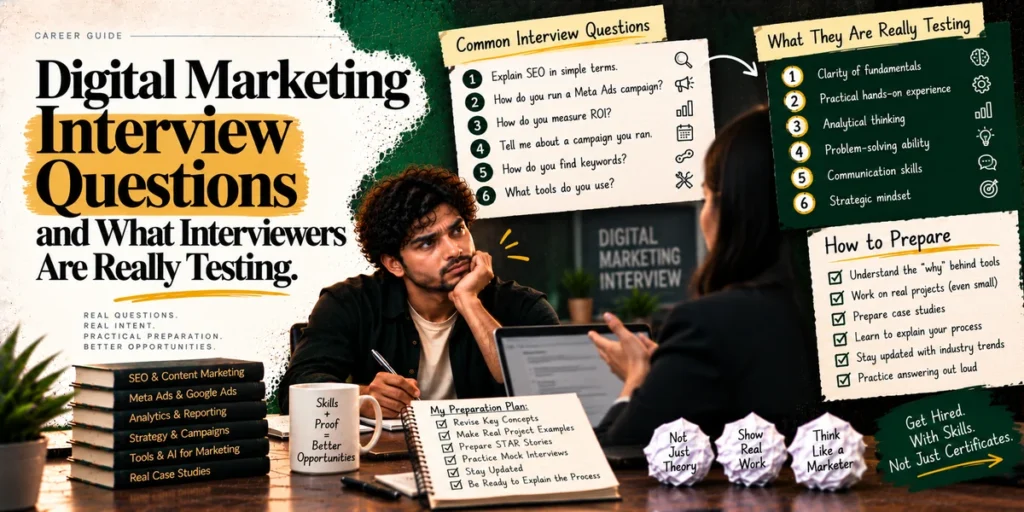
You have studied the theory. You know the definitions. You can explain funnels, objectives, and analytics without looking anything up.
Then the interview starts. And within five minutes, you realise the questions are not what you prepared for.
They are not asking what you know. They are checking how you think. Here are seven digital marketing interview questions you will be asked, and what the interviewer is really testing behind each one.
Direct Answer
Digital marketing interview questions test judgment, not knowledge. Interviewers ask about campaigns you ran, decisions you made, problems you solved, and how you handle feedback. They want to see how you think under pressure. Memorising definitions will not help you. Real project experience will.
1. “Tell Me About a Campaign You Ran”
This is the classic opener. It sounds simple. It is not.
What they are testing: Whether you have actually run a campaign, or whether you have only studied them.
How to answer: Pick one specific campaign. Not three. One. Walk through it in five steps. The goal. The audience. The creative. What broke. What you would change.
If your first answer is “I have not run a campaign yet, but I have studied them”, you have lost the interview. Do not be that candidate. Build a real campaign first, even a small one, on your own money.
2. “Why Did You Choose That Audience?”
The follow-up question. It is designed to test your judgment.
What they are testing: Whether you made a decision or just followed a template.
How to answer: Give a reason based on data, not on assumption. “I chose that audience because I tested three and this one had the lowest cost per lead over five days.” If you do not have that data yet, say what you would test first, and why.
The wrong answer is “I chose it because it seemed relevant.” The right answer has a reason behind it.
3. “What Would You Do If a Campaign Underperformed?”
This is a scenario question. They want to see your thinking process.
What they are testing: Whether you can diagnose a problem, or whether you panic and restart.
How to answer: Walk through a sequence. Check the tracking first. Then the creative. Then the audience. Then the offer. Then the landing page. Explain why you would check in that order, and what each check would tell you.
The wrong answer is “I would change the ad.” The right answer is a diagnosis, not a guess.
4. “How Do You Read These Numbers?”
They will show you a dashboard or describe a scenario. CTR is low. CPM is high. Cost per lead doubled.
What they are testing: Whether you can read a report, not just generate one.
How to answer: Start with the metric that matters most for the objective. If the goal is leads, start with cost per lead. Then work backwards. What changed in the audience. What changed in the creative. What changed in the tracking. Numbers tell a story if you know how to read them.
The wrong answer is to list the definitions of each metric. The right answer is to interpret the pattern.
5. “Tell Me About Something That Broke”
Every real marketer has a story here. Every certificate holder does not.
What they are testing: Whether you have actually worked on live campaigns, and how you handle problems.
How to answer: Pick a real failure. Not a disaster. A problem you solved. What broke. How you found it. What you changed. What happened after.
The wrong answer is “nothing has ever broken for me.” That answer tells the interviewer you have never run anything real.
6. “How Do You Handle Feedback?”
This sounds soft. It is one of the strongest signals in the interview.
What they are testing: Whether you defend your work or improve it.
How to answer: Give an example of criticism you received and what you changed. “A mentor told me my landing page did not match the ad. I rewrote the headline and the offer, and the conversion rate improved.” That is the answer they want.
The wrong answer is “I usually trust my instincts.” The right answer is “I listen, I test, I change.”
7. “What Would You Do in Your First 30 Days?”
This is a favourite for in-house roles. It tests whether you have thought about the job, not just the interview.
What they are testing: Whether you understand the business, not just the marketing.
How to answer: Start with listening. Audit the current state. Talk to the team. Understand the customer. Then propose one improvement you would test in month one, and why. This shows you would start with understanding, not with changes.
The wrong answer is “I would run more ads.” The right answer is a structured diagnosis.
Comparison Table
| Question | What They Test | Weak Answer | Strong Answer |
|---|---|---|---|
| Tell me about a campaign | Real experience | “I have studied them” | Specific campaign, decisions, results |
| Why that audience | Judgment | “It seemed relevant” | Data-backed reason |
| Underperforming campaign | Diagnosis | “Change the ad” | Step-by-step diagnosis |
| Reading numbers | Interpretation | Definitions | Read the pattern |
| Something broke | Real work | “Nothing broke” | Real problem and fix |
| Handle feedback | Coachability | “I trust instincts” | Example of change after feedback |
| First 30 days | Business thinking | “Run more ads” | Audit, then one test |
How to Prepare for These Questions
You cannot memorise your way through these questions. You have to build the experience first.
Here is what actually prepares you.
Run one real campaign. Any size. Any platform. Track it. Know the numbers.
Write a case study. One page. What was the goal. What you did. What broke. What you changed. What the outcome was.
Practise explaining it out loud. Two minutes. Then five minutes. Then fifteen minutes. You should be able to answer every question above from memory of that one project.
Get feedback before the interview. From a peer, a mentor, or a community. Record yourself. Watch it back. Most people do not realise how they sound until they hear it.
Apply to roles that match what you have built. A beginner should not apply to senior roles. Match your level.
What I Actually Did
The first marketing interviews I gave were not good. I answered questions with theory. I talked about what I had learned instead of what I had built. The interviewers were polite but not interested.
The shift came when I had one real project to talk about. A small website for a real business. It was not impressive. But it was real. And suddenly I had answers.
Why did I choose that layout. Because the business needed X. What broke. The form did not submit on mobile. What did I change. A field was interfering. What would I do differently. Use a simpler form.
Those answers were not perfect. But they were real. And interviewers responded to that. They asked follow-ups. They stayed engaged. A few moved me forward.
That is the whole interview. Not what you studied. What you built.
Mistakes to Avoid
Memorising definitions. The interviewer is not testing vocabulary. They are testing judgment.
Talking about courses instead of projects. Courses are not experience. Projects are.
Using vague language. “I grew the account” means nothing. “I grew leads from 5 to 20 per week” means something.
Hiding what broke. Failures with learning build more trust than clean success stories.
Defending your work when criticised. The interviewer is testing coachability, not accuracy.
Not preparing an example for each question. You cannot wing this. Have two or three real projects ready to draw from.
Practical Checklist Before Your Next Interview
- ☐ I have at least one real project I can talk about in detail.
- ☐ I can explain why I made each major decision.
- ☐ I can name one thing that broke and how I fixed it.
- ☐ I can read the key numbers from that project without notes.
- ☐ I have a written case study for that project.
- ☐ I have practised explaining it in under two minutes.
- ☐ I have practised explaining it in five minutes and in fifteen.
- ☐ I have received feedback on my explanation from someone else.
- ☐ I am applying to roles that match my actual level.
- ☐ I can answer each of the seven questions above with a real example.
FAQ
Q: What if I have no real experience to talk about?
A: Build one. Use your own project or a friend’s business. Even a small free project counts if it is real. Do the work, track the numbers, write it up.
Q: Should I mention the courses I have completed?
A: Briefly. One line on the resume. Do not spend interview time on them. Talk about what you built, not what you studied.
Q: How long should my answers be?
A: Two to three minutes per question. Long enough to show depth. Short enough to keep the interviewer interested.
Q: What if I do not know the answer?
A: Say so honestly, then explain how you would find out. That answer beats a fake one every time.
Q: How do I prepare for scenario questions?
A: Practise walking through a diagnosis. Tracking, creative, audience, offer, landing page. The order matters less than the logic.
Q: Can I pass an interview without a portfolio?
A: Rarely. The interviewer needs something to talk about. A portfolio, even a small one, gives the conversation a foundation.
End CTA
If you want to build the kind of portfolio that answers these seven questions naturally, look at the SVidya homepage. The 22-week live program ends with a capstone, a portfolio, and interview practice, including mock interviews with feedback. Every student leaves with real work to talk about. Read the curriculum and check whether it fits your goals. If it does not, that is fine too. The important thing is that you walk into your next interview with proof, not just preparation.
Author Box
Shubhankar Vashist is the founder of SVidya, based in Delhi. He has 6+ years of marketing experience across healthcare, pharma, cosmetics, e-commerce and agencies. He teaches digital marketing by making students build real assets.