
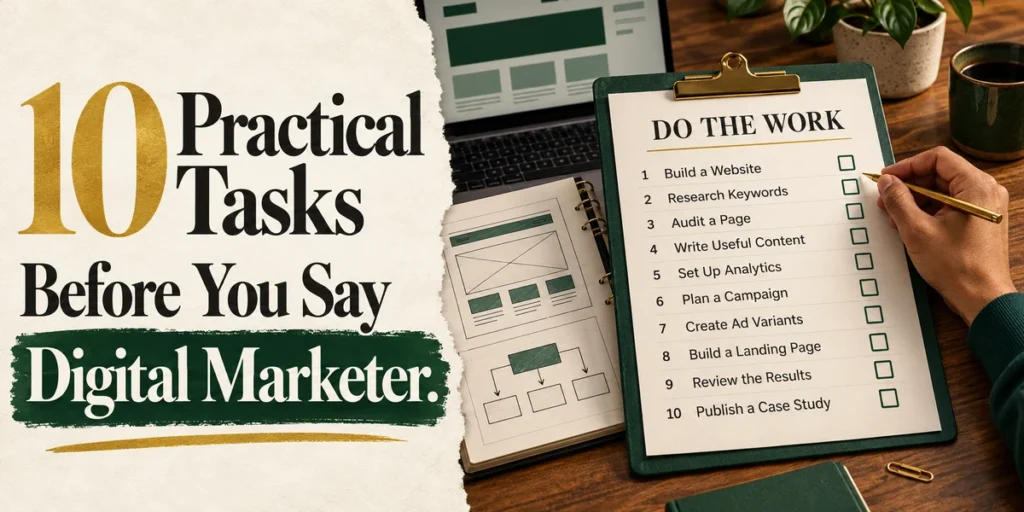
Anyone can say “I am a digital marketer.” A bio line is easy. A certificate is easy. A job is not.
The difference is not confidence. It is proof. Real tasks, finished, with a result you can explain.This post lists ten practical tasks to finish before you call yourself a digital marketer. Each one is small enough to start this month, and strong enough to show in an interview.
The short answer
A digital marketer is someone who has done the work, not someone who has watched it.
Finish these ten tasks and you will have a portfolio, a vocabulary, and the confidence that comes from real practice.
Why tasks beat certificates
A certificate proves you attended. A task proves you can do.
Recruiters know this. That is why most interviews ask about work, not about courses. “Show me something you have built” is the most common opening question.
Tasks also teach faster than videos. When you run a campaign and see the results, the lesson sticks. When you watch a video about campaigns, it fades in a week.
The 10 practical tasks
Here they are, in a sensible order. Do not skip the boring ones. They teach the most.
1. Set up a Google Analytics 4 property
Take a real site, your own or a friend’s, and set up GA4. Find one conversion event.
Why it matters. Reporting is the first task most juniors get. If you cannot open GA4 and read it, you are not ready.
2. Run a full SEO audit on a small site
Pick a small local business site. Check titles, headings, speed, indexing, and internal links. Write a short report.
Why it matters. SEO audits are a common freelance and junior task. A clean audit shows you can think in priorities.
3. Build and rank one blog post
Write one post targeting a specific question. Publish it. Track it in Search Console for a few weeks.
Why it matters. This teaches patience, structure, and how search actually works.
4. Run one small ad campaign
Run a small campaign for a local shop or your own page, with permission. Set one goal. Keep the budget tiny.
Why it matters. Campaigns are where money and measurement meet. One small campaign teaches more than ten slides.
5. Write a campaign report
After the campaign, write a short report. Goal, audience, creative, spend, result, and what you would change.
Why it matters. Reporting is a skill. Most freshers cannot write a clear report, and it shows immediately.
6. Build a two-week content plan
Pick a small brand. Plan two weeks of content. Post ideas, formats, captions, and a simple calendar.
Why it matters. Content planning is a daily job in most marketing roles.
7. Design one set of creatives
Use Canva to make a small set of ads or posts that match one campaign. Same message, different visuals.
Why it matters. Creative testing is a real skill. One set of creatives is enough to show you understand it.
8. Set up Search Console and fix one issue
Add a site to Search Console. Find one issue, like a missing title or an indexing problem, and fix it.
Why it matters. Search Console is free and underused. Knowing it makes you useful on day one.
9. Use AI for one task, then review it
Draft ad copy or a report with AI. Then review every line and note what was wrong.
Why it matters. AI use is expected now. The skill is reviewing the output, not just generating it.
10. Explain one project in one minute
Record yourself explaining one project out loud. One minute. Problem, action, result.
Why it matters. Interviews test whether you can explain your work under pressure. Practice makes the difference.
The practical tasks quiz: what would you do next?
Three short scenes. Pick your move before you scroll. Then read the answer.
Scene one. You have watched ten campaign videos but run none. What do you do?
A. Watch five more videos.
B. Run one small campaign with a tiny budget.
C. Read a book about campaigns.
The smart move: B. Watching is not doing. One small campaign teaches more than ten videos. A and C add knowledge without proof.
Scene two. You have run a campaign but cannot explain the result. What is missing?
A. A bigger budget.
B. A short report and a one-minute explanation.
C. More followers.
The smart move: B. Reporting and explaining are the skills interviews test. A and C do not fix the gap.
Scene three. You use AI for all your copy and never check it. What is the risk?
A. None. AI is reliable.
B. Unchecked AI can be wrong, and it looks careless in a job.
C. AI will make you look too modern.
The smart move: B. Reviewing AI output is a core skill now. A is risky. C is not a real risk.
Do you see the pattern? In every scene, the smart move is the same. Do the task, then explain it.
A real story about proof
A composite story, based on many real cases. A student, call him Harsh, watched dozens of marketing videos. He could define every term. But he had never run a campaign.
He applied to five roles. No replies.
We picked three tasks from the list. He set up GA4, ran a small campaign for a local shop, and wrote a short report.
He updated his resume with the project. Two weeks later, he got an interview.
The interviewer asked about the campaign, not the definitions. Harsh explained it in one minute. He got the role.
Harsh told me, “Video se define karna aata tha, task se kaam karna.” Videos taught me to define. Tasks taught me to do.
That is the lesson. Tasks turn knowledge into proof.
How to use this list
Here is a simple plan. Do not try all ten at once.
- Week one. GA4 and Search Console. Set up both.
- Week two. SEO audit. Pick a small site and write a report.
- Week three. Content plan. Two weeks for a small brand.
- Week four. Campaign and creatives. Run one small campaign.
- Week five. Report and explanation. Write it up and record a one-minute explanation.
Five weeks. Ten tasks. A portfolio that actually says something.
Here is an illustrative example of what a simple portfolio tracker could look like. These numbers are invented for illustration.
| Task | Status | Output |
|---|---|---|
| GA4 setup | Done | One conversion found |
| SEO audit | Done | 6 issues report |
| Campaign | Done | Small result, reported |
| Content plan | In progress | Two-week calendar |
| One-minute pitch | Done | Recorded |
The numbers are illustrative. What matters is the habit of tracking finished work.
Before you start, spend twenty minutes on Google’s Search Essentials and the GA4 documentation. Both are free, and both make the tasks easier.
Common mistakes beginners make
- Watching more videos instead of doing tasks.
- Starting ten tasks and finishing none.
- Skipping the report, so the work cannot be shown.
- Using AI without review.
- Never practising the one-minute explanation.
- Waiting to feel ready before applying.
What tasks cannot promise
Tasks improve your odds. They do not guarantee a job. Hiring depends on your portfolio, your interview, and the market.
Svidya’s numbers are examples, not guarantees. 200+ students taught. A highest package of 9.8 LPA. Three free demo classes. The highest package is one person’s result. It is not a forecast for you.
Your action checklist
Print this. Start this week.
- Set up GA4 and find one conversion.
- Pick a small site and do an SEO audit.
- Write one blog post for a specific question.
- Run one small campaign.
- Write a short campaign report.
- Build a two-week content plan.
- Design one set of creatives.
- Set up Search Console and fix one issue.
- Use AI for one task, then review it.
- Record a one-minute explanation of one project.
- Book the demo. At Svidya you get three free demo classes for the AI-Powered Marketing Course. Attend all three before you decide.
- Track finished tasks, not watched videos.
Final words and your next step
Before you call yourself a digital marketer, finish the tasks. Ten practical tasks are worth more than ten certificates.
GA4, audits, campaigns, reports, content plans, creatives, Search Console, AI review, and a one-minute pitch. That is the real curriculum.
You do not have to guess. Pick one task and finish it this week.
If you want structure and feedback while you do these tasks, start with a free demo class at Svidya’s AI-Powered Marketing Course. Bring the checklist. Ask the awkward questions. Then decide, with proof in your hand and no pressure from anyone.
About the author
Shubhankar Vashist is the founder of SVidya, based in Delhi. He has 6+ years of marketing experience across healthcare, pharma, cosmetics, e-commerce and agencies. He teaches digital marketing by making students build real assets.
FAQ
Do I need a certificate to call myself a digital marketer?
No. Proof of work matters more. Finishing practical tasks, like a campaign, an audit, or a report, shows what you can do. A certificate alone rarely does.
How long does it take to finish these tasks?
Most beginners can finish the ten tasks in about five weeks of steady work. You do not need to rush. Consistency matters more than speed.
What if I have no website to practise on?
Use your own blog, a friend’s small business site, or a local shop with permission. The key is real work, not a perfect setup.
Do I need a budget to run a campaign?
You need a very small budget, but it can be minimal. One small campaign with a tiny spend is enough to learn and to show as proof.
How do I explain my projects in interviews?
Practise a one-minute explanation for each project. Cover the problem, the action, and the result. Record yourself, then improve it.