
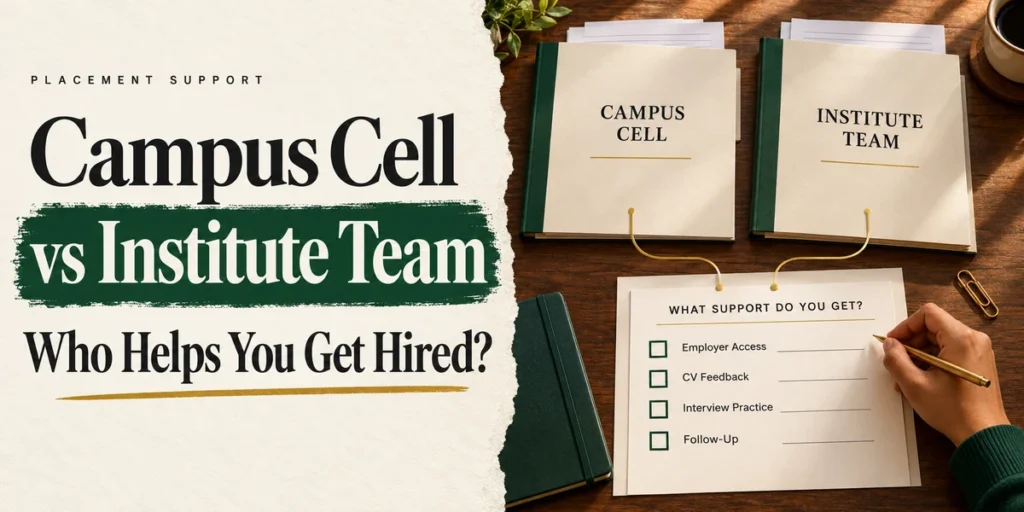
Two names. Both sound official. Both promise help finding a job.A college campus placement cell. An institute placement team. They sound similar, and many students assume they do the same thing.
They do not. The difference matters, because it changes what kind of help you can expect, and what you should ask before you enrol.
This post compares the two honestly, and gives you seven checks before you trust any placement claim.
The short answer
A campus placement cell is part of a college. It connects students with companies that recruit from that campus.
An institute placement team is part of a training institute. It usually helps with resume reviews, mock interviews, and job referrals, but it rarely guarantees a job.
Both can help. Neither guarantees a job. The difference is the network and the scope.
What a campus placement cell does
A campus placement cell sits inside a college or university. It usually does four things.
- Invites companies to campus. Recruiters visit, run interviews, and hire students.
- Runs placement drives. Structured rounds, often in the final year.
- Shares opportunities with students. Job posts, internships, and drives.
- Coordinates the process. Schedules, documents, and follow-ups.
The strength of a campus cell is its recruiter network. If a company recruits from your campus, the process is often easier.
The limitation is eligibility. Campus cells usually serve current students, and sometimes only certain courses.
What an institute placement team does
An institute placement team sits inside a training institute. It usually does four things.
- Resume and profile help. Reviewing your CV and LinkedIn.
- Interview practice. Mock interviews, often with feedback.
- Job referrals. Sharing openings from partner companies or alumni.
- Portfolio support. Helping you present your projects.
The strength of an institute team is the practice and preparation. You get help explaining your work.
The limitation is the network. An institute may have fewer recruiter relationships than a large campus, and it usually cannot guarantee interviews.
The real difference
The real difference is the network and the scope, not the name.
A campus cell offers a recruiter network, but only for a specific college and course. An institute team offers preparation, but usually without a guaranteed recruiter network.
Neither replaces your portfolio. Both can help you present it.
The 7 checks before you trust a placement claim
Here is the practical part. Run these seven checks on any campus cell or institute team.
1. What exactly is included?
Ask for an item-by-item list. Resume review, mock interviews, referrals, portfolio help. Vague words like “full support” mean little.
2. Who is eligible?
Some support is only for students who complete all projects or maintain attendance. Ask upfront.
3. How long does support last?
“Lifetime support” is a phrase. Ask for the exact duration in months or years.
4. Which companies actually recruit?
Ask for a few real examples, with roles. Not just big names. Real roles from recent batches.
5. What share of students got relevant roles?
Ask for a rough share, with a time window. Honest institutes give a range. Nervous ones say “everyone.”
6. Is any part chargeable?
Some support is included. Some is a paid add-on. Ask which is which.
7. Is a job guaranteed?
No honest answer is yes. A clear “no, but here is what we do” is a good sign.
The placement comparison quiz: which helps more?
Three short scenes. Pick your move before you scroll. Then read the answer.
Scene one. A campus cell recruits only from one college. You are not a student there. What is your best option?
A. Apply through that campus cell.
B. Look at an institute placement team or apply directly, with a strong portfolio.
C. Give up on placement help.
The smart move: B. Campus cells serve their own students. A is not usually possible. C ignores other routes.
Scene two. An institute says “100 percent placement.” What is your next question?
A. “Can I pay the fee today?”
B. “What does placement mean here, and is it written anywhere?”
C. “How big is the campus?”
The smart move: B. A 100 percent claim needs a definition. A trusts too fast. C is irrelevant.
Scene three. A campus cell has many recruiters but no interview practice. An institute team has practice but fewer recruiters. What do you do?
A. Pick one and ignore the other.
B. Use both, if possible. The network and the preparation are different strengths.
C. Assume neither works.
The smart move: B. The two strengths are complementary. A ignores the gap. C is too pessimistic.
Do you see the pattern? In every scene, the smart move is the same. Know what each one actually provides, then use both if you can.
A real story about placement help
A composite story, based on many real cases. A student, call her Riya, expected her institute’s placement team to find her a job. She assumed “placement team” meant a recruiter network like a campus cell.
It did not. The team helped with her resume and ran two mock interviews. They shared job links. They did not arrange interviews.
Riya was disappointed at first. Then she used the help properly. She fixed her resume, practised interviews, and applied to roles herself.
She got a role within two months. She told me, “Team ne kaam nahi diya, taiyari di.” The team did not give me work. It gave me preparation.
That is the lesson. Understand what the team actually does, then use it well.
How to compare placement help
Use this table when you compare a campus cell and an institute team. The numbers are illustrative examples, not fixed rules.
| What to compare | Campus placement cell | Institute placement team |
|---|---|---|
| Recruiter network | Strong for its college | Varies |
| Interview practice | Sometimes limited | Usually included |
| Portfolio help | Rare | Common |
| Eligibility | Current students | Enrolled students |
| Job guarantee | No | No |
| Best use | Drives and campus interviews | Preparation and referrals |
The numbers are illustrative. The pattern is the point. Each one has a different strength.
Before you rely on any placement claim, read Google’s Search Essentials. It is free, and it will help you think clearly about claims and evidence, not just in SEO but in any marketing page.
Common mistakes students make
- Assuming a campus cell and an institute team do the same thing.
- Expecting a guaranteed job from either.
- Not asking what is included, item by item.
- Ignoring eligibility conditions.
- Not asking how long support lasts.
- Relying only on placement help and skipping the portfolio.
What no placement help can promise
No campus cell and no institute team can guarantee a job. Hiring depends on your portfolio, your interview, and the market.
Svidya’s numbers are examples, not guarantees. 200+ students taught. A highest package of 9.8 LPA. Three free demo classes. The highest package is one person’s result. It is not a forecast for you.
What good placement help can do is prepare you well. The portfolio and the interview are still yours.
Your action checklist
Print this. Use it with any placement team.
- Ask for an item-by-item list of what is included.
- Ask about eligibility conditions.
- Ask how long support lasts.
- Ask for examples of real roles from recent batches.
- Ask for a rough share of students who got relevant roles.
- Ask whether any part is chargeable.
- Ask directly whether a job is guaranteed.
- Book the demo. At Svidya you get three free demo classes for the AI-Powered Marketing Course. Attend all three before you decide.
- Build your portfolio alongside, because placement help cannot replace it.
Final words and your next step
Campus placement cell vs institute placement team is not a competition. They do different things.
A campus cell offers a recruiter network. An institute team offers preparation. Both can help, and neither guarantees a job.
You do not have to guess. Ask what is included, then use the help properly.
If you are in Delhi and comparing options, start with a free demo class at Svidya’s AI-Powered Marketing Course. Bring the checklist. Ask the awkward questions. Then decide, with proof in your hand and no pressure from anyone.
About the author
Shubhankar Vashist is the founder of SVidya, based in Delhi. He has 6+ years of marketing experience across healthcare, pharma, cosmetics, e-commerce and agencies. He teaches digital marketing by making students build real assets.
FAQ
What is the difference between a campus placement cell and an institute placement team?
A campus placement cell is part of a college and connects students with recruiters who visit the campus. An institute placement team is part of a training institute and usually helps with resume reviews, mock interviews, and referrals.
Does an institute placement team guarantee a job?
No. No honest institute can guarantee a job. A good team helps you prepare and shares opportunities, but hiring depends on your portfolio, interview, and the market.
Which one helps more?
It depends on what you need. A campus cell helps with recruiter access. An institute team helps with preparation. If possible, use both, and build your portfolio alongside.
What should I ask before trusting a placement claim?
Ask what is included, who is eligible, how long support lasts, which roles recent students got, whether any part is chargeable, and whether a job is guaranteed. Get answers in writing.
Can placement help replace a portfolio?
No. Placement help prepares you to present your work. The portfolio is still the proof employers ask for. Build it alongside any placement support.