
You started using AI to write your content. It was faster. Cheaper. You could publish five times as much as before.
Three months later, your traffic is flat. Your engagement is down. Nobody quotes you. Nobody mentions you. You are publishing more and being seen less.
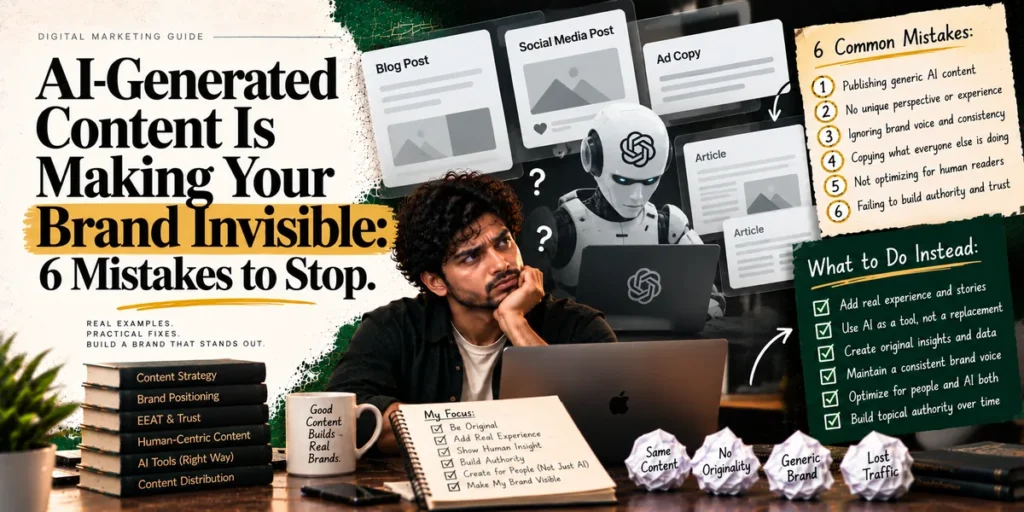
This is the trap. AI content does not fail because AI is bad. It fails because most people use it the same way, producing the same generic output. The internet is flooded with it. If your content looks like everyone else’s, you become invisible.
Here are six mistakes doing the most damage, and how to fix them.
Direct Answer
AI-generated content makes your brand invisible when it sounds generic, lacks real experience, and offers nothing unique. Search engines and AI systems now prefer content with first-hand detail, named authors, and specific insight. Fix the six mistakes below and your content starts being seen again.
1. Publishing Without Adding Your Own Experience
You asked AI to write a blog post about Meta Ads. It produced a clean, well-structured article. You published it. Nothing happened.
Why? Because ten thousand other people did the same thing that week. AI produces content from general patterns. That content is useful as a draft but not as a finished piece. It sounds like everyone else because it is trained on everyone else.
Fix: Use AI for the skeleton. Then add what only you can add. A specific campaign you ran. A number you tracked. A mistake you made. A tool setting you used. One real detail makes the whole piece stand out.
If you do not have a real detail, do not publish the piece yet. Either go get the experience or write about something you actually know.
2. Using the Same Structure as Everyone Else
AI tends to write in the same shape. Introduction. Five subheadings. Conclusion. Bullet lists. Symmetrical paragraphs.
You can spot AI content from a distance because every piece has the same rhythm. Readers do not know why it feels off, but they feel it, and they leave.
Fix: Break the pattern. Start with a specific scene instead of a general intro. Use different paragraph lengths. Mix long explanations with short, punchy lines. Ask a real question in the middle. Do not follow the same template for every post.
The structure should follow the content, not a template.
3. No Named Author or Real Credentials
Anonymous AI content has no author. Or a fake author. Or a generic “Team” byline.
Search engines and AI systems now prefer content with real, named authors. Not for authority by title, but for accountability. A named human can be checked. An anonymous page cannot.
Fix: Put your real name on your content. Add a short bio. Mention your experience. Link to your LinkedIn or your other work. Real authorship is one of the strongest trust signals you have.
If you run a team, each author should be a real person with a real bio. Not a stock photo with a placeholder name.
4. Chasing Volume Over Depth
You used AI to publish fifty blog posts in a month. Then a hundred. The theory was that more content would bring more traffic.
The reality is the opposite. Search engines and AI systems now assess site-level quality. If most of your content is thin, the whole site gets less trust. Your best pages get dragged down by your worst ones.
Fix: Publish less, better. Ten detailed pages with real insight beat a hundred thin ones. Update old content instead of publishing new. Delete or consolidate pages that add nothing.
The goal is not to fill the site. The goal is to be the best answer on each topic you cover.
5. Ignoring Brand Consistency
Your brand name is spelled one way on your site. Another way on Instagram. A third version on a directory. Your founder’s name is spelled inconsistently too.
To an AI system building an answer, this looks like three different entities, none of which can be verified. Brand consistency is not a small thing. It is what makes an entity real.
Fix: Decide on one exact spelling for every brand name, person name, and product name. Use it everywhere. Update old mentions that do not match. Consistency compounds over time.
6. No First-Hand Detail Anywhere
Your content explains how to run a Meta campaign. It lists objectives, audiences, budgets. It never mentions a campaign you actually ran. A number you actually saw. A result you actually got.
This is the single biggest reason AI content fails. It is all second-hand. There is nothing in it that only you could have written.
Fix: In every piece, include one thing that is clearly from your own work. A specific screenshot. A real number. A mistake and what it taught you. A tool quirk you only discovered by using it. That one detail is what makes the difference between content that gets ignored and content that gets shared.
Comparison Table
| Mistake | What It Looks Like | What to Do Instead |
|---|---|---|
| No personal experience | Generic advice anyone could write | Add one real story, number, or mistake |
| Same structure as everyone | Predictable intro, 5 H2s, conclusion | Break the template, vary rhythm |
| No named author | Anonymous or fake byline | Real name, real bio, real experience |
| Volume over depth | 100 thin posts | 10 deep posts, updated over time |
| Inconsistent branding | Name spelled differently everywhere | One exact spelling, used everywhere |
| No first-hand detail | Explains without showing | Screenshot, number, tool quirk, mistake |
What I Actually Did
When AI tools became good at writing, I tried them for content. The output was clean. It was fast. It was also invisible.
I published a few pieces and watched them sit. No traffic. No shares. No citations. Then I compared them to my older pieces, written manually. The older ones had real examples and real numbers. They got quoted. They got shared. They got ranked.
So I changed my process. AI would still do the first draft. But I would not publish until I had added something only I could add. A specific campaign. A real number. A mistake from one of my own projects. After that, the content started working again.
The pattern is not subtle. Readers and systems both prefer content that could only have been written by you. That is the whole game with AI content. Use the tool for speed, then add what the tool cannot.
Mistakes to Avoid
Publishing the first AI draft unchanged. It reads clean but says nothing unique.
Assuming volume solves visibility. It does the opposite when the content is thin.
Skipping the author. A page with no real name behind it is treated as lower trust.
Using AI to write about things you have never done. The output will be technically correct and completely hollow.
Copying AI output from other people’s AI output. The internet now has layers of this. It all reads the same.
Ignoring brand consistency. Inconsistency makes you invisible to systems that need to verify who you are.
Practical Checklist Before You Publish
- ☐ I have added at least one real detail from my own experience.
- ☐ The structure does not follow the same template as my last post.
- ☐ A real named author is on the piece.
- ☐ The brand name is spelled the same way as everywhere else.
- ☐ I would still publish this if I removed all generic sentences.
- ☐ This page adds something the top-ranking pages do not have.
- ☐ I have not published just to hit a volume target.
- ☐ If I updated an old page, it is genuinely better than before.
- ☐ I am comfortable putting my name on this and defending every claim.
- ☐ This content would be recognisable as mine, even without the logo.
FAQ
Q: Should I stop using AI for content altogether?
A: No. Use AI for drafts, research, and structure. Just do not publish without adding real experience.
Q: Will Google penalise AI content?
A: Google penalises low-quality content, regardless of how it was made. Good AI-assisted content with real insight can rank. Thin AI content cannot.
Q: How much of a post should be AI vs human?
A: There is no fixed ratio. The test is whether the final piece has something only you could have added. If it does, the amount of AI used does not matter.
Q: What if I do not have first-hand experience on a topic?
A: Then either get the experience, interview someone who has, or do not write the piece yet. Second-hand content does not stand out.
Q: How often should I update old content?
A: Every few months for top pages. Refreshing an existing page often works better than publishing a new one.
Q: Does brand consistency really matter that much?
A: Yes. Consistency is how AI systems confirm your entity is real. Inconsistency makes you hard to cite.
End CTA
If you want to learn how to use AI for content without making your brand invisible, look at the SVidya homepage. AI content and structure run across multiple weeks in the 22-week live program. Every student works on real content with real experience behind it. Read the curriculum and check whether it fits your goals. If it does not, that is fine too. The important thing is that your next piece of content sounds like you, not like everyone else.
Author Box
Shubhankar Vashist is the founder of SVidya, based in Delhi. He has 6+ years of marketing experience across healthcare, pharma, cosmetics, e-commerce and agencies. He teaches digital marketing by making students build real assets.