
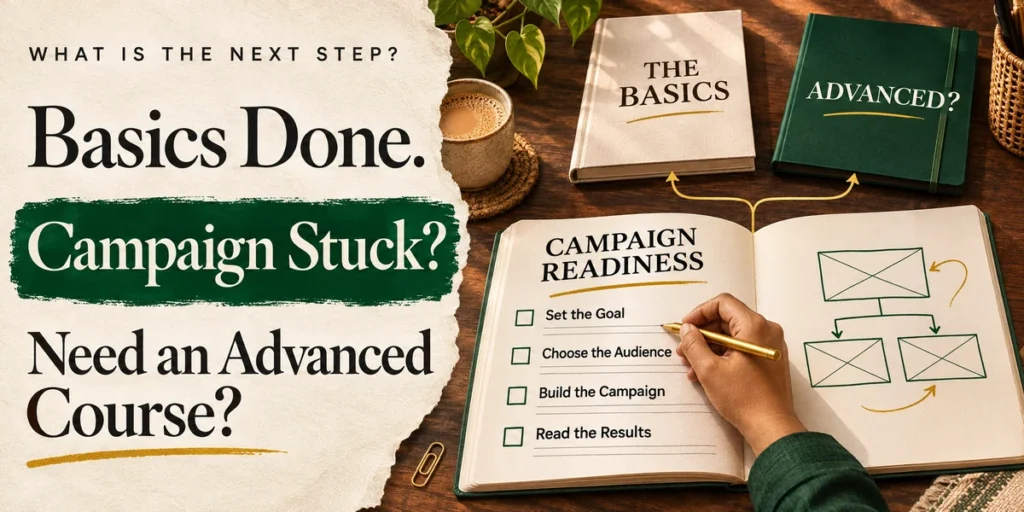
You know what a funnel is. You can define a conversion. You know the difference between CPC and CPM.
But if someone asked you to run a campaign tomorrow, you would not know where to start.
So you wonder: do I need an advanced course?
Maybe. But probably not yet. The gap between knowing and doing is usually not an advanced topic. It is a practice gap. And an advanced course will not fix it.
This post gives you a simple test to decide.
The short answer
If you cannot run a basic campaign, an advanced course will not help. You need to run one basic campaign first.
Advanced courses teach optimisation. You cannot optimise something you have never done.
Why the basics feel incomplete
Most basic courses teach definitions and demos. They show you the interface and explain the terms.
Then they stop. They do not make you run a real campaign from start to finish, with your own budget and your own decisions.
So you know the vocabulary but not the workflow. That is normal, and it is not a sign that you need to go deeper. It is a sign that you need to go sideways, into practice.
The test: can you do these five things?
Here is a simple test. Answer honestly.
- Set a campaign goal. Not “get sales.” A specific, measurable goal.
- Choose an audience. And explain why you chose it.
- Create two creatives. And explain which one you expect to do better, and why.
- Set a small budget. And decide how long the test should run.
- Read the result. And explain what you would change next time.
If you cannot do all five, an advanced course is premature. You need one real campaign, not more theory.
If you can do all five, an advanced course may genuinely help.
What an advanced course actually teaches
Advanced courses are not “basics, but harder.” They cover different things.
- Optimisation. Improving a campaign that already works.
- Scaling. Spending more without losing efficiency.
- Attribution. Understanding which channel actually drove the result.
- Automation. Using rules and tools to reduce manual work.
- Advanced measurement. Incrementality, cohorts, and deeper reports.
These are valuable skills. But they assume you can already run a basic campaign. Without that base, the lessons do not land.
Here is an illustrative example. These numbers are invented for illustration.
| Level | What you learn | What you need first |
| Basics | Terms, tools, demos | Nothing |
| Practice | Run one small campaign | Basics |
| Advanced | Optimise and scale | At least two campaigns |
The numbers are illustrative. The pattern is the point. Advanced sits on top of practice, not on top of theory.
The advanced course quiz: do you need one?
Three short scenes. Pick your move before you scroll. Then read the answer.
Scene one. You know the terms but have never run a campaign. What do you do?
A. Take an advanced course.
B. Run one small campaign first.
C. Take another basics course.
The smart move: B. Practice comes before optimisation. A is too early. C repeats what you already know.
Scene two. You have run three campaigns and want to improve results. What fits?
A. Another basics course.
B. An advanced course on optimisation and scaling.
C. Nothing. You are done learning.
The smart move: B. You have a base to build on. A repeats. C stops growth.
Scene three. A course promises “advanced strategies” but has no projects. What do you do?
A. Take it. Advanced sounds valuable.
B. Ask what you will run and who reviews it.
C. Assume all advanced courses are like this.
The smart move: B. Even advanced courses need practice and review. A trusts a label. C gives up too early.
Do you see the pattern? In every scene, the smart move is the same. Match the course to your current level, not to the label.
A real story about the wrong upgrade
A composite story, based on many real cases. A student, call him Manav, finished a basics course and still could not run a campaign. He assumed he needed an advanced course.
He paid for one. The first two sessions covered scaling and attribution. He understood the words but not the practice, because he had never run a basic campaign.
He dropped out after three weeks.
We changed the plan. He ran one small campaign on his own account, with a tiny budget. It was messy. He made mistakes. He learned more in two weeks than in the advanced course.
Manav told me, “Advanced se pehle practice chahiye thi.” I needed practice before advanced.
That is the lesson. The gap was practice, not depth.
What to do instead of an advanced course
Here is a simple plan.
- Run one small campaign. One goal, one audience, two creatives, a small budget.
- Set a test window. Three to five days. Do not change anything inside it.
- Read the result. Which creative did better? Why?
- Write a short report. Goal, action, result, learning.
- Run a second campaign. Apply what you learned.
- Then decide. If you want to optimise and scale, an advanced course may help.
Six steps. About a month. That is the base an advanced course assumes.
Before you start, read the Meta Ads Manager help center and the GA4 documentation. Both are free, and both explain the workflow you need to practise.
Common mistakes students make
- Taking an advanced course before running a basic campaign.
- Confusing knowing terms with doing the work.
- Taking another basics course instead of practising.
- Choosing an advanced course with no projects.
- Expecting an advanced course to fix a practice gap.
- Never writing up the campaign result.
What no course can promise
No course can promise a job or campaign results. Practice and feedback improve your odds. The rest depends on the market and your work.
Svidya’s numbers are examples, not guarantees. 200+ students taught. A highest package of 9.8 LPA. Three free demo classes. The highest package is one person’s result. It is not a forecast for you.
Your action checklist
Print this. Use it before you pay for another course.
- Take the five-part test. Can you do all five?
- If not, run one small campaign first.
- Set a test window and do not change anything inside it.
- Read the result and write a short report.
- Run a second campaign with what you learned.
- Then decide whether advanced topics are your real gap.
- Book the demo. At Svidya you get three free demo classes for the AI-Powered Marketing Course. Attend all three before you decide.
- Choose the course that matches your level, not the label.
Final words and your next step
You finished the basics but still cannot run a campaign. That is not a sign you need an advanced course. It is a sign you need practice.
Run one small campaign. Then another. Then decide.
You do not have to guess. The gap is usually practice, not depth.
If you want structured practice with reviews, start with a free demo class at Svidya’s AI-Powered Marketing Course. Bring the checklist. Ask the awkward questions. Then decide, with proof in your hand and no pressure from anyone.
About the author
Shubhankar Vashist is the founder of SVidya, based in Delhi. He has 6+ years of marketing experience across healthcare, pharma, cosmetics, e-commerce and agencies. He teaches digital marketing by making students build real assets
FAQ
Do I need an advanced course if I cannot run a campaign?
No. If you cannot run a basic campaign, an advanced course will not help. You need to run one small campaign first. Advanced courses assume a base of practice.
What should I do before taking an advanced course?
Run at least one or two small campaigns with your own budget and decisions. Write up the results. That base makes advanced lessons understandable.
What does an advanced marketing course teach?
Usually optimisation, scaling, attribution, automation, and deeper measurement. These are valuable, but they build on practical experience.
How do I know if I am ready for an advanced course?
If you can set a goal, choose an audience, create two creatives, set a budget, and read the result, you are ready to explore advanced topics.
Can an advanced course replace practice?
No. No course can replace running a real campaign. A course can guide you, but the doing is yours.