
You open an institute website. Logos, badges, stars, and photos of smiling students.
Everything looks trustworthy. That is the problem. Trust signals are easy to add, and many of them mean nothing.
Some signals are real evidence. Others are decoration. Learning to tell them apart saves you months and money.
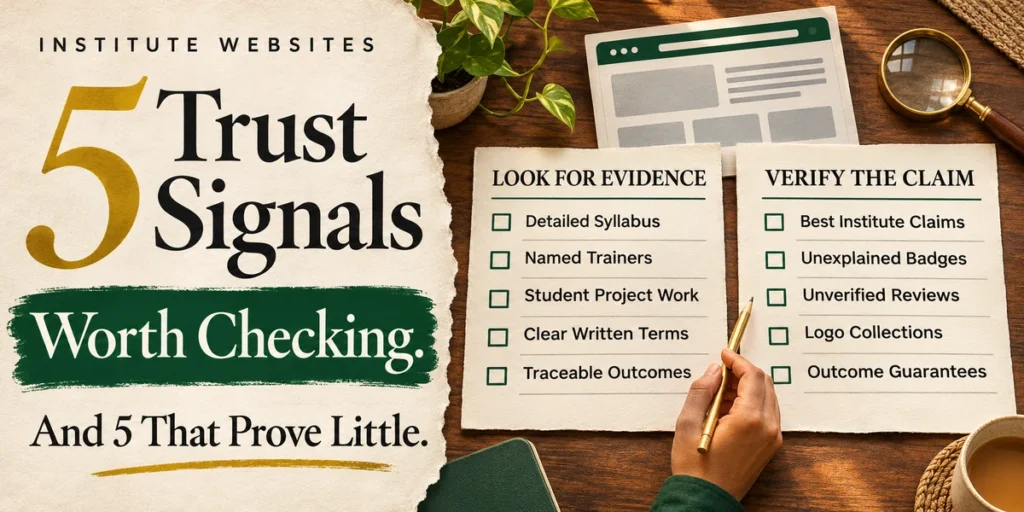
This post lists five trust signals that mean something, and five that usually do not.
The short answer
Real trust signals are specific and checkable. Fake ones are general and emotional.
A named trainer with a visible background is real. A “featured in” logo wall is usually decoration. Specifics build trust. Slogans do not.
Why trust signals matter
A course is a big purchase, made online, from a stranger. You need signals to decide.
But most signals are designed to create a feeling, not to provide evidence. So you need to know which ones to check.
5 trust signals that mean something
Here they are. Each one is checkable.
1. Named trainers with real backgrounds
A name and a background you can verify. Not “expert faculty.”
What to check. Search the trainer’s name. Look at their LinkedIn or past work. A real background is easy to find.
2. Visible student work
Projects, audits, reports, and campaigns, with names removed.
What to check. Ask to see one. Real work has detail, mistakes, and results. Stock photos and certificates are not work.
3. A clear, specific syllabus
Week-by-week, with named tools and projects.
What to check. Ask for the full syllabus in writing. Specific plans are a good sign. Vague promises are not.
4. Honest placement language
Numbers with context, limits, and a clear statement that no job is guaranteed.
What to check. Look for the response rate and the year. A page with only big numbers is marketing.
5. A visible refund and support policy
Clear terms about refunds, batch changes, and support after the course.
What to check. Ask for the policy in writing. A clear policy is a strong signal.
5 trust signals that usually do not mean much
Here they are. They are not always dishonest, but they are easy to fake or exaggerate.
1. A logo wall of companies
“Featured in” or “our students work at” logos.
Why it is weak. A logo does not prove a student works there, or that the course helped. It can be a single intern, years ago.
2. Star ratings with no detail
Five stars, no reviews, or only glowing quotes.
Why it is weak. Ratings are easy to collect and easy to fake. Specific reviews with detail are stronger.
3. Stock photos of happy students
Smiling faces, modern classrooms, perfect lighting.
Why it is weak. Stock photos prove design budget, not teaching quality.
4. Big numbers with no context
“Highest package 15 LPA.” “1000+ students placed.”
Why it is weak. A number without a year, a sample size, and a role tells you little. A highest package is one person’s result.
5. Award badges and “certified” icons
“Best institute 2024.” “ISO certified.”
Why it is weak. Many awards are paid for, and certifications do not measure teaching. They are not worthless, but they are not evidence of skill.
The trust signals quiz: real or decoration?
Three short scenes. Pick your move before you scroll. Then read the answer.
Scene one. A website shows a logo wall of companies. What do you do?
A. Trust it. Big companies are listed.
B. Ask which role a recent student got, and when.
C. Assume all logos are fake.
The smart move: B. A logo is not proof. A specific role and date is. A trusts a symbol. C is too strong.
Scene two. A site shows a 5-star rating with no written reviews. What do you think?
A. It is a strong signal.
B. It is weak evidence without detail.
C. The course is a scam.
The smart move: B. Ratings without detail are easy to collect. A trusts the stars. C is too fast.
Scene three. A page lists a highest package with no year or sample size. What do you ask?
A. “Which year, how many students, which role?”
B. “Is the fee negotiable?”
C. “How big is the campus?”
The smart move: A. Context turns a number into evidence. B and C do not test the claim.
Do you see the pattern? In every scene, the smart move is the same. Ask for specifics, not symbols.
A real story about a logo wall
A composite story, based on many real cases. A student, call her Isha, chose an institute because of its logo wall. Ten companies were listed.
She enrolled. The course was mostly recorded videos. She finished with a certificate and no portfolio.
Later, she asked about the logos. One was a student who had interned there for two weeks, years earlier. The rest were old or unrelated.
Isha told me, “Logos acche the, course nahi.” The logos were good. The course was not.
That is the lesson. A symbol is not evidence. A specific role and date is.
Here is an illustrative example of weak and strong trust signals. These details are invented for illustration.
| Weak signal | Strong signal |
| Logo wall | “A 2025 student now works as a marketing executive at a Delhi agency” |
| 5 stars, no reviews | Three detailed reviews with names removed |
| “Highest package 15 LPA” | “Highest package in 2025, based on 40 students, one role” |
The details are illustrative. The pattern is real. Specific and dated beats general and emotional.
Before you judge a website, spend twenty minutes on Google’s Search Essentials and the Google Business Profile help center. Both are free, and both help you think clearly about claims and evidence.
How to check trust signals in a demo class
Here is a simple plan.
- Ask to meet the trainer. A named trainer is a real signal.
- Ask to see student work. One real project tells you more than ten logos.
- Ask for the full syllabus in writing.
- Ask about placement numbers. Year, sample size, and role.
- Ask for the refund and support policy in writing.
- Check the reviews for detail. Specific reviews are stronger than stars.
Six checks. About thirty minutes. That is enough to separate evidence from decoration.
Common mistakes students make
- Trusting logo walls and star ratings.
- Not asking for the year and sample size behind a number.
- Skipping the trainer’s background check.
- Never asking to see student work.
- Ignoring the refund policy.
- Assuming awards mean teaching quality.
What no trust signal can promise
No signal can promise a good course. It can only raise or lower your confidence. The demo class and the work decide.
Svidya’s numbers are examples, not guarantees. 200+ students taught. A highest package of 9.8 LPA. Three free demo classes. The highest package is one person’s result. It is not a forecast for you.
Your action checklist
Print this. Use it on any institute website.
- Look for named trainers, and check their backgrounds.
- Ask to see real student work.
- Ask for the full syllabus in writing.
- Ask for the year, sample size, and role behind any number.
- Ask for the refund and support policy in writing.
- Read reviews for detail, not stars.
- Book the demo. At Svidya you get three free demo classes for the AI-Powered Marketing Course. Attend all three before you decide.
- Decide on evidence, not decoration.
Final words and your next step
Trust signals on an institute website are a mix of evidence and decoration.
Real ones are specific and checkable. Named trainers. Student work. Clear syllabi. Honest placement language. Visible policies.
Fake ones are general and emotional. Logo walls. Star ratings. Stock photos. Big numbers. Award badges.
You do not have to guess. Ask for specifics.
If you are in Delhi and comparing options, start with a free demo class at Svidya’s AI-Powered Marketing Course. Bring the checklist. Ask the awkward questions. Then decide, with proof in your hand and no pressure from anyone.
About the author
Shubhankar Vashist is the founder of SVidya, based in Delhi. He has 6+ years of marketing experience across healthcare, pharma, cosmetics, e-commerce and agencies. He teaches digital marketing by making students build real assets
FAQ
What are real trust signals on an institute website?
Specific, checkable things: named trainers with real backgrounds, visible student work, a clear week-by-week syllabus, honest placement language with context, and a visible refund and support policy.
Are logo walls and star ratings useful?
They are weak signals. A logo does not prove a student works there or that the course helped. Star ratings without detailed reviews are easy to collect and easy to fake. Look for specifics instead.
Why is a highest package number not enough?
Because it is one person’s result, often from an older batch. Without a year, a sample size, and a role, it tells you very little about your own chances.
How do I verify a trainer’s background?
Ask for the trainer’s full name, then check their LinkedIn or past work. A real background is easy to find. “Expert faculty” is not a name.
Can trust signals replace a demo class?
No. Trust signals raise or lower your confidence. The demo class shows you the real teaching, which is the strongest evidence you can get.