
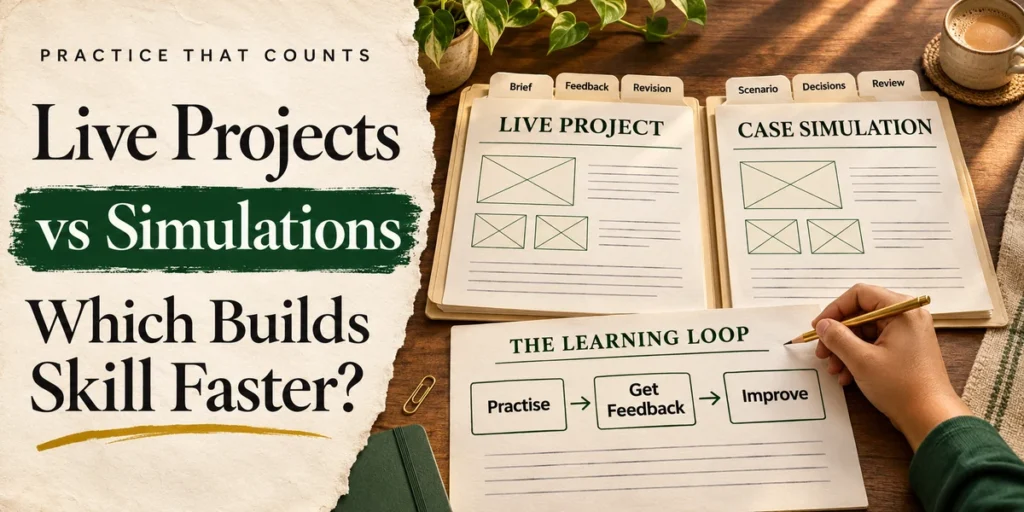
Two ways to practice marketing in a course. One is a live project. A real site, a real campaign, a real deadline. The data is messy. The client changes the brief.
The other is a case study simulation. A fictional or past scenario, with prepared data. The brief is fixed. You work through it step by step.
Both teach something. Both are used in courses. But they build different skills, and students often confuse them.
This post compares live projects vs case study simulations, honestly, and shows which builds real skill faster.
The short answer
Simulations build understanding. Live projects build judgment.
If you are new, simulations help you learn the method safely. If you want to be job-ready, live projects are what interviews test. The best courses use both, in that order.
What a case study simulation is
A simulation gives you a prepared scenario. A brand with a problem. A data set. A clear brief.
You work through it, often in class, with a trainer nearby. The data usually behaves. The brief does not change.
Simulations are common in business schools and in structured courses, because they are safe, repeatable, and easy to assess.
What a live project is
A live project involves a real subject. A local shop, your own site, or a friend’s business.
The data is messy. Tracking breaks. The brief changes. Nobody tells you when to stop.
Live projects are harder to run and harder to assess. That is also why they teach more.
Where simulations win
Simulations have real strengths. Do not dismiss them.
- Safety. You can be wrong without cost.
- Clarity. The brief is fixed, so you focus on the method.
- Repeatability. Everyone gets the same scenario, which makes teaching easier.
- Speed. You can practise several scenarios in a week.
- Assessment. Results are easy to compare.
For a beginner, this is valuable. You cannot run a real campaign before you understand what a campaign is.
Where live projects win
Live projects teach what simulations cannot.
- Messy data. You learn to check, verify, and explain gaps.
- Real constraints. A small budget, a tight deadline, a vague brief.
- Judgment. You decide when the work is good enough.
- Communication. You explain your work to someone outside the classroom.
- Portfolio proof. A real project, with a real result, is stronger evidence.
Live projects are where classroom knowledge becomes skill.
The comparison, in numbers
Here is an illustrative example. These numbers are invented for illustration.
| Factor | Case study simulation | Live project |
| Data quality | Clean | Messy |
| Brief | Fixed | Changes |
| Time to complete | 1 to 2 days | 2 to 4 weeks |
| Risk of failure | Low | Real |
| Portfolio value | Moderate | High |
| Skill built | Method | Judgment |
The numbers are illustrative. The pattern is the point. Simulations teach the method faster. Live projects build judgment, and take longer.
The 7 checks before you choose a course
Here is how to judge whether a course uses each well.
1. Does the course use simulations first?
A good course starts with simulations to teach the method, then moves to live work.
What to check. Ask when the first simulation and the first live project happen.
2. Are the live projects real?
Ask whether you will work on a real site or campaign, with permission, and with a real goal.
What to check. Ask for an example from a past batch, names removed.
3. Is the data messy?
A live project should include gaps, broken tracking, or unclear briefs, because that is what real work looks like.
What to check. Ask how they handle messy data in teaching.
4. Is there a review after each project?
Projects without reviews teach less. Ask who reviews the work, and how.
What to check. Ask for an example of the feedback.
5. How many projects will you finish with?
One simulation is not a portfolio. Ask for the project count and the mix.
What to check. Get the list in writing.
6. Is there a client-style presentation?
Explaining your work out loud is a skill. Ask whether you will present your project.
What to check. Ask how presentations are handled.
7. How is the work assessed?
Simulation results are easy to grade. Live projects need judgment. Ask how the course handles both.
What to check. Ask for the assessment method in writing.
The projects vs simulations quiz: which builds skill?
Three short scenes. Pick your move before you scroll. Then read the answer.
Scene one. A course uses only simulations. What is the gap?
A. None. Simulations are enough.
B. You may learn the method but not the judgment that live work needs.
C. You will learn too much.
The smart move: B. Simulations teach the method safely, but they do not build judgment. A accepts too little. C is not a real risk.
Scene two. A live project has messy data. What is the value?
A. It is a distraction.
B. It teaches you to check, verify, and explain gaps, which is real work.
C. It means the trainer is unprepared.
The smart move: B. Messy data is the lesson. A misses the point. C may be true sometimes, but messy data is normal.
Scene three. You have two simulations and no live project. What is missing for your portfolio?
A. Nothing. Simulations are portfolio pieces.
B. A real project with a real result, which carries more weight.
C. More simulations.
The smart move: B. Real projects are stronger proof. A overstates simulations. C repeats the gap.
Do you see the pattern? In every scene, the smart move is the same. Use simulations to learn, live projects to prove.
A real story about the two
A composite story, based on many real cases. A student, call her Ritu, did five simulations in class. She could work through any scenario on paper.
Then she joined a live project for a local shop. The tracking was broken. The brief changed twice. She felt lost for a week.
Her trainer told her something simple. “Simulation mein method seekha. Project mein judgment seekhna hai.” In simulations you learned the method. In the project you learn judgment.
She slowed down, asked more questions, and fixed the tracking. The project became her strongest portfolio piece.
Ritu told me, “Simulation easy tha, project asli tha.” The simulation was easy. The project was real.
That is the lesson. Both matter. They teach different things.
How to get the most from both
Here is a simple plan.
- Learn the method in simulations. Take notes on the steps.
- Repeat one simulation on your own data. See what changes.
- Move to a live project as soon as you can. Even a small one.
- Expect messy data. Check before you report.
- Ask for feedback on outcomes.
- Present your project out loud.
- Write it up. Problem, action, result, learning.
Seven steps. Simulations first, live projects next.
Before you start, spend twenty minutes on Google’s Search Essentials and the GA4 documentation. Both are free, and both help you read real data more confidently.
Common mistakes students make
- Staying in simulation mode and expecting clean data on live projects.
- Skipping simulations and jumping into live work without the method.
- Treating simulations as portfolio pieces.
- Never presenting work out loud.
- Avoiding live projects because they feel uncomfortable.
- Not writing up the project.
What neither format can promise
Neither simulations nor live projects can promise a job. Together, they build method and judgment, which interviews test.
Svidya’s numbers are examples, not guarantees. 200+ students taught. A highest package of 9.8 LPA. Three free demo classes. The highest package is one person’s result. It is not a forecast for you.
Your action checklist
Print this. Use it as you practise.
- Do one simulation and note the steps.
- Repeat it on your own data.
- Start one small live project this month.
- Expect messy data and check before you report.
- Ask for feedback on outcomes.
- Present your project out loud.
- Write it up in four sections.
- Book the demo. At Svidya you get three free demo classes for the AI-Powered Marketing Course. Attend all three before you decide.
- Keep learning new methods while you work on live projects.
Final words and your next step
Live projects vs case study simulations is not a competition. It is a sequence.
Simulations teach the method safely. Live projects build the judgment that interviews test. Use both, in that order.
You do not have to guess. Learn the method, then apply it to something real.
If you want structured practice plus live projects and reviews, start with a free demo class at Svidya’s AI-Powered Marketing Course. Bring the checklist. Ask the awkward questions. Then decide, with proof in your hand and no pressure from anyone.
About the author
Shubhankar Vashist is the founder of SVidya, based in Delhi. He has 6+ years of marketing experience across healthcare, pharma, cosmetics, e-commerce and agencies. He teaches digital marketing by making students build real assets
FAQ
What is the difference between a live project and a case study simulation?
A simulation uses a prepared scenario with clean data and a fixed brief. A live project uses a real site or campaign with messy data, changing briefs, and real constraints.
Which builds real skill faster?
Simulations build the method faster. Live projects build judgment, which takes longer but matters more for interviews. The best courses use simulations first, then live projects.
Are simulations useful at all?
Yes. They teach the method safely and quickly. Beginners need them before they can handle messy live data. Skipping them can make live projects confusing.
Can I use simulations in my portfolio?
You can, but real projects carry more weight. A live project with a real result is stronger proof than a simulation, because it shows you handled real constraints.
How many live projects should a course include?
Enough to build a portfolio, usually three or more. Ask for the project list and the mix of simulations and live work before you enrol.