
You finish the course. You get interview calls. And then the first question lands.
“Tell me about a campaign you ran.”
You freeze. You did campaigns in class, but on the institute’s account, with the trainer guiding you. You cannot explain it as your own.
This is the gap most institutes leave. They prepare you for the theory questions and skip the ones that decide the outcome.
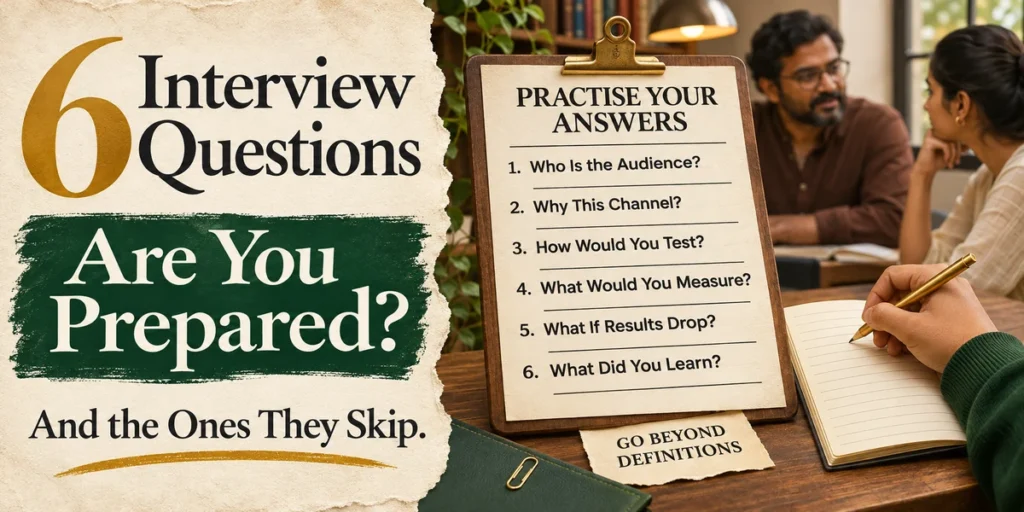
This post lists six interview questions institutes should prepare you for, and the ones they often skip.
The short answer
Institutes usually prepare you for definitions and tools. They skip the questions about real work, decisions, and failures.
Those skipped questions are exactly what interviewers ask. If your course does not prepare you for them, prepare yourself.
Why interviews feel different from class
In class, the question is on the slide. In an interview, you have to find the answer under pressure.
Class rewards knowing. Interviews reward explaining. Those are different skills, and only practice builds the second one.
The 6 questions institutes should prepare you for
Here they are. Each one is common in fresher marketing interviews.
1. “Tell me about a campaign you ran.”
This is the most common opening question. Interviewers want to hear a real project, with a goal, an action, and a result.
Why institutes skip it. Many courses run campaigns on shared accounts, so students cannot show them as their own.
How to prepare. Build one small campaign on your own account. Practise a one-minute answer. Problem, action, result.
Here is an illustrative example answer. These numbers are invented for illustration.
“I ran a small Meta campaign for a local shop. The goal was enquiries. I tested two creatives, kept the budget small, and got 12 enquiries in three weeks. The better creative was the one with the price in the first line.”
The numbers are illustrative. The structure is the point. Goal, action, result.
2. “Why did you choose that audience or creative?”
This tests whether you understand the reasoning, not just the steps.
Why institutes skip it. Class often gives the audience and creative as part of the exercise.
How to prepare. For each project, write one line on why you chose the audience and the creative.
3. “What would you do differently?”
This tests judgment and honesty. Interviewers want to see that you can learn from your work.
Why institutes skip it. Course projects are designed to succeed, so there is little to reflect on.
How to prepare. Pick one thing that went wrong in each project. Say what you would change.
4. “How would you measure success?”
This tests whether you think beyond likes. Interviews look for conversion, cost per result, and clear goals.
Why institutes skip it. Measurement is often taught as a separate module, disconnected from projects.
How to prepare. For each project, state the metric you used and why.
5. “Show me your portfolio.”
This is not a question. It is a request, and it comes early.
Why institutes skip it. Some courses do not build a portfolio at all.
How to prepare. Keep a simple one-page portfolio with two or three projects. Problem, action, result, and a screenshot.
6. “Where do you use AI, and where does it fail?”
This is increasingly common. Interviewers want to know you can use AI without trusting it blindly.
Why institutes skip it. AI is often taught as a tool demo, not as a workflow with review.
How to prepare. Prepare one example of AI helping and one example of AI being wrong. Show how you caught it.
The ones they skip
Here are the questions institutes often skip, and why they matter.
- “What did you do when the data was messy?” Tests problem-solving.
- “How did you handle a deadline?” Tests reliability.
- “Why this role, and why our company?” Tests preparation.
- “What is the weakest part of your portfolio?” Tests self-awareness.
- “How would you explain this result to a client?” Tests communication.
None of these are in most courses. All of them appear in interviews.
The interview questions quiz: how would you answer?
Three short scenes. Pick your move before you scroll. Then read the answer.
Scene one. The interviewer asks about a campaign. You did one in class on the institute’s account. What do you say?
A. Describe the class campaign as your own.
B. Describe a small campaign you ran on your own account.
C. Say you have not run one.
The smart move: B. Your own project is honest and explainable. A can unravel under follow-up questions. C undersells you.
Scene two. The interviewer asks what you would do differently. You have no answer. What is the problem?
A. You need better luck.
B. You have not reflected on your projects, which is a skill you can build.
C. The question is unfair.
The smart move: B. Reflection is a skill, and it needs practice. A and C avoid the gap.
Scene three. The interviewer asks where AI fails. You only know how to prompt. What do you do?
A. Guess an answer.
B. Prepare one real example before the next interview.
C. Say AI never fails.
The smart move: B. A real example is what they want. A is risky. C is not true.
Do you see the pattern? In every scene, the smart move is the same. Prepare real examples before the interview.
A real story about the skipped questions
A composite story, based on many real cases. A student, call him Sahil, finished a course with good marks. He could define every term.
In his first interview, the questions were different. What campaign did you run? Why that audience? What would you change? How did you measure it?
He had no real answers. The class campaigns were on shared accounts, and he had never reflected on the choices.
He did not get the role. He told me, “Class mein sab aata tha, interview mein kuch nahi.” In class I knew everything. In the interview, nothing.
He built two small projects on his own accounts, practised one-minute answers, and prepared one failure story. His next interview went better.
That is the lesson. Interviews test explanation, not memory.
How to prepare for these questions
Here is a simple plan.
- Build two small projects on your own accounts.
- Write a one-minute answer for each. Goal, action, result.
- Write one line on why you chose the audience and creative.
- Write one thing you would do differently.
- Write the metric you used and why.
- Build a one-page portfolio.
- Prepare one AI success and one AI failure. Show how you caught the failure.
- Practise out loud. Record yourself.
Eight steps. About a week of work.
Here is an illustrative example of a simple portfolio entry. These details are invented for illustration.
| Section | Example |
| Problem | Local shop had no enquiries from Instagram |
| Action | 12 posts over 4 weeks, one call to action per post |
| Result | 40 saves, 6 enquiries |
| Learning | Question-based posts got more messages than design posts |
The details are illustrative. The structure is the point. Problem, action, result, learning.
Before you practise, spend twenty minutes on Google’s Search Essentials and the GA4 documentation. It will help you speak clearly about measurement and search.
Common mistakes candidates make
- Describing class exercises as personal projects.
- Having no numbers or results to mention.
- Never reflecting on what went wrong.
- Not knowing which metric they used.
- Having no portfolio link ready.
- Claiming AI never fails.
- Never practising out loud.
What interview preparation cannot promise
Preparation cannot promise a job. It can make you clear, honest, and ready. The rest depends on the role and the market.
Svidya’s numbers are examples, not guarantees. 200+ students taught. A highest package of 9.8 LPA. Three free demo classes. The highest package is one person’s result. It is not a forecast for you.
Your action checklist
Print this. Use it before your next interview.
- Build two small projects on your own accounts.
- Write a one-minute answer for each.
- Write why you chose the audience and creative.
- Write what you would do differently.
- Write the metric you used and why.
- Build a one-page portfolio.
- Prepare one AI success and one AI failure.
- Book the demo. At Svidya you get three free demo classes for the AI-Powered Marketing Course. Attend all three before you decide.
- Practise out loud and record yourself.
Final words and your next step
Institutes prepare you for definitions. Interviews ask about work.
Prepare for the six questions that matter. Tell me about a campaign. Why that audience? What would you change? How did you measure it? Show me your portfolio. Where does AI fail?
You do not have to guess. Build two projects and practise the answers out loud.
If you want structured practice and mock interviews, start with a free demo class at Svidya’s AI-Powered Marketing Course. Bring the checklist. Ask the awkward questions. Then decide, with proof in your hand and no pressure from anyone.
About the author
Shubhankar Vashist is the founder of SVidya, based in Delhi. He has 6+ years of marketing experience across healthcare, pharma, cosmetics, e-commerce and agencies. He teaches digital marketing by making students build real assets
FAQ
What interview questions should a digital marketing course prepare me for?
At minimum: tell me about a campaign you ran, why you chose that audience or creative, what you would do differently, how you measured success, show me your portfolio, and where AI helps and fails.
Why do institutes skip these questions?
Often because course projects are done on shared accounts or designed to succeed, so students have little to explain or reflect on. That makes the real interview harder.
How do I prepare if my course does not?
Build two small projects on your own accounts, write one-minute answers, note one thing you would change, and practise out loud. A one-page portfolio helps too.
Do I need my own projects if I did campaigns in class?
Yes. Interviewers ask follow-up questions, and class campaigns on shared accounts are hard to defend as your own. Your own projects are honest and explainable.
How do I answer the AI question?
Prepare one example where AI helped and one where it was wrong, and explain how you caught the error. That shows you use AI with judgment, not blindly.