
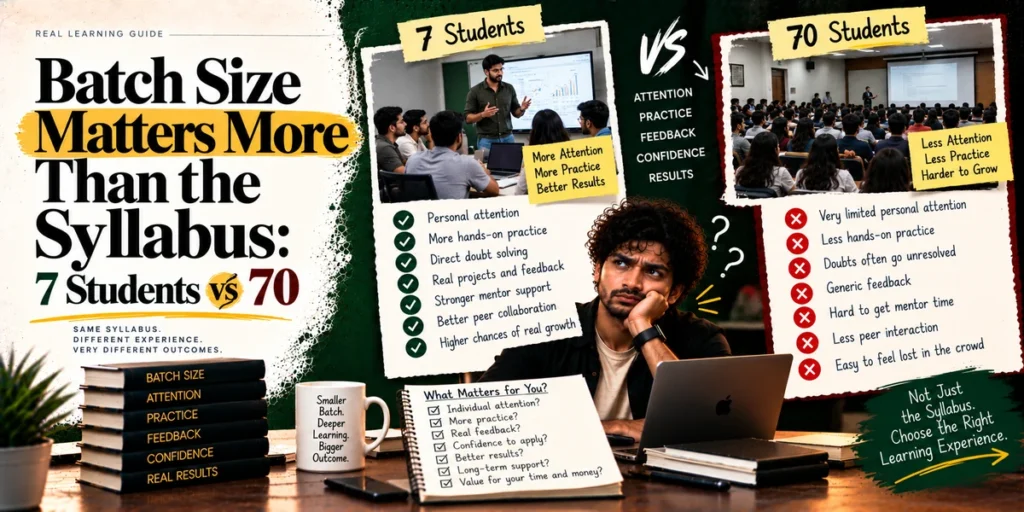
You are comparing two programs. Both have similar curriculums. Both teach the same tools. Both offer live sessions.
One has 7 students in a batch. The other has 70. The price difference is small.
Most people compare syllabuses. They should compare batch sizes. A great syllabus with 70 students is a worse learning experience than a decent syllabus with 7. Here is why batch size matters more than the syllabus.
Direct Answer
Batch size decides how much personal attention you get, how much feedback you receive, and how fast you learn. A batch of 7 students gets reviewed work, live doubt clearing, and direct accountability. A batch of 70 gets a broadcast, a chat box, and a lot of unanswered questions. The syllabus matters less than the room you learn in.
1. Doubt Clearing
7 students: You ask a question. The instructor answers it. Sometimes the question is for you, sometimes it is for someone else. You hear it, learn from it, and move on. The session stays interactive.
70 students: You type your question into a chat. It scrolls. The instructor tries to answer some. Yours might be missed. If it is answered, it is brief. You cannot ask the follow-up.
Real doubt clearing needs conversation. Conversation needs a small room.
2. Feedback on Your Work
7 students: You submit an assignment. The instructor reviews it personally. You get specific feedback on your decisions, not just your output. You fix the mistakes and improve.
70 students: You submit an assignment. In a good program, someone skims it. In a bad one, nobody looks. You do not know if your choices were right. You keep repeating the same mistakes.
Feedback is where learning actually happens. Without it, you are guessing.
3. Accountability
7 students: The instructor notices if you miss a session. The other six notice too. You do not want to be the one who disappears. You show up.
70 students: Nobody notices. You fall behind. Then you feel lost. Then you stop showing up. Nobody knows.
Accountability is invisible but real. It is one of the strongest reasons students finish a small batch and disappear from a large one.
4. Peer Learning
7 students: You learn from the six other students. You see their work. You compare approaches. You ask them for help. They ask you. A small group becomes a team.
70 students: You do not know who the others are. Everyone is anonymous. You learn only from the instructor. You miss the second-most-important source of learning.
Peers are the underrated part of any good course. Small batches unlock them.
5. Real Discussion
7 students: The session can go off-script. You ask a question that leads to a real discussion. The instructor answers based on what you actually need. Every session is slightly different.
70 students: The instructor follows the script. Deviations would mean losing half the room. The session is efficient for the instructor, but flat for the student.
Discussion beats lecture for skill building. Small batches allow discussion.
6. Instructor Energy
7 students: The instructor can see your face. They notice when you are confused, when you are bored, when something landed. The teaching adapts in real time.
70 students: The instructor is teaching to a screen. They cannot see individual reactions. The lesson is delivered, not taught.
Teaching is a live exchange. Small batches make it work.
7. Career Impact
7 students: You leave with a small network of peers who know your work. Referrals, collaborations, and job leads often come from these relationships. Your instructor knows you well enough to recommend you.
70 students: You leave with a certificate. No relationships. No referrals. No one who can vouch for you personally.
The career value of a course is not the content. It is the network and the accountability. Both require a small room.
Comparison Table
| Factor | 7 Students | 70 Students |
|---|---|---|
| Doubt clearing | Direct, conversational | Chat-based, often missed |
| Feedback on work | Personal, specific | Skimmed or skipped |
| Accountability | High, everyone notices | None, easy to disappear |
| Peer learning | Strong, team-like | Weak, everyone anonymous |
| Discussion | Real, off-script | Structured, on-script |
| Instructor energy | Adapts in real time | Broadcast only |
| Career network | Small but strong | Large but weak |
| Fee per student | Higher | Lower |
| Actual learning outcome | Higher | Lower |
Why Providers Run Large Batches
Large batches are a business decision. Not a learning decision.
A batch of 70 generates more revenue than a batch of 7. It is the same instructor hours, but the revenue per hour is higher. From the provider’s side, it is efficient.
The trade-off is your experience. You get a lower price and a worse learning environment. That is the actual exchange.
Some large-batch programs are honest about this. They call themselves self-paced with live Q&A or recorded sessions with community support. That is fine, as long as you know what you are buying.
The problem is when a program markets itself as live and personal, and then puts 70 people in a room. That is where the promise breaks.
What I Actually Did
When I first started teaching, I ran a larger batch. I thought more students meant more value for everyone. I was wrong.
The sessions became broadcasts. Doubts piled up in the chat. Assignments got skimmed. Students disappeared without anyone noticing. A few finished. Most did not.
I changed the format. Smaller batches. Fewer students. Every assignment reviewed. Every doubt answered. Every student noticed.
The results changed immediately. Students finished. Their work improved. Some built portfolios they were proud of. The fee per student went up, but so did the outcome per student. That is the only comparison that matters.
This is why I now cap batch sizes. Not as a marketing line. As a design decision. If I let the batch grow, the format breaks. The whole reason the program works is that it stays small.
Mistakes to Avoid
Choosing based on price alone. A cheaper large batch may cost less, but the learning outcome is lower. You get what you pay for.
Assuming all live batches are similar. Live means different things at different batch sizes. A 70-person live session is not the same as a 7-person one.
Not asking about feedback. Feedback is the real value. If nobody reviews your work, you are paying for a recorded course with extra steps.
Ignoring the peer factor. Small batches create peers who become future collaborators. Large ones do not.
Being seduced by brand names. A big brand with 200-person batches is a different experience from a small program with 7.
Believing the syllabus is the differentiator. It rarely is. Every syllabus looks similar. The delivery is what differs.
Practical Checklist Before You Pay
- ☐ I know the exact batch size for my cohort.
- ☐ I know who reviews the assignments and how often.
- ☐ I know how doubts are handled during sessions.
- ☐ I have asked whether the instructor is present live or an assistant runs the sessions.
- ☐ I have spoken to a past student about the actual experience.
- ☐ I have compared the price to what the batch size actually delivers.
- ☐ I understand what live means in this program.
- ☐ I am not choosing based on the syllabus alone.
- ☐ I have asked what happens if I fall behind.
- ☐ The price matches the attention I will receive.
FAQ
Q: Is a small batch always better?
A: For live skill-building, yes. For recorded content, batch size does not apply. If the program is live and personal, small batches deliver more.
Q: How small should a batch be?
A: Under 20 is a strong rule. Under 10 is ideal. Above 25, the personal attention starts to disappear. Above 50, it is a broadcast.
Q: Why are small batches more expensive?
A: Because the instructor’s time is fixed. Fewer students means the same hours spread across fewer people. You are paying for attention, not just content.
Q: What if I cannot afford a small batch?
A: Then a self-paced program with good structure is a reasonable alternative. Do not pay for a live large batch expecting personal attention.
Q: Is a large batch ever the right choice?
A: For self-driven learners who only need the content, yes. For skill building with feedback, no.
Q: How do I verify the batch size claim?
A: Ask to speak with a past student. Ask how many were in their batch. Ask how many finished. Those numbers tell the truth.
End CTA
If you want a program that runs on small batches with personal review and real accountability, look at the SVidya homepage. The 22-week live program is built around small groups, weekly reviewed assignments, and honest batch sizes. Read the curriculum and check whether the format fits your goals. If it does not, that is fine too. The important thing is that you choose a room where you will actually be seen.
Author Box
Shubhankar Vashist is the founder of SVidya, based in Delhi. He has 6+ years of marketing experience across healthcare, pharma, cosmetics, e-commerce and agencies. He teaches digital marketing by making students build real assets.