
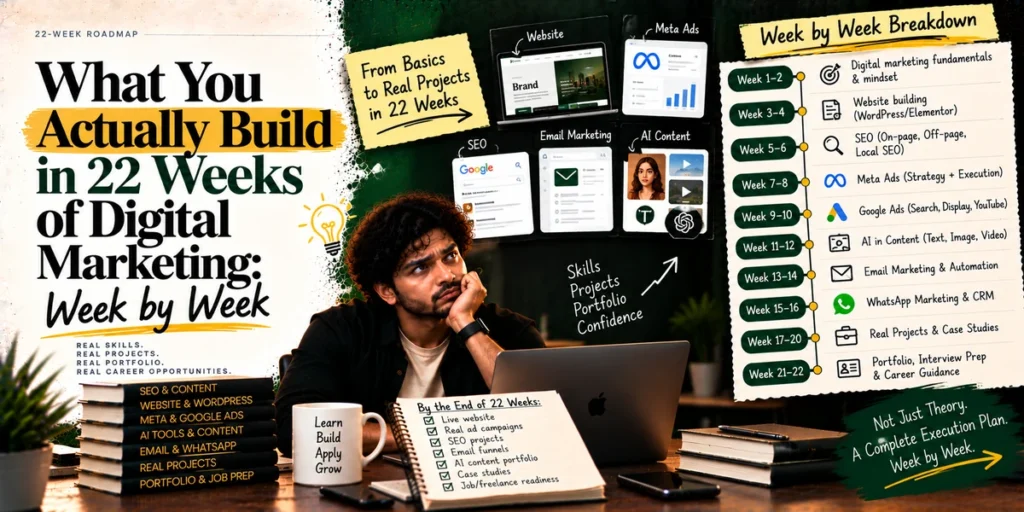
Most courses tell you what you will learn. Very few tell you what you will build.
That is the wrong way around. Learning is invisible. Building is proof. When you finish a program, what you have to show matters more than what you covered.
Here is a week-by-week look at what a real 22 weeks of digital marketing produces. Not the topics. The outputs. Every week, something to add to your portfolio.
Direct Answer
In a well-structured 22 weeks of digital marketing, you build a new real asset almost every week, starting with a marketing brief and ending with a capstone project. The output is not a certificate. It is a portfolio of websites, campaigns, audits, automations, and case studies that you can show to employers or clients.
The Five Phases
The 22 weeks break into five phases. Foundation. Content and Creative. Paid Marketing. SEO and Search. AI and Automation. Each phase builds on the last.
Below is what you build in each phase, week by week.
Phase 1: Foundation (Weeks 1 to 5)
Week 1: Marketing Brief and Customer Journey Map
You pick a real or mock business. You write a brief: who the customer is, what they need, what problem you are solving. You map their journey from awareness to purchase.
Output: A one-page marketing brief and a customer journey diagram.
Week 2: Tested Prompt Library
You learn to brief AI with context and constraints. You test prompts against real marketing problems: content ideas, competitor research, ad copy.
Output: A prompt library you will keep using after the course.
Week 3: Working WordPress Setup
You connect a domain and hosting. You install WordPress. You understand the structure behind a live site.
Output: A working WordPress installation, ready to build on.
Week 4: Business Website and Blog
You plan the page structure. You build the key pages. You publish a blog. You add clear calls to action.
Output: A live business website with a working blog.
Week 5: E-commerce Store
You build a Shopify store. You add products, organise categories, and work through the customer purchase journey.
Output: A demonstration e-commerce store with a functional checkout flow.
Phase 2: Content and Creative (Weeks 6 to 8)
Week 6: Brand Kit and Campaign Creative
You define a visual direction. You turn brand decisions into a set of consistent creative assets.
Output: A brand kit plus a set of campaign creatives.
Week 7: AI Image and Video Campaign
You experiment with AI generation tools. You turn prompts and references into a coherent creative campaign.
Output: An AI-assisted image and video campaign.
Week 8: Social Strategy and Content Calendar
You build content pillars, hooks, and platform-specific ideas. You plan publishing and learn to evaluate performance.
Output: A social strategy and a 30-day content calendar.
Phase 3: Paid Marketing (Weeks 9 to 13)
Week 9: Meta Ads Campaign
You work through campaign objectives, audiences, creative, and budgets. You make decisions, not just follow steps.
Output: A Meta campaign setup with a clear testing plan.
Week 10: Tracking Plan and CRO Audit
You learn events, conversion tracking, and the Conversions API. You find friction in a landing page journey.
Output: A tracking plan and a landing page improvement audit.
Week 11: Google Ads Campaign
You connect search intent to keywords, ad groups, ads, and landing pages. You read performance with a clear objective.
Output: A search campaign with a full keyword structure.
Week 12: YouTube and Display Campaign Plan
You explore targeting, formats, placements, and measurement for video and display.
Output: A video and display campaign plan.
Week 13: Landing Page and Marketplace Brief
You build a focused landing page that matches an offer. You study marketplace advertising.
Output: A live landing page plus a marketplace advertising brief.
Phase 4: SEO and Search (Weeks 14 to 17)
Week 14: Search Research Document and Keyword Map
You understand how search works. You research intent, keywords, competitors, and topics worth building around.
Output: A keyword map and search research document.
Week 15: SEO Audit and On-Page Fixes
You improve content structure and metadata. You investigate indexing, internal linking, and technical issues.
Output: A full SEO audit with implemented on-page improvements.
Week 16: Local Visibility Plan and GEO Experiment
You work on authority building, local discovery, and generative engine optimisation.
Output: A local visibility plan and one GEO experiment.
Week 17: Answer-Focused Content and YouTube Optimisation
You structure content for answer engines. You optimise video titles, descriptions, and topics.
Output: An answer-focused content asset and a YouTube optimisation plan.
Phase 5: AI and Automation (Weeks 18 to 22)
Week 18: Messaging Workflow
You map lead follow-up and messaging journeys with triggers, consent, and handoffs.
Output: A messaging workflow and a follow-up sequence.
Week 19: n8n Automation Workflow
You connect tools with triggers, actions, and logic. You test data flow and handle failures.
Output: A working automation workflow with documented test cases.
Week 20: AI or Voice Agent Prototype
You design an agent around a specific task. You define its boundaries and test how it handles real inputs.
Output: A working agent prototype.
Week 21: Marketing Tool Prototype
You translate a marketing problem into a small app. You iterate with AI assistance.
Output: A working marketing tool.
Week 22: Capstone, Portfolio, and Demo Day
You bring everything together. You document decisions. You present the work.
Output: A full case study, a portfolio, and a demo-day presentation.
What You End Up With
By the end of 22 weeks, you have more than knowledge. You have:
- A live website and a blog
- A Shopify store
- A brand kit and campaign creatives
- An AI image and video campaign
- A Meta Ads campaign
- A Google Ads campaign
- A tracking plan and CRO audit
- A landing page
- An SEO audit with fixes
- A local visibility plan
- A messaging workflow
- An n8n automation
- An AI agent prototype
- A marketing tool
- A capstone case study
- A portfolio
- A demo-day presentation
That is what you take to interviews. Not a certificate. A body of work.
Comparison Table
| Typical Course | This 22-Week Program |
|---|---|
| Lectures and slides | Weekly build outputs |
| Final exam or quiz | Capstone project and demo day |
| Certificate at the end | Portfolio of 13+ real assets |
| Notes and PDFs | Live websites, campaigns, and workflows |
| Theory-first | Build-first |
What I Actually Did
When I was learning marketing, I had no structured 22-week plan. I learned from free content and built on my own. It worked, but it was slow. I made mistakes that a structured program would have caught.
The gap I kept running into was proof. I knew things. I had no portfolio. The day I started writing up my projects as case studies, my interviews changed. Not because I knew more. Because I could finally show what I had done.
That experience shaped how I teach. Every week has an output. Not because homework is fun. Because the output is what gets you hired. Watching builds nothing. Building builds a career.
Mistakes to Avoid
Skipping the boring weeks. Tracking, SEO audits, and documentation feel less exciting than ad campaigns. They are also what separates a professional from an amateur.
Not saving your work. Every week’s output should go into a folder. By week 22, that folder is your portfolio.
Rushing the capstone. The capstone is where the whole program lands. Do not treat it as an afterthought.
Not documenting decisions. The output matters, but the reasoning behind it matters more in interviews.
Copying templates without understanding them. The template is a starting point. Your thinking is the actual deliverable.
Ignoring the peer review. Your batchmates’ feedback often catches things you miss.
Practical Checklist for Getting the Most Out of 22 Weeks
- ☐ I have a folder for each week’s output.
- ☐ I document the decisions, not just the deliverable.
- ☐ I submit every assignment, even the boring ones.
- ☐ I review my classmates’ work and ask questions.
- ☐ I revisit early outputs after learning more.
- ☐ I write up at least three outputs as full case studies.
- ☐ I practise explaining my work out loud each week.
- ☐ I keep the capstone in mind from week one.
- ☐ I do not skip the tracking and audit weeks.
- ☐ By week 22, I have a portfolio, not just notes.
FAQ
Q: How much time per week does a 22-week program take?
A: A live program with weekly outputs usually takes around 8 to 12 hours per week. That includes live sessions and assignment work.
Q: Do I need to be technical to build all these things?
A: No. The program starts from fundamentals and builds up. If you can follow instructions and ask for help when stuck, you can complete the outputs.
Q: What if I fall behind?
A: Most programs allow you to catch up. Ask what happens if you miss a week, before you enrol. The plan for falling behind matters.
Q: Is 22 weeks enough to become a marketer?
A: It is enough to become job-ready at the entry level, with a portfolio. Mastery takes longer. But you will have real work and real confidence by week 22.
Q: Can I do this while working full-time?
A: Yes, if the sessions fit your schedule and you can commit the weekly hours. Most students in this format are working professionals.
Q: What should I do after week 22?
A: Apply the portfolio. Apply to jobs. Run campaigns for real clients. Keep learning through real work, not more courses.
End CTA
If you want a program that runs on weekly outputs and ends with a real portfolio, look at the SVidya homepage. The 22-week live program is built around weekly deliverables, reviewed assignments, and a final capstone. Read the curriculum and check whether the structure fits your goals. If it does not, that is fine too. The important thing is that whatever you choose, you end it with proof, not just knowledge.
Author Box
Shubhankar Vashist is the founder of SVidya, based in Delhi. He has 6+ years of marketing experience across healthcare, pharma, cosmetics, e-commerce and agencies. He teaches digital marketing by making students build real assets.