
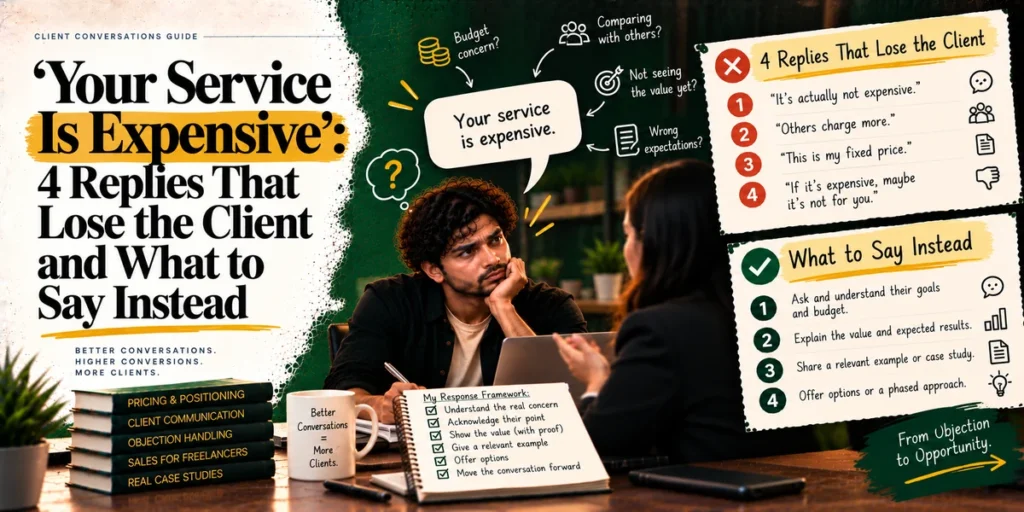
You sent your proposal. You waited. The reply comes back.
“Your service is expensive.”
Your heart drops a little. You start typing. And within thirty seconds, you say something that kills the deal.
This is not a price problem. It is a response problem. How you handle “your service is expensive” often decides whether you get the client or lose them. Most beginners say one of four things that end the conversation. All four feel reasonable in the moment. All four cost you the sale.
Here is what not to say, and what to say instead.
Direct Answer
When a client says your service is expensive, do not drop your price, apologies, or argue. Ask what they are comparing it to. Then reframe the conversation around the outcome, not the cost. The right reply keeps the conversation going and often closes the deal at your original price.
4 Replies That Lose the Client
1. “I can give you a discount”
You panic. You drop your price. You hope the client says yes.
Why it loses the client: It signals that your original price was not real. If you can drop it that fast, you were overcharging to begin with. The client now trusts you less, not more. And even if they buy, they will push on every future invoice too.
2. “I understand, let me know if you change your mind”
You accept the rejection gracefully. You close the message. You feel mature.
Why it loses the client: “Expensive” is rarely a final no. It is usually a signal that the client does not yet see the value, or does not have the full budget for the whole scope. By closing the conversation, you remove every chance to address either.
3. “You get what you pay for”
You defend your price. You imply the client is being cheap.
Why it loses the client: It insults them. Even if it is true, it shuts down the conversation. The client feels judged and moves on.
4. “Fine, I will do it for less this one time”
You make an exception. You tell yourself it is just for this client. It will not become a pattern.
Why it loses the client: It becomes a pattern. The client now expects the discount every time. They also start to see you as someone whose price is negotiable, which means they will negotiate everything.
3 Replies That Save the Deal
1. “What are you comparing it to?”
This is the single strongest reply. It is calm, curious, and it moves the conversation forward.
Why it works: It gives the client a chance to explain. Most of the time, they are comparing your quote to a cheaper provider who is offering far less work. Once that comes out, you can explain the difference without sounding defensive.
2. “Same rate, smaller scope”
You keep your price intact. You reduce the project size.
Why it works: The client’s real problem is usually budget, not price. By offering a smaller first phase at the same rate, you solve their cash flow problem without lowering your rate. And you create a natural path for more work later.
Example: “I cannot change the price, but I can change the scope. We can start with the first phase at a smaller investment, and add the rest when you see results.”
3. “Let me walk you through what is included”
You explain, calmly, what the price covers. Not to defend it. To inform.
Why it works: Most clients who say “expensive” do not understand the scope. They are comparing your full-service price to a stripped-down alternative. When they see the difference, the price often stops feeling expensive.
Example: “I get that. Let me explain why the price is where it is. The scope includes X, Y, and Z. Cheaper options usually skip one of these, and that usually costs more later.”
The 5-Step Reply That Actually Works
Here is a five-step reply that handles the objection without dropping the price.
Step 1: Acknowledge. “I understand.”
Step 2: Ask. “Can I ask what you are comparing it to?”
Step 3: Reframe. “Most clients who said that at first were comparing it to X, which does not include Y. Would it help if I explained the difference?”
Step 4: Reduce scope, not price. “If budget is tight, we can start with the first phase. Same rate, smaller project.”
Step 5: Offer a clear next step. “Should we hop on a 15-minute call to look at which phase makes sense for you?”
Five steps. No discount. No apology. No argument. Most clients respond with either “yes, let us talk” or “okay, I understand the pricing now”.
Why Clients Say “Expensive”
Most of the time, “expensive” is not about money. It is about clarity.
The client is not convinced the outcome is worth the price. Maybe they do not understand what they get. Maybe they do not trust you yet. Maybe they do not see the value in the outcome.
Your job in the reply is not to defend the price. It is to close the clarity gap. When they understand the outcome, the price usually stops feeling expensive.
Comparison Table
| What You Say | What Client Hears | What Actually Works |
|---|---|---|
| “I can give you a discount” | “The price was not real” | “What are you comparing it to?” |
| “Let me know if you change your mind” | “I do not want to solve your problem” | “Let me share one thing that might change how you see it” |
| “You get what you pay for” | “You are being cheap” | “Let me walk you through what is included” |
| “Fine, one-time discount” | “Every invoice is negotiable” | “Same rate, smaller scope for phase one” |
| Silence and waiting | “I do not know how to respond” | Ask a specific question that moves forward |
What I Actually Did
The first time a client told me I was expensive, I dropped my price immediately. Not because I wanted to. Because I did not know what else to do.
It worked that one time. Then the client expected a discount on every invoice. Then they referred me to a friend who also expected a discount. My rates went down, not up.
The second time I heard “expensive”, I tried a different approach. I asked what they were comparing it to. It turned out they were comparing my quote to a much smaller competitor who was offering a fraction of the work. Once I explained what was included, the client understood. They did not buy that project, but they came back three months later for a different one, at full price.
The third time, I used the five-step reply. The client said yes. Full price. The project ran well. They referred me to two other clients.
The pattern is simple. When I dropped my price, I lost trust. When I defended my price, I lost the client. When I explained my price, I usually kept the client, sometimes at a smaller scope, often at full price.
Mistakes to Avoid
Responding instantly. Take a few minutes. Your first instinct is usually the wrong reply.
Treating “expensive” as a final no. It usually is not. It is a checkpoint.
Dropping your price out of fear. It signals desperation and weakens every future conversation.
Getting defensive. Defence closes the conversation. Curiosity opens it.
Explaining your process instead of the outcome. Clients do not care how you work. They care what they get.
Not asking what they are comparing it to. The comparison tells you what the client actually wants, and what they are willing to pay for.
Practical Checklist Before You Reply
- ☐ I am calm and not replying instantly.
- ☐ I will not drop my price in the first message.
- ☐ I will ask what they are comparing it to.
- ☐ I will restate the outcome, not the process.
- ☐ I am ready to reduce scope, not price.
- ☐ I will offer one clear next step.
- ☐ I will not use the phrase “you get what you pay for”.
- ☐ I will not offer a “one-time discount”.
- ☐ I will keep the conversation open even if they say no.
- ☐ I will follow up politely in a week if I do not hear back.
FAQ
Q: Should I ever drop my price?
A: Rarely, and never in the first reply. If you do reduce the price, reduce the scope at the same time. Same rate, smaller project.
Q: What if the client genuinely cannot afford it?
A: Then the project is not a fit. Politely say so. Refer them to a cheaper provider if you can. Not every client is your client.
Q: How do I know if my price is actually too high?
A: If every client says expensive, your price might be out of line with your market. If one in five says expensive, it is just a normal objection.
Q: Should I offer instalments instead of a discount?
A: Yes. Instalments solve the cash flow problem without lowering your price. The total stays the same.
Q: What if the client says “expensive” after already agreeing to the price?
A: That is a different situation. Ask what changed. Do not renegotiate the agreed price. The scope may need to be clarified, but the price stands.
End CTA
If you want to learn how to handle objections, price your work, and close clients without dropping your rates, look at the SVidya homepage. Sales training and client communication are covered in the 22-week live program. Every student practises real conversations, not theoretical scripts. Read the curriculum and check whether it fits your goals. If it does not, that is fine too. The important thing is that the next time a client says “expensive”, you reply from strength, not fear.
Author Box
Shubhankar Vashist is the founder of SVidya, based in Delhi. He has 6+ years of marketing experience across healthcare, pharma, cosmetics, e-commerce and agencies. He teaches digital marketing by making students build real assets.