
You opened your portfolio. You uploaded your certificates. Google, Meta, HubSpot, a few others. It looks impressive.
The interviewer opens it. Scans. Closes it. You do not hear back.
You assume you need more certificates. You do not. You need proof. Certificates show you studied. Proof shows you can do the work. Only one of them gets you hired.
Direct Answer
A digital marketing portfolio needs proof of real work, not a list of certificates. Show projects you built, the decisions you made, and the results you got. Replace the certificate wall with three real case studies and your interviews will change.
Why Certificates Do Not Work in a Portfolio
A portfolio is not a list of things you have done. It is a demonstration of how you think.
A certificate says “I completed a course”. It does not say what you can do with the knowledge. It does not show how you solve problems. It does not show how you handle failure. It does not show what happens when the tool does not behave the way the tutorial showed.
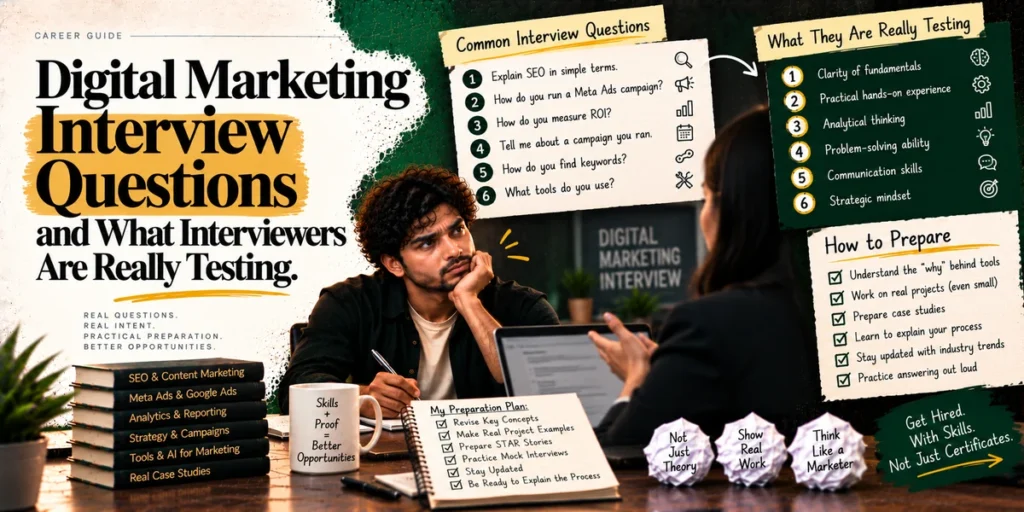
Interviewers know this. That is why they ask about campaigns, decisions, and outcomes. Not about certificates.
1. Employers Want to See Your Thinking
The first thing an interviewer looks for is judgment. Not knowledge. Judgment.
They will ask a simple question. “Why did you choose that audience?” Or “Why did you use that headline instead of another?”
A certificate holder often answers with general principles. A marketer who has actually run campaigns answers with specifics. “Because I tested three audiences, and this one had the lowest cost per lead over five days. Here is the number.”
That is the difference. One answer is theory. The other is proof.
2. Proof Shows You Can Handle Real Constraints
Real projects have limits. Limited budgets. Limited time. Limited tools. Limited data.
Certificates do not show how you work inside those limits. Real projects do. When you can say “I ran this campaign on Rs 500 per day and got 12 leads”, the interviewer knows you can deliver with less.
3. Proof Shows You Have Actually Faced Problems
Courses teach the happy path. Real work hits friction. Tracking breaks. Ads get rejected. A client changes the brief halfway through.
An interviewer wants to know how you handle problems. Your portfolio should include at least one thing that broke, and what you did about it.
4. Proof Shows You Can Take Feedback
This sounds soft. It is not. It is one of the strongest signals in an interview.
When your portfolio includes a case study that says “here is what I would do differently next time”, it signals to the interviewer that you learn from feedback. That is what they want in a teammate.
5. Proof Shows Your Range, Not Just Your Study List
Certificates list topics. Proof shows outcomes across different areas. A website. An ad campaign. An SEO audit. An automation. A content plan.
The range of work in a portfolio tells the interviewer more about you than any syllabus ever could.
6. Proof Survives the Twenty-Second Scan
Interviewers do not read portfolios carefully. They scan. In the first twenty seconds, they decide whether to look closer.
A page of certificates gets skipped. A page with a screenshot, a number, and a one-line context gets read. That is what proof does. It earns the second look.
7. Proof Is What Gets You Recommended
Hiring managers do not just hire. They recommend candidates to other teams. What gets recommended is visible work, not credentials.
If your portfolio has real projects, someone will send it to a colleague with a note. That is the highest form of career momentum.
Comparison Table
| Portfolio Element | Weak Version | Strong Version |
|---|---|---|
| Certificates | Screenshots of completions | One line on resume only |
| Project screenshots | “Here is a page I made” | “Here is the audience and why this layout” |
| Ad campaign | “I ran ads” | Objective, audience, creative, what broke, numbers |
| SEO work | “I did SEO” | Keyword research, on-page changes, results |
| Reflection | None | “What I would do differently” |
| Numbers | Imaginary or vague | Real, even if small |
| Failure | Hidden | Explained honestly |
How to Build Proof Fast
You do not need a hundred projects. Three real case studies, written properly, are worth more than any certificate.
A case study does not need a big client. It can be your own project. A friend’s shop. A small business you helped for free. The size does not matter. What matters is that it is real and you can explain the thinking behind it.
Here is a simple structure. One page is enough.
Title. Business name or “Personal project”. One line.
Context. Two or three sentences. What was the problem, what was the goal.
What I did. Three to five bullet points. The decisions you made, not just the tasks.
What broke. One honest line about a problem you ran into. This is what most people skip, and it is the part that builds trust.
What I changed. One or two lines. How you fixed it.
The outcome. Numbers if real. If not, a clear description of what happened.
What I would do differently. One line. Shows you think, not just execute.
That last line, “What I would do differently”, is the single strongest thing in a portfolio. It tells the interviewer you are self-aware, and that you learn from your work.
What I Actually Did
When I started building my own portfolio, I made the same mistake. I led with what I had done. Course completions, tool logos, a long list of skills.
It did not work. Interviewers were polite, but I could see them lose interest. Nothing in my portfolio showed how I thought.
The change came when I started writing case studies. Not just “here is a website I built”, but “here is the business, here is the problem, here is what I decided, here is what broke, here is what I would do differently”.
That format changed the conversation. Interviewers spent more time on each project. They asked better questions. A few asked me to walk through the work in detail. Those were the interviews that went somewhere.
I did not add more certificates. I removed the ones at the centre of the portfolio and replaced them with three honest case studies. Same experience, better packaging, completely different result.
Mistakes to Avoid
Leading with certificates. Put them at the bottom or leave them off. Lead with work.
Showing screenshots without context. A picture means nothing without the why behind it.
Hiding failures. The failures are the parts that make you look real. Show them.
Using fake numbers. One real number beats ten imaginary ones. If you do not have numbers, describe what changed in plain language.
Making the portfolio pretty but empty. Design matters. Substance matters more.
Only showing success. Interviewers trust people who can describe what went wrong and what they learned.
Practical Checklist for a Proof-Driven Portfolio
- ☐ I have at least three real case studies.
- ☐ Each case study has context, decisions, execution, and outcome.
- ☐ Each case study includes one thing that broke and how I handled it.
- ☐ Each case study ends with what I would do differently.
- ☐ Certificates are one line on a resume, not the centre of the portfolio.
- ☐ Numbers are real, even if small.
- ☐ Screenshots have context beside them.
- ☐ The portfolio loads quickly and works on mobile.
- ☐ A stranger can understand each project in under two minutes.
- ☐ I can talk through every project out loud without notes.
FAQ
Q: Should I remove my certificates completely?
A: No. Keep them on your resume or at the bottom of your portfolio. Just do not lead with them. Lead with work.
Q: What if I do not have any real projects?
A: Build one. Pick a small business or your own project. Even a free project counts if it is real. Do the work, write it up, and use it.
Q: How many case studies do I need?
A: Three is a good start. More is fine, but three strong ones beat ten weak ones
Q: Should I show failures in a portfolio?
A: Yes. One honest line about what broke makes the whole portfolio feel real. Hiding failures makes you look polished but untrustworthy.
Q: Can I use a personal project as a case study?
A: Yes. Personal projects are often the best starting point. They are fully yours, and you can explain every decision.
Q: Do I need a website for my portfolio?
A: A simple one-page site is ideal. A Notion page or a PDF also works. What matters is that the content is clear and easy to read.
End CTA
If you want to build a portfolio with real projects, real case studies, and feedback on how you present your work, look at the SVidya homepage. Portfolio building runs through the 22-week live program, with a capstone, case study, and demo day at the end. Every student leaves with three or more real projects to show. Read the curriculum and check whether it fits your goals. If it does not, that is fine too. The important thing is that your portfolio shows proof, not just attendance.
Author Box
Shubhankar Vashist is the founder of SVidya, based in Delhi. He has 6+ years of marketing experience across healthcare, pharma, cosmetics, e-commerce and agencies. He teaches digital marketing by making students build real assets.