
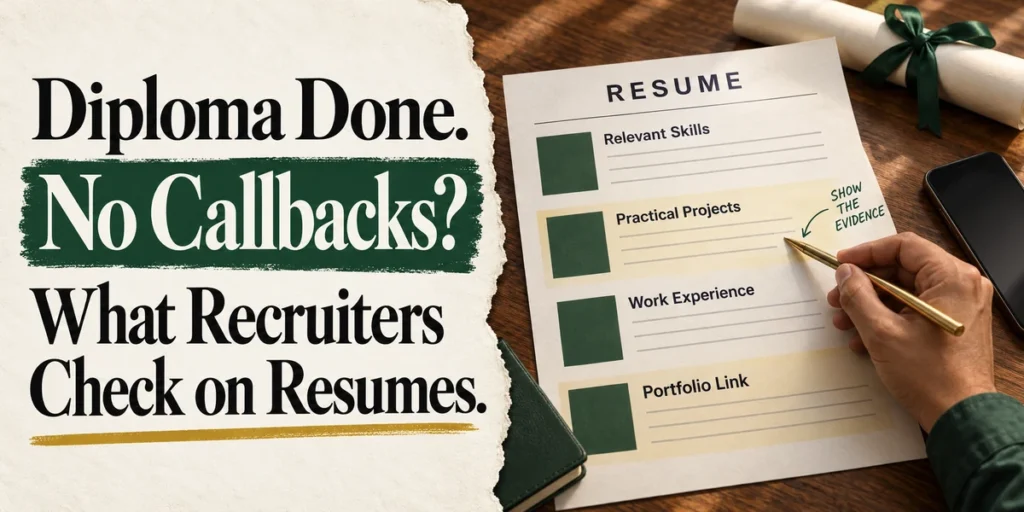
You finished the diploma. You updated your resume. You applied to twenty roles.
Two replies. Zero interviews. And the silence is starting to feel personal.
It is not personal. Recruiters spend seconds on a first scan, and most resumes fail in those seconds. Not because the candidate is weak, but because the resume does not show what they are looking for.
This post explains what recruiters actually check on resumes, the seven mistakes that get you ignored, and how to fix each one.
The short answer
Recruiters scan for three things. Can you do the job, can you show proof, and are you easy to read?
A diploma answers the first only partly. Proof answers the second. Format answers the third. Most rejections happen because one of these three is missing.
Why the diploma alone does not work
A diploma says you completed a course. It does not say what you can do.
Recruiters see hundreds of resumes with the same course names. They look for what makes one different. Usually, that is a project, a result, or a clear skill.
So the diploma is not the problem. The problem is that the resume stops at the diploma.
What recruiters check, in order
Here is what a recruiter actually scans, usually in under a minute.
- The headline. Does it match the role?
- The top third. Any proof of work?
- The skills section. Named tools, or vague words?
- The experience or projects. Real work, or only course names?
- The formatting. Easy to read, or a wall of text?
- The contact details. Correct and reachable?
Six things. Most resumes fail at two or three.
The 7 mistakes that get you ignored
Here they are. Check your resume against each one.
1. No proof in the top third
The top third of the page is the most-read part. If it only lists your name, degree, and course, you have wasted it.
What to do. Add one line of proof. “Ran a small Meta campaign that generated 12 enquiries.” Even a small result beats no result.
2. A skills list with no tools
“I know digital marketing” is a claim. “GA4, Meta Ads Manager, Search Console, Canva” is a list of tools.
What to do. Name the tools. Keep it short and specific.
3. Projects described as courses
“The digital marketing diploma covered SEO and ads” tells the recruiter what you studied. It does not tell them what you did.
What to do. Describe projects, not modules. Problem, action, result.
4. No numbers at all
Numbers are proof. Even small numbers. Reach, enquiries, sessions, clicks.
What to do. Add numbers where you honestly can. Small real numbers beat big vague claims.
Here is an illustrative example of a weak line and a stronger line. These numbers are invented for illustration.
| Weak line | Stronger line |
|---|---|
| “Did social media marketing” | “Ran 12 posts over 4 weeks, 40 saves, 6 enquiries” |
| “Worked on SEO” | “Audited a 6-page site, fixed 4 issues, impressions rose in 3 weeks” |
The numbers are illustrative. The pattern is real. Specific beats general.
5. A wall of text
Dense paragraphs are hard to scan. Recruiters scan, they do not read.
What to do. Use short bullets. One line per point. White space helps.
6. One resume for every role
A generic resume is easy to spot. It does not match the role.
What to do. Tailor the headline and the top three bullets for each role. Small changes, big difference.
7. Broken links or wrong contact details
A portfolio link that does not load, or an old phone number. These small errors cost interviews.
What to do. Test every link. Confirm your phone and email.
The resume quiz: what would you fix?
Three short scenes. Pick your move before you scroll. Then read the answer.
Scene one. Your resume lists your diploma but no projects. What do you add first?
A. A longer skills list.
B. One project with a clear result.
C. A photo.
The smart move: B. Proof beats a skill list. A adds words. C does not help.
Scene two. Your resume says “good at social media.” What do you change it to?
A. “Excellent at social media.”
B. “Ran 12 posts over 4 weeks, 40 saves, 6 enquiries.”
C. “Social media expert.”
The smart move: B. Specific results prove the claim. A and C are adjectives, not evidence.
Scene three. You apply to ten roles with the same resume. What is the risk?
A. None. Volume is good.
B. The resume may not match any role well, so it gets ignored.
C. Recruiters will not notice.
The smart move: B. A generic resume is easy to spot and easy to ignore. A mistakes volume for strategy. C is not true.
Do you see the pattern? In every scene, the smart move is the same. Show proof, use specifics, and tailor the resume.
A real story about a resume fix
A composite story, based on many real cases. A student, call him Aman, finished a diploma and applied to twenty-five roles. No interviews.
We looked at his resume. It listed the course name, the modules, and a skills list. No projects. No numbers. One dense paragraph.
We made three changes. We added one project line with a small result. We named the tools. We broke the text into short bullets.
He applied to ten roles with the new resume. He got three interviews.
Aman told me, “Resume mein kaam dikhana tha, course nahi.” The resume needed to show work, not the course.
That is the lesson. Recruiters check for proof. Give it to them in the first few seconds.
How to fix your resume in one hour
Here is a simple plan.
- Rewrite the headline to match your target role.
- Add one proof line in the top third. A project with a result.
- Replace the skills list with named tools.
- Rewrite two project bullets as problem, action, result.
- Add honest numbers where you have them.
- Break paragraphs into short bullets.
- Test every link. Portfolio, LinkedIn, email.
- Tailor the top three bullets for each role you apply to.
One hour. Most of the improvement comes from the first three steps.
Before you apply, spend twenty minutes on Google’s Search Essentials and the GA4 documentation. It is not about resumes, but it will help you write clearer, more specific bullets about the work you did.
Common mistakes job seekers make
- Listing course modules instead of projects.
- Using adjectives instead of numbers.
- Writing dense paragraphs that are hard to scan.
- Sending one generic resume to every role.
- Forgetting to test portfolio links.
- Assuming a diploma alone will get callbacks.
What no resume can promise
A strong resume cannot promise a job. It can get you the interview. The interview, the portfolio, and the market decide the rest.
Svidya’s numbers are examples, not guarantees. 200+ students taught. A highest package of 9.8 LPA. Three free demo classes. The highest package is one person’s result. It is not a forecast for you.
Your action checklist
Print this. Use it before your next application.
- Rewrite the headline for your target role.
- Add one proof line in the top third.
- Replace vague skills with named tools.
- Rewrite two project bullets as problem, action, result.
- Add honest numbers where you have them.
- Break dense text into short bullets.
- Test every link and contact detail.
- Book the demo. At Svidya you get three free demo classes for the AI-Powered Marketing Course. Attend all three before you decide.
- Tailor the top three bullets for each role.
Final words and your next step
Diploma done, still no callbacks? The problem is usually not the diploma. It is the resume.
Recruiters check for proof, tools, and clarity. Show one project with a real result. Name the tools. Make it easy to scan.
You do not have to guess. Fix the top third of your resume this week.
If you want to build the projects that make a resume work, start with a free demo class at Svidya’s AI-Powered Marketing Course. Bring the checklist. Ask the awkward questions. Then decide, with proof in your hand and no pressure from anyone.
About the author
Shubhankar Vashist is the founder of SVidya, based in Delhi. He has 6+ years of marketing experience across healthcare, pharma, cosmetics, e-commerce and agencies. He teaches digital marketing by making students build real assets.
FAQ
Why am I not getting callbacks after finishing a diploma?
Usually because the resume shows the course, not the work. Recruiters look for proof of projects, named tools, and clear results in the first few seconds. A diploma alone rarely gets callbacks.
What do recruiters check first on a resume?
The headline and the top third of the page. If the role match and proof are not visible there, the rest of the resume often goes unread.
Should I list course modules on my resume?
No, list projects instead. Modules tell the recruiter what you studied. Projects tell them what you can do. Describe each project as a problem, an action, and a result.
Do numbers matter on a resume?
Yes, even small ones. Numbers like reach, enquiries, or sessions make a claim believable. Small honest numbers are better than big vague claims.
How long should a fresher’s resume be?
One page is usually enough. Keep it short, use bullets, and put the strongest proof in the top third. Recruiters scan quickly, so clarity matters.