
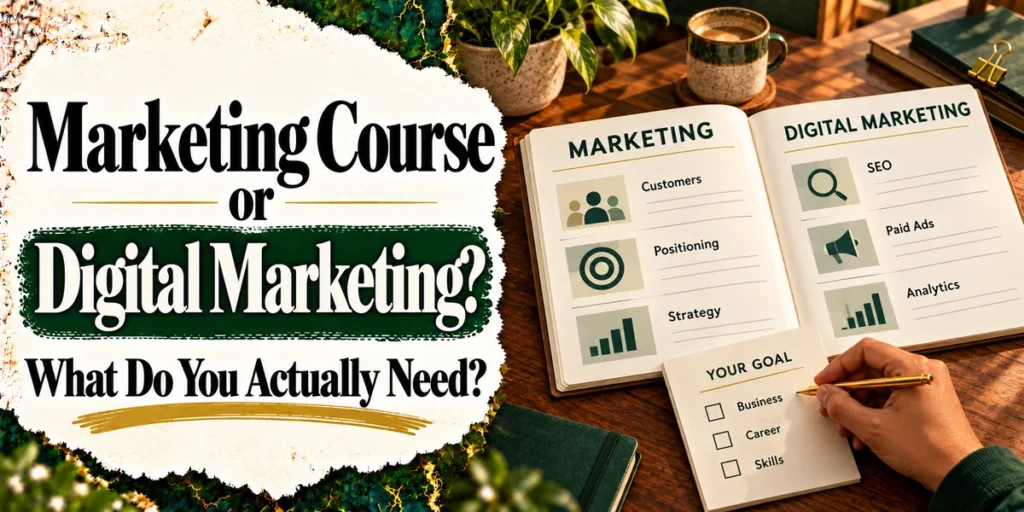
Two course names. One sounds broader. One sounds modern. Both promise a career.
You open both pages. The syllabus looks similar. The fee is similar. So which one do you actually need?
This is a marketing course vs digital marketing course question, and most students answer it by guessing. That guess can cost months, because the two paths lead to different first jobs.
This post breaks down the difference, honestly, and gives you seven questions to ask before you enrol.
The short answer
A marketing course teaches the whole field. A digital marketing course focuses on online channels.
If you want a broad career in brand, product, or general marketing, choose the broader course. If you want a first job in ads, SEO, social, or analytics, choose the digital one.
Most freshers in Delhi should choose digital, because that is where the entry-level roles are. But “most” is not “everyone.” Read on.
What a marketing course covers
A traditional marketing course is wider. It usually includes:
- Consumer behaviour. Why people buy.
- Brand and positioning. How a product sits in the market.
- Market research. Surveys, interviews, and data.
- Product and pricing. How offers are built.
- Distribution and sales. How products reach people.
- Digital basics. Often a small part, not the main focus.
It is a good base if you want a career in brand management, product marketing, or general marketing. It is less hands-on with tools, and it moves slower.
What a digital marketing course covers
A digital marketing course is narrower and more tool-heavy. It usually includes:
- SEO. How sites appear in search.
- Paid ads. Google Ads and Meta Ads Manager.
- Analytics. GA4 and reporting.
- Content and social. Planning, creating, and measuring.
- AI workflows. Drafting, summarising, reviewing.
- Projects. Campaigns, audits, and a portfolio.
It is practical and fast. It prepares you for roles like digital marketing executive, SEO associate, performance marketing trainee, or social media executive.
The real difference
The real difference is not the topic list. It is the first job.
A marketing course prepares you for broader roles, which often ask for experience or a business degree. A digital marketing course prepares you for specific, entry-level roles that hire freshers.
That is why most freshers choose digital first. You can add the broader marketing knowledge later, often on the job, or with a short course.
So the question is not “which is better?” The question is “which first job am I aiming for?”
The 7 questions to ask before you enrol
Here is the practical part. Ask these before you pay for either course.
1. What job title does this course prepare me for?
A clear answer is a good sign. “Digital marketing executive” or “brand associate” are clear. “Many opportunities” is not.
2. What will I build by the end?
Projects are proof. Ask for a website, a campaign, an SEO audit, or a report. If the answer is “notes and a certificate,” the course is thin.
3. Which tools will I use, by name?
GA4, Google Ads, Meta Ads Manager, Search Console, Canva. Named tools mean a real plan. “Industry tools” is a phrase.
4. Is the course practical or theoretical?
Ask how much time is spent building vs listening. A practical course has live accounts and reviews. A theoretical course has slides.
5. Does it include AI, and where?
For a digital marketing course, AI should be inside real tasks. For a broader course, AI may be a small module. Ask which.
6. How will I be assessed?
Campaign plus report is closer to the job. A test is closer to school. Pick the one that matches the role you want.
7. What share of recent students got a relevant role?
Ask for a rough share, with a time window. Honest institutes give a range. Nervous ones give “everyone.”
The comparison quiz: which course do you need?
Three short scenes. Pick your move before you scroll. Then read the answer.
Scene one. You want a first job in ads or SEO within a year. Which course fits?
A. A broad marketing course, because it covers more.
B. A digital marketing course with real campaigns and tools.
C. Either one. They are the same.
The smart move: B. Ads and SEO roles hire for specific skills and proof. A is broader but slower to a first job. C ignores the difference.
Scene two. You want a career in brand management. Which course fits better?
A. A broad marketing course, with digital as a bonus.
B. A digital course only, because digital is the future.
C. Neither. You need an MBA.
The smart move: A. Brand roles value wider marketing knowledge. B is too narrow. C is not always true, though an MBA can help later.
Scene three. A course promises “many opportunities” but cannot name a job title. What do you do?
A. Enrol. Broad is good.
B. Ask for the specific job titles recent students got.
C. Assume the course is fake.
The smart move: B. A specific answer tells you what the course prepares you for. A trusts a slogan. C is too fast.
Do you see the pattern? In every scene, the smart move is the same. Match the course to the first job you want.
A real story about choosing wrong
A composite story, based on many real cases. A student, call her Simran, joined a broad marketing course because it sounded prestigious. She learned consumer behaviour, branding, and research.
She finished with strong theory and no portfolio. Her first interviews were for digital roles, because those were the jobs hiring freshers. The interviewers asked to see campaigns and dashboards. She had neither.
She told me, “Theory acchi thi, par kaam nahi dikha.” The theory was good, but I had no work to show.
Six months later, she completed a short digital course with projects and reviews. She got a role.
Simran did not waste her first course. The theory helps her now. But she chose it without asking what job it prepared her for, and that cost her a year.
That is the lesson. Choose the course that matches the first job, not the one that sounds bigger.
Common mistakes students make
- Choosing the broader course because it sounds prestigious. Prestige does not hire freshers.
- Assuming “digital” is a small part. In most entry-level jobs, it is the main part.
- Not asking which job title the course prepares you for.
- Ignoring projects and tools. These are the proof recruiters ask for.
- Choosing a course with no live reviews. Reviews are where skills are built.
What neither course can promise
Neither course can promise a job. Hiring depends on your portfolio, your interview, and the market.
Svidya’s numbers are examples, not guarantees. 200+ students taught. A highest package of 9.8 LPA. Three free demo classes. The highest package is one person’s result. It is not a forecast for you.
What a good course can do is give you the skills, the projects, and the reviews. The choice of course is yours.
Your action checklist
Print this. Use it before you enrol.
- Write down the first job title you want.
- Ask each course what job title it prepares you for.
- Ask what you will build by the end.
- Ask for the named tools.
- Ask where AI fits in the course.
- Ask how you will be assessed.
- Ask what share of recent students got a relevant role.
- Book the demo. At Svidya you get three free demo classes for the AI-Powered Marketing Course. Attend all three before you decide.
- Choose the course that matches the first job, not the bigger name.
Final words and your next step
Marketing course or digital marketing course? The answer depends on the first job you want.
A broad course gives you range. A digital course gives you tools and proof, faster. Most freshers should start with digital, then add broader marketing knowledge on the job.
You do not have to guess. Match the course to the job. Ask the seven questions. Then decide.
If you are in Delhi and want a practical start with real projects, begin with a free demo class at Svidya’s AI-Powered Marketing Course. Bring the checklist. Ask the awkward questions. Then decide, with proof in your hand and no pressure from anyone.
About the author
Shubhankar Vashist is the founder of SVidya, based in Delhi. He has 6+ years of marketing experience across healthcare, pharma, cosmetics, e-commerce and agencies. He teaches digital marketing by making students build real assets.
FAQ
What is the difference between a marketing course and a digital marketing course?
A marketing course covers the whole field, including brand, research, and product. A digital marketing course focuses on online channels like SEO, ads, analytics, and content, with more tools and projects.
Which course is better for freshers?
For most freshers, a digital marketing course is more practical, because entry-level roles hire for specific digital skills and proof of work. A broad marketing course can be useful later, or for brand-focused roles.
Can I do both courses?
Yes, but not at once. Start with the course that matches your first job. Add the broader knowledge later, on the job or with a short course.
Do I need a marketing degree to work in marketing?
Not always. Many entry-level digital marketing roles hire for skills and portfolio, not degrees. A degree can help for some roles, but proof of work matters more at the start.
How do I choose between the two?
Ask which job title the course prepares you for, what you will build, and which tools you will use. Choose the course that matches the first job you want, not the one that sounds bigger.