
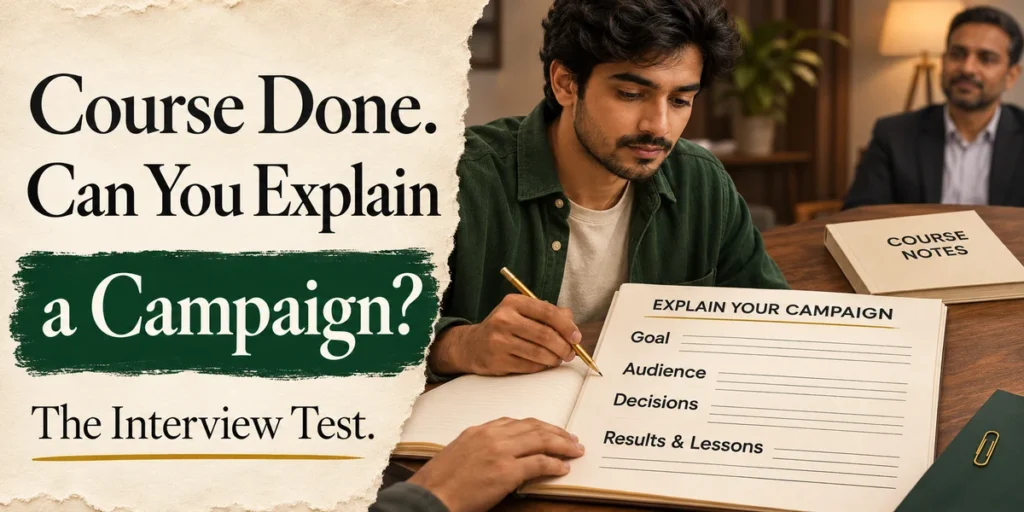
You finished the online course. You know the terms. You can define a funnel, a conversion, a cost per click. Then the interviewer asks one question. “Tell me about a campaign you ran.”
And you freeze. You did campaigns in class, but on shared accounts, with the trainer guiding you. You never had to explain one on your own.
This is one of the most common interview failures, and it is fixable. This post explains why it happens, and gives you a simple structure to answer the question well.
The short answer
You freeze because you never practised explaining your work out loud.
Knowing a campaign and explaining a campaign are different skills. The fix is to run one small campaign yourself, write it up, and practise a one-minute answer until it is natural.
Why the freeze happens
Three reasons. All of them common.
1. The work was not yours. Class campaigns often run on the institute’s accounts, with the trainer setting up the structure. You followed steps, but you did not own the decisions.
2. You never practised out loud. You wrote notes and passed tests, but you never said the answer to another person.
3. The question feels personal. When someone asks about your work, silence feels like failure. That pressure makes it harder to think.
The freeze is not a knowledge problem. It is a practice problem.
What interviewers actually want
They are not testing whether you remember definitions. They are testing three things.
- Can you do the work? Did you actually run something?
- Can you think? Do you understand why you made those choices?
- Can you communicate? Can you explain it clearly, under pressure?
A short, clear answer covers all three. A long, vague one covers none.
The 5-step answer structure
Here is a simple structure you can use for any campaign question.
- The situation. One line on who it was for and what the goal was.
- The action. Two or three lines on what you did.
- The result. One line with a number, even a small one.
- The learning. One line on what you would change.
- The offer. One line inviting a follow-up question.
Five steps. About one minute. That is the whole answer.
Here is an illustrative example. These numbers are invented for illustration.
| Step | Example |
| Situation | A local shop wanted more enquiries from Instagram |
| Action | I ran a small Meta campaign with two creatives and a small budget |
| Result | 12 enquiries in three weeks, better on the price-led creative |
| Learning | I would test the landing message next time |
| Offer | Happy to walk through the report if useful |
The numbers are illustrative. The structure is the point. Situation, action, result, learning, offer.
Before an interview, spend twenty minutes on Google’s Analytics 4 documentation. It will help you speak clearly about measurement, which is where most answers weaken.
The campaign explanation quiz: what would you fix?
Three short scenes. Pick your move before you scroll. Then read the answer.
Scene one. You did a campaign in class on a shared account. What do you say in the interview?
A. Describe it as your own campaign.
B. Describe a small campaign you ran on your own account.
C. Say you have not run one.
The smart move: B. Your own project is honest and explainable. A can unravel under follow-up questions. C undersells you.
Scene two. The interviewer asks why you chose that creative. You do not remember. What is the fix?
A. Guess.
B. Prepare one line of reasoning for each project before the interview.
C. Change the topic.
The smart move: B. Reasoning is what they want to hear. A is risky. C avoids the question.
Scene three. You have a result but it is small. What do you do?
A. Hide it.
B. Share it honestly and explain what you learned.
C. Invent a bigger number.
The smart move: B. Honest small results build trust. A looks evasive. C is a serious mistake.
Do you see the pattern? In every scene, the smart move is the same. Own the work, prepare the reasoning, and be honest about the result.
A real story about the freeze
A composite story, based on many real cases. A student, call him Arjun, finished an online course with good marks. He could define every term.
In his first interview, the campaign question came. He froze. He described the class campaign, but he could not answer the follow-up questions. Why that audience? What was the cost per result? What would you change?
He did not get the role. He told me, “Class mein sab aata tha, bolne mein nahi.” I knew everything in class, but I could not say it.
We fixed three things. He ran one small campaign on his own account. He wrote a five-line summary. He practised the one-minute answer out loud, ten times.
His next interview went well. He got the role.
That is the lesson. Explaining is a skill, and it needs practice.
How to prepare in one week
Here is a simple plan.
- Run one small campaign on your own account or a friend’s business.
- Write a five-line summary. Situation, action, result, learning, offer.
- Prepare one line of reasoning for the audience and the creative.
- Prepare one thing you would change.
- Record yourself saying the answer in one minute.
- Listen back and cut anything vague.
- Practise with a friend and take one question.
- Repeat until it feels natural.
One week. About two hours of practice. That is enough to stop the freeze.
Here is an illustrative example of what to cut from a weak answer. The details are invented for illustration.
| Weak answer | Stronger answer |
| “We did a campaign on social media and it went well.” | “A local shop wanted enquiries. I ran a small Meta campaign with two creatives. It got 12 enquiries in three weeks. Next time I would test the landing message.” |
The details are illustrative. The pattern is real. Specific beats vague.
Common mistakes candidates make
- Describing class exercises as personal projects.
- Giving a long answer with no result.
- Not knowing why they chose the audience or creative.
- Hiding small results.
- Never practising out loud.
- Freezing and then rushing to fill the silence.
What preparation cannot promise
Preparation cannot promise a job. It can make you clear, honest, and ready. The rest depends on the role and the market.
Svidya’s numbers are examples, not guarantees. 200+ students taught. A highest package of 9.8 LPA. Three free demo classes. The highest package is one person’s result. It is not a forecast for you.
Your action checklist
Print this. Use it before your next interview.
- Run one small campaign on your own account.
- Write the five-line summary.
- Write why you chose the audience and the creative.
- Write what you would change.
- Record a one-minute answer.
- Cut anything vague.
- Practise with a friend and take one follow-up question.
- Book the demo. At Svidya you get three free demo classes for the AI-Powered Marketing Course. Attend all three before you decide.
- Repeat until the answer feels natural.
Final words and your next step
You finished the online course. You know the terms. What you need now is one real campaign and one practised answer.
Use the five-step structure. Situation, action, result, learning, offer. Keep it to a minute. Be honest about the numbers.
You do not have to guess. Run one campaign and practise the answer out loud.
If you want structured practice and mock interviews, start with a free demo class at Svidya’s AI-Powered Marketing Course. Bring the checklist. Ask the awkward questions. Then decide, with proof in your hand and no pressure from anyone.
About the author
Shubhankar Vashist is the founder of SVidya, based in Delhi. He has 6+ years of marketing experience across healthcare, pharma, cosmetics, e-commerce and agencies. He teaches digital marketing by making students build real assets
FAQ
Why can’t I explain a campaign in an interview after finishing a course?
Usually because the class campaigns were on shared accounts and you never practised explaining the work out loud. Knowing a campaign and explaining it are different skills.
What should I say when asked about a campaign?
Use a five-step structure: situation, action, result, learning, and an offer to share more. Keep it to about one minute and be specific about the goal and the result.
Do I need my own campaign if I did one in class?
Yes. Interviewers ask follow-up questions, and class campaigns on shared accounts are hard to defend as your own. A small campaign on your own account is honest and easier to explain.
What if my campaign result was small?
Share it honestly and explain what you learned. Small, specific results build more trust than big, vague claims. Interviewers value clear thinking.
How do I practise for the interview?
Write a five-line summary, record a one-minute answer, cut anything vague, and practise with a friend who asks one follow-up question. Repeat until it feels natural.