
You want to learn SEO. Two roads. A certified course with a fee and a certificate. Or self-learning with free videos, blogs, and practice.
Both work. Both fail. The difference is not the road. It is whether you finish with proof.
Most people who self-learn stop halfway. Most people who take a course still finish without a portfolio, if the course is weak.
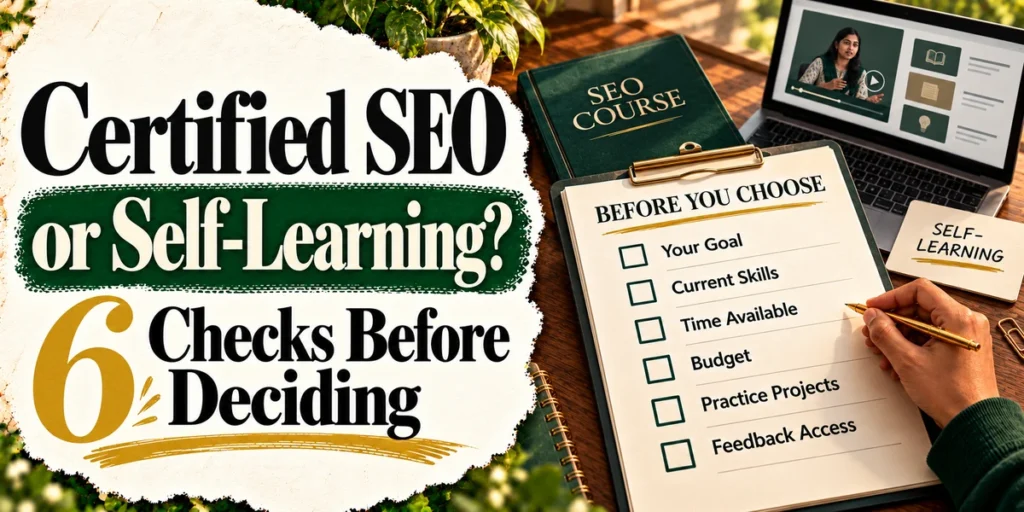
So the real question is not “which is better?” It is “which one gets me to proof, faster, given my habits?” Here are six checks to help you decide.
The short answer
Take a certified SEO course if you need structure, feedback, and a faster path to a portfolio. Self-learn if you are disciplined, already have a project, and can build proof alone.
Certificates matter less than proof. A recruiter will ask what you have ranked, not what you have framed.
What a certified SEO course gives you
A good course gives you four things self-learning struggles to match.
- Structure. A clear order. Basics, then technical, then content, then links.
- Feedback. Someone reviews your audit or your page and tells you what is wrong.
- Speed. You skip months of confusion, because someone has already mapped the path.
- A deadline. Fixed classes and projects force you to finish.
That last one matters more than most people admit. Deadlines are what turn learning into work.
What self-learning gives you
Self-learning has its own strengths, and they are real.
- Cost. Free or near-free. This matters if budget is tight.
- Independence. You learn to find answers, which is the actual job.
- Real practice. You can start a blog or a small site and learn from live data.
- Flexibility. You can go fast on easy topics and slow on hard ones.
- No waiting. You can start today, without a batch date.
But self-learning has a cost too, and it is not money. It is time and structure.
The 6 checks before you decide
Here is the practical part. Run these six checks on yourself, honestly, before you choose.
1. Can you finish things alone?
Be honest. Look at your last three attempts to learn something alone. Did you finish?
If the answer is no, a course with deadlines will help. If the answer is yes, self-learning is viable.
2. Do you already have a project?
Self-learning works best when you have a real site to practise on. A blog, a small business site, a friend’s shop.
If you have no project, a course with live sites and reviews gives you one. If you have a project, self-learning becomes much stronger.
3. Do you need feedback to improve?
SEO has many small mistakes. A noindex tag, a bad internal link, a thin page. Many beginners cannot see their own errors.
If you know you need feedback, a course with reviews is worth the fee. If you can find feedback elsewhere, for example in communities, self-learning can work.
4. How much is your time worth?
Self-learning takes longer, because you waste time on wrong paths. A course compresses that.
If your time is limited, a course can be cheaper in real terms. If you have plenty of time, self-learning is fine.
5. What is your goal?
If you want a job in SEO, proof and feedback matter most. A course with live reviews and a portfolio helps.
If you want to rank your own site, self-learning is often enough, because you learn from your own data.
6. What does the course actually give you?
Do not judge by the certificate. Judge by the projects, the reviews, and the tools.
Ask what you will build. Ask who reviews it. Ask if you will use Search Console and GA4 on real sites. If the answers are thin, the certificate is decoration.
The comparison quiz: course or self-learning?
Three short scenes. Pick your move before you scroll. Then read the answer.
Scene one. You have started five free courses and finished none. What do you do?
A. Start a sixth free course.
B. Choose a structured course with deadlines and reviews.
C. Give up on SEO.
The smart move: B. If you do not finish alone, structure helps. A repeats the pattern. C is too fast.
Scene two. You already run a blog and want to rank it. What fits you best?
A. A full certified course, because certificates matter.
B. Self-learning with Search Console, plus a short course if you get stuck.
C. Nothing. SEO cannot be learned.
The smart move: B. You have a project and a feedback loop in your own data. A may be useful but is not always needed. C is wrong.
Scene three. A course promises a certificate but no projects and no reviews. What do you do?
A. Take it. The certificate will help.
B. Ask about projects and reviews, and look elsewhere if the answers are thin.
C. Assume all courses are like this.
The smart move: B. A certificate without proof is weak. A trusts paper. C gives up too early.
Do you see the pattern? In every scene, the smart move is the same. Choose the path that gets you to proof and feedback.
A real story about two learners
A composite story, based on many real cases. Two people wanted to learn SEO in Delhi.
Kabir self-learned. He started a small blog about local events. He used Search Console daily, made mistakes, and fixed them. It took him eight months, but he ranked a few pages and had real proof.
Ananya took a certified course. She had projects and reviews. She finished in four months with three audits and a portfolio.
Both got interviews. Kabir’s story was stronger in the room, because he had ranked real pages. Ananya got there faster.
The lesson is not that one path is better. It is that both need proof. Kabir’s proof came from his own site. Ananya’s came from her course projects.
Without proof, neither path works. With proof, both do.
Common mistakes learners make
- Collecting certificates instead of building projects.
- Starting a free course and stopping at week two.
- Practising only on theory, never on a real site.
- Ignoring Search Console, the free tool that teaches the most.
- Choosing a course for the certificate, not the projects and reviews.
- Never asking for feedback, even when it is available.
What neither path can promise
Neither a certified SEO course nor self-learning can promise a job or a ranking. Results depend on your proof, your practice, and the market.
Svidya’s numbers are examples, not guarantees. 200+ students taught. A highest package of 9.8 LPA. Three free demo classes. The highest package is one person’s result. It is not a forecast for you.
What a good course can do is give you structure, reviews, and projects. What self-learning can do is build independence and real proof, if you finish.
Your action checklist
Print this. Use it before you decide.
- Check your last three attempts to learn alone. Did you finish?
- List any real site you can practise on.
- Decide whether you need feedback to improve.
- Estimate your available time each week.
- Write your goal. A job, or ranking your own site?
- Ask any course what you will build and who reviews it.
- Book the demo. At Svidya you get three free demo classes for the AI-Powered Marketing Course. Attend all three before you decide.
- Choose the path that gets you to proof, not the one that looks more impressive.
Final words and your next step
Certified SEO course or self-learning? The honest answer depends on your habits, your time, and your goal.
If you finish things alone and have a site, self-learning works. If you need structure and feedback, a course saves months. Either way, the certificate is not the point. The proof is.
You do not have to guess. Run the six checks. Then choose.
If you are in Delhi and want structure with real projects, start with a free demo class at Svidya’s AI-Powered Marketing Course. Bring the checklist. Ask the awkward questions. Then decide, with proof in your hand and no pressure from anyone.
About the author
Shubhankar Vashist is the founder of SVidya, based in Delhi. He has 6+ years of marketing experience across healthcare, pharma, cosmetics, e-commerce and agencies. He teaches digital marketing by making students build real assets.
FAQ
Is a certified SEO course better than self-learning?
Not always. A course helps if you need structure, feedback, and a faster path to a portfolio. Self-learning works if you are disciplined and have a real site to practise on. The certificate matters less than proof.
Do employers care about SEO certificates?
Most care more about proof. They want to see pages you have ranked, audits you have done, and how you think. A certificate can help in some cases, but it rarely replaces a portfolio.
Can I learn SEO for free?
Yes. Google’s Search Essentials and Search Console documentation are free and reliable. Combine them with a real site, and you can learn a lot. What free resources rarely give you is feedback on your work.
How long does it take to learn SEO?
It varies. With a structured course and reviews, some learners build a portfolio in a few months. Self-learning often takes longer, because you spend time on wrong paths.
What should I check before paying for an SEO course?
Ask what you will build, who reviews it, which tools you will use, and how you will be assessed. If the answers are vague, the certificate is likely decoration. Check the projects, not the paper.