
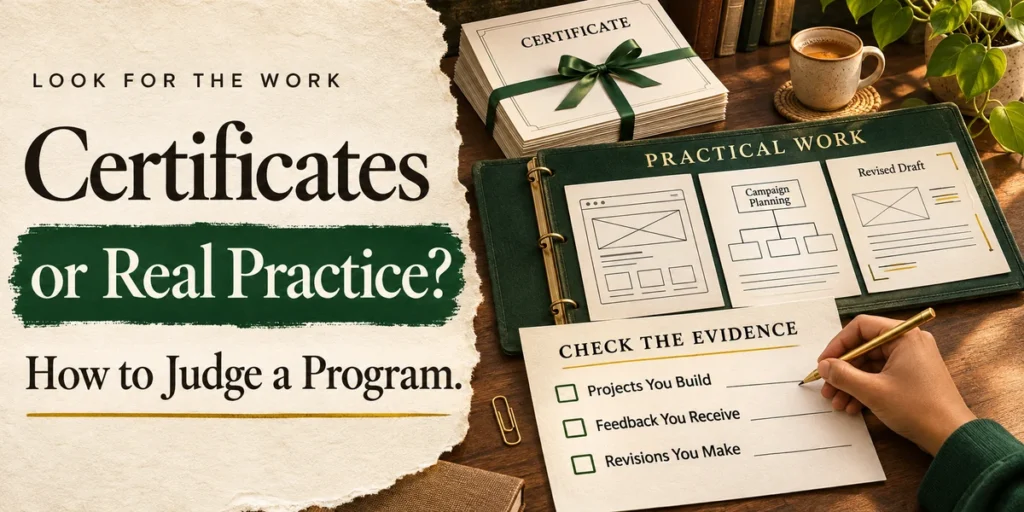
Two programs. Both promise a certificate. Both look similar on the website.
One teaches you to do the work. The other teaches you to pass a test, then hands you paper.
The difference is not always obvious from the outside. That is why you need a way to judge.
This post compares a certification mill vs hands-on practice, and gives you seven checks to judge any program before you pay.
The short answer
A certification mill gives you a certificate and little else. A hands-on program gives you projects, feedback, and a portfolio.
The fastest test is simple. Ask what you will build by week four. A mill answers with modules. A hands-on program answers with projects.
What a certification mill looks like
A certification mill is built around completion, not skill. Here is what it usually looks like.
- Recorded videos. The whole course is pre-recorded.
- Multiple-choice tests. You pass by remembering definitions.
- A certificate at the end. The main output is paper.
- No live reviews. Nobody looks at your work.
- No portfolio. You finish with notes and a certificate.
Mills are not always dishonest. Some are cheap and quick. But they do not build skill, and they do not prepare you for interviews.
What hands-on practice looks like
A hands-on program is built around doing the work. Here is what it usually looks like.
- Live classes. A trainer, in the room, with real accounts.
- Projects. A website, a campaign, an audit, a report.
- Live reviews. Someone reviews your work and tells you what to fix.
- Assessment by output. You are graded on what you built, not what you memorised.
- A portfolio. You finish with something to show.
Hands-on programs cost more to run, because trainer time and real projects cost money. That is why mills are cheaper.
The comparison, in numbers
Here is an illustrative example. These numbers are invented for illustration.
| Factor | Certification mill | Hands-on program |
| Live classes | Rare | Regular |
| Projects | 0 to 1 | 3 or more |
| Reviews | None | Weekly or biweekly |
| Assessment | MCQ test | Campaign and report |
| Portfolio | None | Yes |
| Interview readiness | Low | Higher |
The numbers are illustrative. The pattern is the point. Mills optimise for completion. Hands-on programs optimise for skill.
The 7 checks to judge a program
Here is the practical part. Run these seven checks on any program.
1. What will you build by week four?
This is the fastest test. A hands-on program has a named project by week four. A mill has modules.
What to check. Ask for the project list in writing.
2. Are classes live or recorded?
Recordings are fine as a supplement. They are not enough on their own.
What to check. Ask what share of the course is live, and whether the trainer opens real tools.
3. Who reviews your work?
Reviews are where skill is built. A mill has no reviews. A hands-on program has regular ones.
What to check. Ask who reviews, how often, and for an example.
4. How are you assessed?
A multiple-choice test checks memory. A campaign and report check skill.
What to check. Ask for the assessment method in writing.
5. Which tools will you use, by name?
GA4, Google Ads, Meta Ads Manager, Search Console, Canva. Names, not phrases.
What to check. Ask for the tool list in writing.
6. What does the certificate actually certify?
Some certificates are recognised. Many are not. Ask what the certificate is, and who issues it.
What to check. Ask whether it is an internal certificate or an external one.
7. Can you talk to a past student?
One conversation tells you more than the website.
What to check. Ask what they built, and what they would change.
The certification mill quiz: would you catch it?
Three short scenes. Pick your move before you scroll. Then read the answer.
Scene one. A program promises a certificate and says nothing about projects. What do you ask?
A. “Is the certificate recognised?”
B. “What will I build by week four?”
C. “How much is the fee?”
The smart move: B. Projects are the proof of hands-on practice. A is a fair question but misses the gap. C comes later.
Scene two. A course is fully recorded, with a multiple-choice test. What is it likely to be?
A. A hands-on program.
B. A certification mill.
C. A hybrid program.
The smart move: B. Recorded only, tested by MCQ, no reviews. That is a mill pattern. A and C do not match the description.
Scene three. A program says “real projects” but cannot name one. What do you do?
A. Trust it. It sounds practical.
B. Ask for the project list in writing before you pay.
C. Assume the course is fake.
The smart move: B. Named projects are proof. A trusts a phrase. C is too fast, because the program may simply be vague.
Do you see the pattern? In every scene, the smart move is the same. Ask what you will build, and get it in writing.
A real story about a mill
A composite story, based on many real cases. A student, call him Yash, paid for a program that promised a certificate in six weeks. It was fully recorded. The test was multiple choice.
He passed. He got the certificate. He applied to ten roles and got no interviews.
The interviews he did get asked the same question. “Show me something you built.” He had nothing.
Yash told me, “Certificate mila, kaam nahi.” I got the certificate, not the work.
Six months later, he joined a hands-on program with three projects and weekly reviews. He got interviews within two months.
That is the lesson. A certificate is not proof. A portfolio is.
How to judge a program in one call
Here is a simple script you can use.
“Before I decide, I want to ask three things. First, what will I build by week four and by the end? Second, who reviews my work, and how often? Third, how am I assessed, and which tools will I use, by name?”
Three questions. A hands-on program answers all three clearly. A mill gives vague answers or changes the topic.
Here is an illustrative example of the difference. These details are invented for illustration.
| Question | Mill answer | Hands-on answer |
| What will I build by week four? | “You will learn many modules” | “A live audit of a small site” |
| Who reviews my work? | “Feedback is available” | “Weekly, with a trainer” |
| How am I assessed? | “Final MCQ test” | “Campaign and written report” |
The details are illustrative. The pattern is real. Specific answers mean a real program.
Before you call, spend twenty minutes on Google’s Search Essentials and the GA4 documentation. It will help you judge whether the program teaches real skills or just names them.
Common mistakes students make
- Choosing a program for the certificate alone.
- Not asking what they will build.
- Accepting recorded-only classes as a full course.
- Ignoring the assessment method.
- Not asking who reviews the work.
- Never talking to a past student.
What no program can promise
No program can promise a job. A hands-on program improves your odds by giving you proof. The rest depends on your work and the market.
Svidya’s numbers are examples, not guarantees. 200+ students taught. A highest package of 9.8 LPA. Three free demo classes. The highest package is one person’s result. It is not a forecast for you.
Your action checklist
Print this. Use it on every program.
- Ask what you will build by week four and by the end.
- Ask what share of the course is live.
- Ask who reviews your work, and how often.
- Ask how you will be assessed.
- Ask for the tool list, by name.
- Ask what the certificate actually certifies.
- Talk to one past student.
- Book the demo. At Svidya you get three free demo classes for the AI-Powered Marketing Course. Attend all three before you decide.
- Decide on projects and reviews, not on paper.
Final words and your next step
Certification mill vs hands-on practice is easy to tell apart once you ask the right questions.
Ask what you will build. Ask who reviews it. Ask how you will be assessed. A mill gives vague answers. A hands-on program gives specifics.
You do not have to guess. Ask three questions on the call.
If you want projects, reviews, and real tools from week one, start with a free demo class at Svidya’s AI-Powered Marketing Course. Bring the checklist. Ask the awkward questions. Then decide, with proof in your hand and no pressure from anyone.
About the author
Shubhankar Vashist is the founder of SVidya, based in Delhi. He has 6+ years of marketing experience across healthcare, pharma, cosmetics, e-commerce and agencies. He teaches digital marketing by making students build real assets
FAQ
What is a certification mill?
A certification mill is a program built around completion rather than skill. It usually relies on recorded videos and multiple-choice tests, with no live reviews or portfolio work. The main output is a certificate.
How do I tell a certification mill from a hands-on program?
Ask what you will build by week four, who reviews your work, and how you will be assessed. A hands-on program gives specific answers about projects, reviews, and campaign-based assessment. A mill stays vague.
Is a certificate worthless?
Not always. Some certificates are recognised and can help. But a certificate alone rarely gets you a job. Proof of work, like projects and a portfolio, matters more.
Do hands-on programs cost more?
Usually yes, because they involve live teaching, real projects, and reviews. That cost buys skill and proof. A cheaper mill may cost you more later if you need a second course.
Can I learn hands-on skills without a program?
Yes, by building your own projects and asking for feedback from seniors or communities. A good program speeds this up with structure and reviews.