
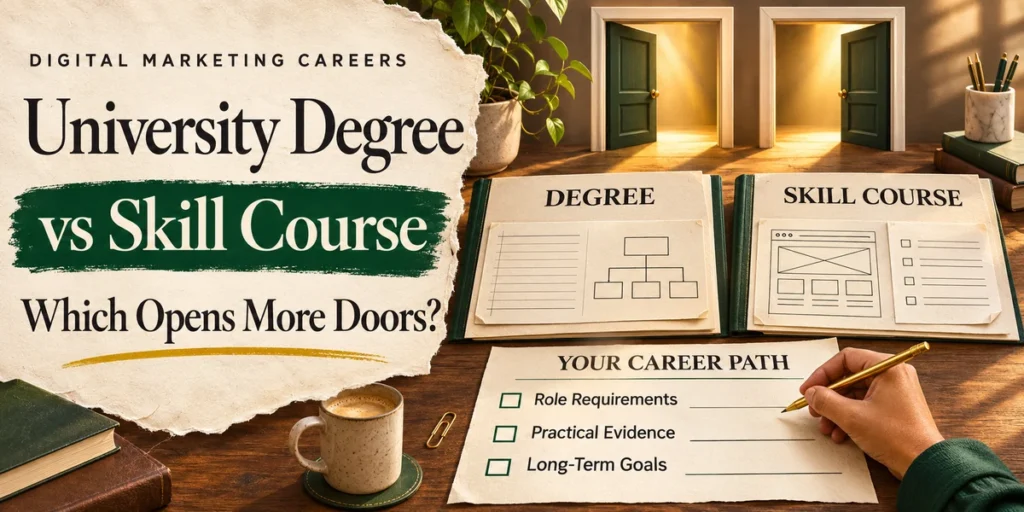
One path takes three years. The other takes a few months. One gives you a degree. The other gives you a portfolio.
Both claim to open doors in digital marketing. And students keep asking the same question. Which one actually works?
The honest answer is that they open different doors, at different stages. This post compares a university degree vs a skill based course for digital marketing, fairly, and shows you how to choose.
The short answer
A skill-based course opens the first door faster. A university degree opens some later doors wider.
For entry-level digital marketing roles, proof of work matters most. For some larger companies, government roles, or long-term management paths, a degree still helps.
Choose based on the door you want first.
What a university degree gives you
A degree is a long, structured path. Here is what it does well.
- A recognised qualification. Some employers filter by degree.
- Breadth. Marketing theory, business, economics, and communication.
- Campus placement. Access to recruiters who visit the campus.
- Time to mature. Three years to build understanding and networks.
- Long-term options. Some management and government roles require a degree.
The cost is time and money. Three years is a long commitment, and the syllabus may lag behind current tools.
What a skill-based course gives you
A skill-based course is short and practical. Here is what it does well.
- Speed. Months, not years.
- Tools and practice. GA4, ads platforms, and real projects.
- A portfolio. Proof you can show in interviews.
- Lower cost. Usually much less than a degree.
- Current content. Tools and AI workflows that are used now.
The limitation is depth and recognition. Some employers still prefer a degree, and a short course does not replace years of education.
The comparison, in numbers
Here is an illustrative example. These numbers are invented for illustration.
| Factor | University degree | Skill-based course |
| Duration | 3 years | 4 to 6 months |
| Cost | Higher | Lower |
| Portfolio | Limited | Strong |
| Tools | Often outdated | Current |
| Recognition | High | Varies |
| Speed to first job | Slower | Faster |
The numbers are illustrative. The pattern is the point. The degree gives recognition and time. The course gives speed and proof.
Which opens more doors, and when
Here is the honest breakdown.
Entry-level digital marketing roles. A skill-based course with a portfolio opens more doors. Most fresher interviews focus on what you have built.
Larger companies with strict filters. A degree can help you pass the first filter. But the interview still tests skills.
Government and public sector roles. A degree is often required. A short course may not be enough.
Long-term management roles. A degree can help later, especially for senior positions.
Freelancing. Clients care about results, not degrees. A portfolio matters more.
So the answer depends on the door. For the first job in digital marketing, skills and proof usually win. For some later doors, the degree still counts.
The 7 checks before you choose
Here is the practical part. Run these seven checks before you decide.
1. What is your target role?
Look at five job posts for the role you want. Note whether they ask for a degree, and what skills they list.
What to check. If most ask for a degree, factor that in.
2. How soon do you need income?
A degree takes years. A course takes months. If you need to earn soon, speed matters.
What to check. Be honest about your savings and family expectations.
3. Do you already have a degree?
If you already have a degree in another field, a skill-based course may be enough. If you have no degree at all, consider the long-term doors.
What to check. List the roles that require a degree and whether they matter to you.
4. Can you build a portfolio?
A course gives you projects. A degree may not. Either way, the portfolio is what gets you interviews.
What to check. Ask what you will build, and by when.
5. What does the course actually teach?
Not all skill-based courses are good. Some are thin. Check projects, reviews, and tools.
What to check. Ask for the syllabus and project list in writing.
6. What does the degree actually teach?
Some degrees are theoretical and slow to update. Check whether the syllabus includes current tools and practical work.
What to check. Ask about projects, internships, and placement support.
7. Can you combine both?
Some students do a degree and add a skill-based course alongside. That gives recognition and proof.
What to check. Ask whether the course fits around your degree schedule.
The degree vs course quiz: which door do you want?
Three short scenes. Pick your move before you scroll. Then read the answer.
Scene one. You want a digital marketing job within a year. Which path fits?
A. A three-year degree.
B. A skill-based course with real projects.
C. Neither. Wait.
The smart move: B. Speed and proof matter for an entry-level role. A delays. C avoids the decision.
Scene two. You want a government marketing role that requires a degree. What do you do?
A. Take a short course and apply anyway.
B. Check the requirement, and consider a degree if it is mandatory.
C. Give up on the role.
The smart move: B. Requirements matter. A may waste time. C is too fast.
Scene three. You already have a degree in another field. What is your best next step?
A. Another degree.
B. A skill-based course with a portfolio.
C. Nothing. The degree is enough.
The smart move: B. You already have recognition. What you need now is proof. A adds years. C leaves a skills gap.
Do you see the pattern? In every scene, the smart move is the same. Match the path to the door you want first.
A real story about two paths
A composite story, based on many real cases. Two friends wanted digital marketing careers.
One did a three-year degree. She learned theory, did an internship, and graduated with a campus placement. It took time, but the door opened.
The other did a four-month skill-based course. She built three projects and started applying in month five. She got a role at a small agency.
Both are working now. The degree holder earns more today, four years later. The course holder started earning three years earlier.
Neither path was wrong. They chose different doors, at different times.
That is the lesson. The question is not which path is better. It is which door you want first.
Common mistakes students make
- Assuming a degree alone gets a digital marketing job.
- Assuming a short course replaces a degree everywhere.
- Choosing a course without checking projects and reviews.
- Choosing a degree without checking whether the syllabus is current.
- Ignoring the time cost of a degree.
- Never building a portfolio on either path.
What neither path can promise
Neither a degree nor a course can promise a job. Hiring depends on your portfolio, your interview, and the market.
Svidya’s numbers are examples, not guarantees. 200+ students taught. A highest package of 9.8 LPA. Three free demo classes. The highest package is one person’s result. It is not a forecast for you.
Your action checklist
Print this. Use it before you decide.
- Write your target role.
- Check five job posts. Do they ask for a degree?
- Be honest about how soon you need income.
- Note whether you already have a degree.
- Ask each course what you will build, and when.
- Ask about projects, reviews, and tools.
- Consider combining a degree with a short course.
- Book the demo. At Svidya you get three free demo classes for the AI-Powered Marketing Course. Attend all three before you decide.
- Choose based on the door you want first.
Final words and your next step
University degree vs skill-based course is not a battle. It is a timing question.
A course opens the first door faster. A degree opens some later doors wider. Many people eventually need both.
You do not have to guess. Decide which door you want first, then choose the path that opens it.
If you want to open the first door with real projects and reviews, start with a free demo class at Svidya’s AI-Powered Marketing Course. Bring the checklist. Ask the awkward questions. Then decide, with proof in your hand and no pressure from anyone.
About the author
Shubhankar Vashist is the founder of SVidya, based in Delhi. He has 6+ years of marketing experience across healthcare, pharma, cosmetics, e-commerce and agencies. He teaches digital marketing by making students build real assets
FAQ
Is a university degree better than a skill-based course for digital marketing?
Neither is universally better. A degree gives recognition and opens some later doors. A skill-based course gives speed and a portfolio, which matter most for entry-level roles. Choose based on the door you want first.
Can I get a digital marketing job with only a short course?
Yes, if the course gives you real projects and a portfolio. Most entry-level interviews focus on what you have built. A short course with strong proof can open the first door.
Do employers require a degree for digital marketing roles?
Some do, especially larger companies and government roles. Many entry-level roles hire for skills and proof. Check five job posts for your target role to see the pattern.
Should I do a degree and a course together?
Some students do. A degree gives recognition, and a short course gives current skills and a portfolio. Check whether the course schedule fits around your degree.
Which path is faster to a first job?
A skill-based course is usually faster, because it focuses on tools and projects. A degree takes years but can open different doors later.