
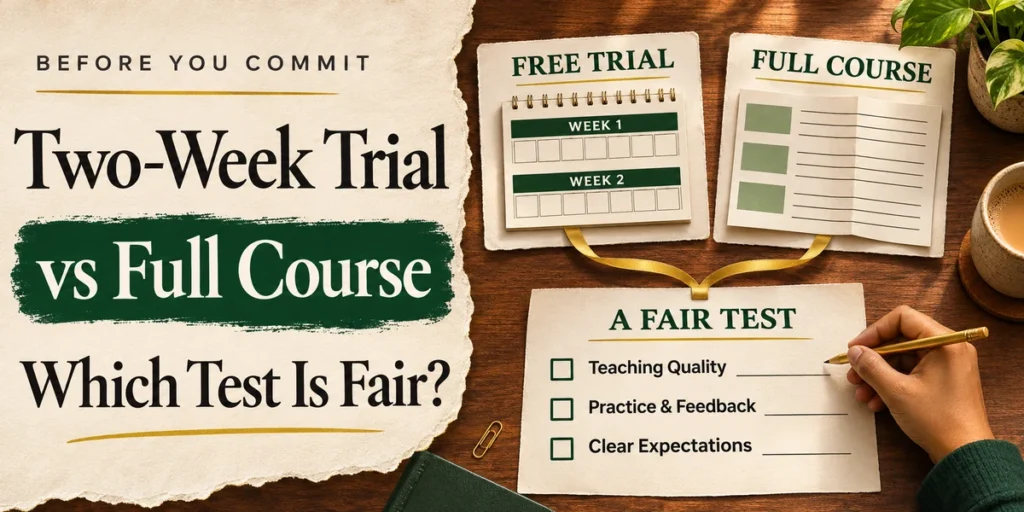
Some institutes offer a free trial. Two weeks. Attend classes, see the teaching, decide later. Others ask for a commitment upfront. Pay, enrol, start. No trial.
Both approaches claim to be fair to students. Both can be. Both can also be unfair, in different ways.
This post compares a two-week free trial vs full course commitment, honestly, and shows you how to judge which test is actually fair.
The short answer
A free trial is fair if it shows you real teaching, real tools, and real reviews. A commitment is fair if the terms are clear and the refund policy is honest.
The question is not which format is better. It is whether the test lets you see the real course before you are locked in.
Why this comparison matters
A course is a big decision. Money, months, and career direction.
You want a fair test before you commit. But a test can be designed to look good, just like a brochure.
So the real question is this. Does the trial show you the actual course, or a polished version of it?
What a two-week free trial gives you
A trial is a low-risk way to test the course. Here is what it does well.
- Low financial risk. You can see the teaching before paying.
- A real feel for the trainer. You meet the person who will teach you.
- A test of the batch timing. You can check whether you can actually attend.
- A view of the tools. You can see whether live accounts are used.
- A chance to ask questions. Without commitment, you can be honest.
The risk is that a trial shows the best two weeks, then the course changes.
What a full course commitment gives you
A commitment is a clear decision. You pay, you start, you finish. Here is what it does well.
- Structure from day one. No hesitation, no delay.
- A full plan. You know the whole path, not just two weeks.
- Deeper immersion. You are fully in, which helps some learners.
- Often better value. Some institutes offer lower fees or extra support for committed students.
The risk is that you commit before you know the teaching. If it is weak, you have paid.
The trade-off, in numbers
Here is an illustrative example. These numbers are invented for illustration.
| Factor | Two-week trial | Full commitment |
| Upfront cost | Rs 0 | Rs [X] |
| Risk if teaching is weak | Low | High |
| Time to decide | 2 weeks | Before paying |
| Depth of exposure | Partial | Full |
| Refund options | Usually none needed | Depends on policy |
The numbers are illustrative. The pattern is the point. A trial lowers the risk but shows less. A commitment shows more but asks for trust first.
The 7 checks for a fair test
Here is the practical part. Run these seven checks on any trial or commitment offer.
1. Does the trial show real teaching?
A fair trial puts you in a real class, with the real trainer. Not a special “demo” session designed for marketing.
What to check. Ask whether you will attend an actual batch class.
2. Are real tools used?
A fair trial shows live tools. GA4, Meta Ads Manager, Search Console. Not just slides.
What to check. Watch for a live account, not a screenshot.
3. Is the trial two weeks of real work?
A trial that only lets you watch is weaker than one where you build something.
What to check. Ask whether you will complete a small project during the trial.
4. What happens at the end of the trial?
A fair trial has a clear next step. No pressure, no sudden fee change.
What to check. Ask what happens after week two, and whether the fee is fixed.
5. Is the commitment terms clear?
If you commit, the terms should be in writing. Fee, duration, projects, reviews, and refund policy.
What to check. Ask for the terms in writing before you pay.
6. Is there a refund policy?
A commitment is fairer with a clear refund policy. Even a partial one.
What to check. Ask for the policy in writing, including the conditions.
7. Can you talk to a past student?
One honest conversation tells you more than a trial or a brochure.
What to check. Ask for one past student contact, or find one yourself.
The trial vs commitment quiz: which is fairer?
Three short scenes. Pick your move before you scroll. Then read the answer.
Scene one. A trial lets you watch classes but not build anything. What do you think?
A. It is fair. Watching is enough.
B. It is a partial test. Ask whether you can build a small project.
C. It is a scam.
The smart move: B. Watching shows teaching, but building shows the real work. A accepts too little. C is too strong.
Scene two. A course asks for full payment with no refund policy. What do you do?
A. Pay. It is normal.
B. Ask for the refund policy in writing before you pay.
C. Walk away immediately.
The smart move: B. A clear policy protects you. A is risky. C is understandable but you can ask first.
Scene three. A trial shows a special demo class, not a real batch. What is the issue?
A. None. A demo is a demo.
B. You are seeing a polished version, not the real course.
C. It is better than a real class.
The smart move: B. A special demo can hide the real teaching. A misses the point. C is not true.
Do you see the pattern? In every scene, the smart move is the same. Ask whether the test shows the real course.
A real story about a fair trial
A composite story, based on many real cases. A student, call her Meera, joined a two-week trial. She attended real batch classes, built a small project, and got one review.
By week two, she knew the trainer’s style, the batch size, and the review quality. She enrolled with confidence.
Her friend joined a course with no trial. The demo was polished. The real classes were different. The trainer read from slides.
Meera told me, “Trial ne sach dikhaya.” The trial showed me the truth.
That is the lesson. A fair test shows the real course, not a special version.
What a fair trial should look like
Here is a simple standard.
- Real batch class. Not a special demo.
- Real trainer. The one who will teach you.
- Real tools. Live accounts.
- One small project. So you build something.
- One review. So you see the feedback quality.
- Clear next step. No pressure, fixed fee.
- Past student contact. So you can verify.
Seven points. If a trial meets most of them, it is a fair test.
Before you start a trial, spend twenty minutes on Google’s Search Essentials and the GA4 documentation. It will help you judge whether the class is teaching real skills.
Common mistakes students make
- Accepting a polished demo as a real class.
- Not asking whether you can build anything during the trial.
- Committing without a written refund policy.
- Not checking the fee after the trial ends.
- Skipping the past student conversation.
- Assuming a trial is always fair, or a commitment always unfair.
What neither format can promise
Neither a trial nor a commitment can promise a job. They are ways to test and start. The teaching and your work decide the outcome.
Svidya’s numbers are examples, not guarantees. 200+ students taught. A highest package of 9.8 LPA. Three free demo classes. The highest package is one person’s result. It is not a forecast for you.
Your action checklist
Print this. Use it before you decide.
- Ask whether the trial is a real batch class.
- Check whether live tools are used.
- Ask whether you can build a small project.
- Ask what happens after the trial, and whether the fee is fixed.
- Ask for the commitment terms in writing.
- Ask for the refund policy in writing.
- Talk to one past student.
- Book the demo. At Svidya you get three free demo classes for the AI-Powered Marketing Course. Attend all three before you decide.
- Choose based on what the test actually shows.
Final words and your next step
Two-week free trial vs full course commitment is not a simple choice. It depends on what the test shows.
A fair trial shows real classes, real tools, and real feedback. A fair commitment has clear terms and an honest refund policy.
You do not have to guess. Ask whether the test shows the real course.
If you are in Delhi and comparing options, start with a free demo class at Svidya’s AI-Powered Marketing Course. Bring the checklist. Ask the awkward questions. Then decide, with proof in your hand and no pressure from anyone.
About the author
Shubhankar Vashist is the founder of SVidya, based in Delhi. He has 6+ years of marketing experience across healthcare, pharma, cosmetics, e-commerce and agencies. He teaches digital marketing by making students build real assets
FAQ
Is a two-week free trial better than committing to a full course?
It depends on what the trial shows. A fair trial with real classes, live tools, and a small project is a strong test. A polished demo is not. A commitment can be fair if the terms and refund policy are clear.
What should a fair free trial include?
Real batch classes with the actual trainer, live tools, one small project, one review, a clear next step with a fixed fee, and a chance to talk to a past student.
Should I pay for a course with no refund policy?
Be careful. A clear refund policy, even a partial one, protects you. Ask for it in writing before you pay, and check the conditions.
How do I know if a demo class is real?
Ask whether you will attend an actual batch class with the trainer who will teach you. A special demo session can be polished and may not reflect the real course.
Can a trial guarantee the course is good?
No. A trial shows teaching and tools, but your results depend on your work and the market. Use the trial to check quality, then decide with clear terms.