
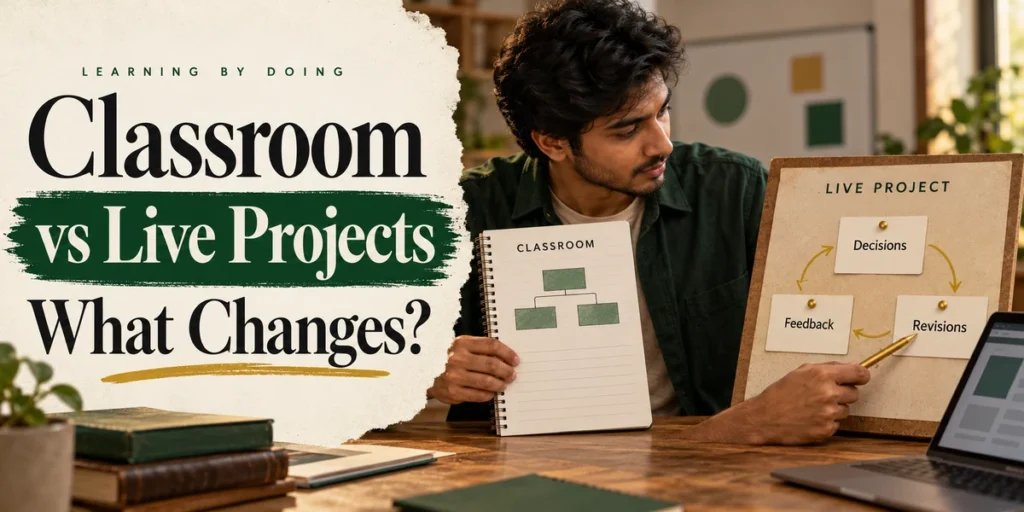
In a classroom, everything is clear. The trainer explains a concept. You take notes. The example works. You feel like you understand.
Then you work on a live project. The data has gaps. The client changes the brief. Nothing works the first time.
This is the difference between classroom learning and live projects. Not just harder. Different in kind.
This post explains what changes, why it matters, and how to get the most from both.
The short answer
A classroom teaches you the method. A live project teaches you the job.
Classroom learning gives you clean examples and clear steps. Live projects give you messy data, real deadlines, and problems nobody warned you about. You need both, in the right order.
What a classroom gives you
A classroom is a controlled space. That is its strength.
- Clear explanations. Concepts are broken down step by step.
- Clean examples. The data behaves. The campaign works.
- Guided practice. Someone is there when you get stuck.
- A shared pace. You move with the batch, which keeps you consistent.
- A safe place to be wrong. A mistake in class costs nothing.
For a beginner, this is valuable. You cannot run a campaign before you understand what a campaign is.
What a live project gives you
A live project is the opposite. It is messy, and that is the point.
- Real constraints. A small budget, a tight deadline, a vague brief.
- Messy data. Missing events, broken tracking, numbers that do not add up.
- Real consequences. The work is seen by someone outside the classroom.
- Decision pressure. You have to choose, not just follow steps.
- A portfolio piece. Something you can show and explain.
Live projects are where classroom knowledge becomes skill.
What changes when you move to live projects
Here are the main changes. Each one is worth knowing before you start.
1. The problem is not given to you
In class, the question is on the slide. In a live project, you have to find the real problem first.
What changes. You spend more time asking questions and less time following steps.
2. The data fights back
In class, the numbers are clean. In a live project, tracking breaks, events go missing, and two tools show different results.
What changes. You learn to check, verify, and explain gaps, not just read numbers.
3. Nobody tells you when to stop
In class, the trainer says when the exercise is done. In a live project, you decide when it is good enough.
What changes. You learn judgment, which is harder than knowledge.
4. The feedback is about outcomes, not steps
In class, feedback is about whether you followed the method. In a live project, feedback is about whether it worked.
What changes. You learn to defend your choices, not just repeat them.
5. Your work becomes public
In class, your work stays in the room. In a live project, it goes into a portfolio, or in front of a client.
What changes. You learn to present, explain, and take questions.
The classroom vs live projects quiz: what is this situation?
Three short scenes. Pick your move before you scroll. Then read the answer.
Scene one. The trainer gives you clean data and a clear brief. What kind of learning is this?
A. Live project.
B. Classroom exercise.
C. Portfolio review.
The smart move: B. Clean data and a clear brief are classroom conditions. A involves messy data and real constraints. C is about feedback.
Scene two. Your campaign data has gaps and you have to find out why. What kind of learning is this?
A. Classroom exercise.
B. Live project.
C. A test.
The smart move: B. Finding gaps is a live-project skill. A usually has clean data. C checks memory, not problem-solving.
Scene three. You have to explain your work to a client who asks hard questions. What is this?
A. A classroom quiz.
B. A live project review.
C. A brochure.
The smart move: B. Explaining work under questions is a live-project skill. A is graded work, not a client conversation. C is not learning at all.
Do you see the pattern? In every scene, the smart move is the same. Know which kind of learning you are in, and what it is teaching you.
A real story about the shift
A composite story, based on many real cases. A student, call her Sneha, did well in class. Clean exercises, good marks, confident notes.
Then she joined a live project for a small local business. The tracking was broken. The brief changed twice. She felt lost for a week.
Her trainer told her something simple. “Class mein method seekha. Project mein judgment seekhna hai.” In class you learned the method. In the project you learn judgment.
She slowed down, asked more questions, and fixed the tracking. The project took longer than expected, but she finished it. It became her strongest portfolio piece.
Sneha told me, “Class easy tha, project asli tha.” Class was easy. The project was real.
That is the lesson. Both are necessary. They teach different things.
How to get the most from both
Here is a simple approach.
- Learn the method in class. Take notes on the steps, not just the outcome.
- Repeat one exercise on your own account. See what breaks when you do it alone.
- Move to a live project as soon as you can. Even a small one, for a local shop.
- Expect messy data. Build the habit of checking before you report.
- Ask for feedback on outcomes, not steps. “Did this work?” matters more than “Did I follow the method?”
- Write up every project. Problem, goal, action, result, learning.
- Keep both habits. Class for new skills, projects for judgment.
Here is an illustrative example of how the two compare. These numbers are invented for illustration.
| What changes | Classroom | Live project |
|---|---|---|
| Data quality | Clean | Messy |
| Brief | Clear | Vague or changing |
| Feedback | On steps | On outcomes |
| Deadline | Set by trainer | Set by client or you |
| Output | Exercise | Portfolio piece |
The numbers are illustrative, but the pattern is real. Classroom is controlled. Live projects are not. That is why both matter.
Before you start a project, spend twenty minutes on Google’s Search Essentials and the GA4 documentation. Both are free, and both help you read real data more confidently.
Common mistakes students make
- Staying in classroom mode, waiting for instructions on a live project.
- Expecting clean data and freezing when it is messy.
- Treating feedback on steps as feedback on outcomes.
- Never moving from exercises to real projects.
- Skipping the write-up, so the project is not usable as proof.
- Avoiding projects because they feel uncomfortable.
What neither format can promise
Neither classroom learning nor live projects can promise a job. Together, they give you method and judgment, which is what interviews test.
Svidya’s numbers are examples, not guarantees. 200+ students taught. A highest package of 9.8 LPA. Three free demo classes. The highest package is one person’s result. It is not a forecast for you.
Your action checklist
Print this. Use it as you move from class to projects.
- Take notes on the method, not just the result.
- Repeat one class exercise on your own account.
- Start one small live project this month.
- Expect messy data and check before you report.
- Ask for feedback on outcomes.
- Write up the project in five sections.
- Book the demo. At Svidya you get three free demo classes for the AI-Powered Marketing Course. Attend all three before you decide.
- Keep learning new methods in class while you work on projects.
Final words and your next step
Classroom learning vs live projects is not a competition. It is a sequence.
Class gives you the method. Projects give you judgment. You need both, and the order matters.
You do not have to guess. Learn the method, then apply it to something real.
If you want structure plus live projects and reviews, start with a free demo class at Svidya’s AI-Powered Marketing Course. Bring the checklist. Ask the awkward questions. Then decide, with proof in your hand and no pressure from anyone.
About the author
Shubhankar Vashist is the founder of SVidya, based in Delhi. He has 6+ years of marketing experience across healthcare, pharma, cosmetics, e-commerce and agencies. He teaches digital marketing by making students build real assets.
FAQ
What is the difference between classroom learning and live projects?
Classroom learning teaches the method with clean examples and guided steps. Live projects teach judgment with messy data, real deadlines, and vague briefs. Both are necessary, in that order.
Are live projects better than classroom learning?
Neither is better on its own. Classroom learning builds the base. Live projects build the skill. Without the base, projects are confusing. Without projects, the base stays theoretical.
How do I start a live project if I have no client?
Use your own page, a friend’s small business, or a local shop with permission. Set one clear goal, do the work, and measure the result. That is enough for a portfolio piece.
Why does live project data always look messy?
Because real data is messy. Tracking breaks, events go missing, and tools disagree. Learning to check and explain gaps is a core skill, and it is one of the main things live projects teach.
Can I get a job with only classroom learning?
It is harder. Interviews usually ask what you have built and how you think. Live projects give you something real to show and explain, which matters more than notes.