
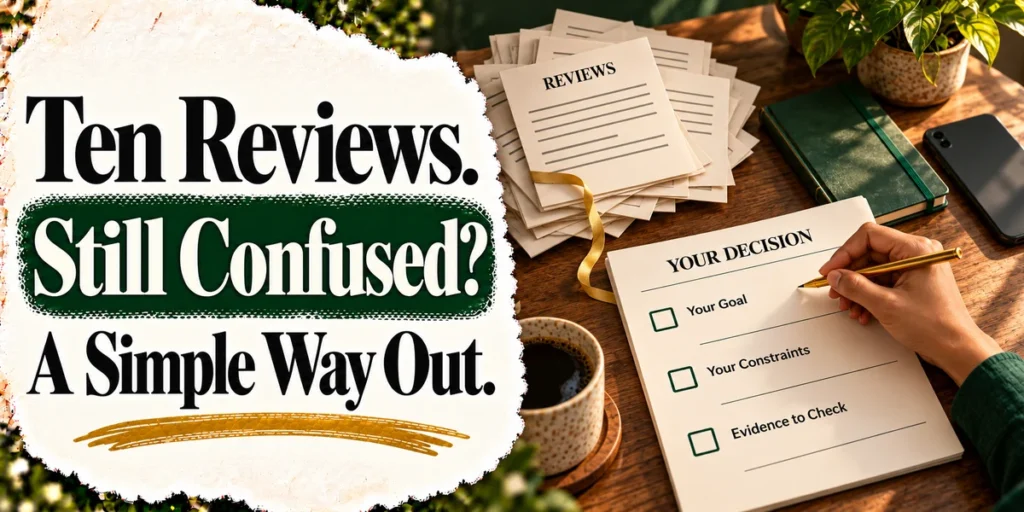
You read ten reviews. Five said great. Three said average. Two said terrible.
Now you are more confused than before. Every review sounds true. Every institute has happy students and unhappy ones.
This is the point where most people either give up or pick the loudest option. Both are mistakes.
There is a simpler way. It does not need more reviews. It needs a different way of reading the ones you already have, and one small test.
The short answer
Stop counting good and bad reviews. Start looking for patterns and specifics.
A review with a specific detail is worth ten reviews with a general opinion. And a demo class is worth more than all of them, because you can see the work yourself.
Why ten reviews confuse you
Reviews confuse people for three reasons.
1. They are emotional. People write reviews when they are very happy or very angry. The middle, where most students live, rarely writes anything.
2. They are about different things. One person is reviewing the trainer. Another is reviewing the fee. Another is reviewing the placement support. You are comparing apples to buses.
3. They are easy to fake or bias. Some reviews are genuine. Some are written by friends. Some are written in the first week, before the hard part. You cannot always tell which is which.
So the problem is not that you read ten reviews. The problem is that reviews alone cannot decide this.
The simple way out: three steps
Here is the method. It takes about an hour, and it works better than reading ten more reviews.
Step 1: Sort reviews by what they are about
Do not count good and bad. Sort them into three buckets.
- About the teaching. Trainer quality, live classes, feedback.
- About the outcomes. Portfolio, interviews, job support.
- About the service. Fee, counsellor behaviour, scheduling.
Now look at which bucket has the most complaints. That tells you where the real risk is.
If most complaints are about service, the teaching may still be good. If most complaints are about teaching, no fee discount fixes that.
Step 2: Look for specific details
A specific review sounds like this. “In week four, the trainer opened a real ad account and walked us through a broken campaign.”
A general review sounds like this. “Great institute, highly recommended.”
Specific reviews are harder to fake, because they contain details. When you find three specific reviews that say the same thing, that is a pattern. Trust it.
When reviews are all general, treat them as advertising, not evidence.
Step 3: Test it yourself
This is the step most people skip. Book a demo class, and check the claims you read.
Did the trainer open a real tool? Was there live feedback? Could you see student work? The demo class is the only review that is not written by someone else.
Three steps. Sort, look for specifics, test it yourself. That is the whole method.
The review-deciding quiz: what would you do?
Three short scenes. Pick your move before you scroll. Then read the answer.
Scene one. Ten reviews. All say “great institute.” No details. What do you do?
A. Trust them. Ten is a lot.
B. Treat them as advertising and look for specific reviews or a demo class.
C. Assume the institute is fake.
The smart move: B. General praise is not evidence. Specific details are. A trusts volume. C is too fast.
Scene two. Three reviews say the trainer is excellent. Five reviews complain about scheduling. What is the real risk?
A. The teaching is bad.
B. The service is the risk, not the teaching.
C. The institute is a scam.
The smart move: B. Sorting by topic shows where the risk sits. A misreads the pattern. C is too strong.
Scene three. You cannot decide between two institutes. What is the fastest way out?
A. Read ten more reviews.
B. Attend a demo class at both and compare the work you see.
C. Ask a friend who has never studied marketing.
The smart move: B. A demo class is the one review you can verify yourself. A adds confusion. C adds an opinion without evidence.
Do you see the pattern? In every scene, the smart move is the same. Sort by topic, look for specifics, and test it yourself.
A real story about review confusion
A composite story, based on many real cases. A student, call him Nitin, read twelve reviews about two institutes. He could not decide for three weeks.
One institute had more positive reviews. The other had fewer, but several detailed ones.
We sorted the reviews together. Most positive reviews for the first institute were general. “Best institute in Delhi.” No details.
The second institute had three specific reviews. One described a live campaign in week six. One described a trainer fixing a tracking issue. One described a portfolio review.
Nitin attended a demo class at both. At the first, the trainer showed slides. At the second, the trainer opened a real account and showed a broken campaign.
He chose the second. He told me, “Reviews ne confuse kiya, demo ne clear kiya.” Reviews confused me. The demo made it clear.
That is the lesson. Reviews can guide you. Only the demo can decide for you.
How to read reviews like a pro
Here is a simple table to use when you read reviews.
| What to look for | Weak review | Strong review |
|---|---|---|
| Detail | “Great course” | “Week four, real campaign review” |
| Topic | Mixed | Clear, one topic |
| Timing | Written in week one | Written after finishing |
| Balance | All praise or all anger | Mentions one weakness |
| Specifics | Names no tools or projects | Names tools and projects |
A review that mentions a weakness is often more trustworthy than a perfect one. Nobody’s experience is perfect. A balanced review sounds like a real person.
Before you trust any review, spend twenty minutes on Google’s Search Essentials and the GA4 documentation. Both are free. They will help you judge whether a review describes real work or just enthusiasm.
Common mistakes people make with reviews
- Counting positive and negative reviews instead of sorting by topic.
- Trusting general praise with no details.
- Ignoring reviews written after the course, which are usually more honest.
- Skipping the demo class, the one review you can verify yourself.
- Reading ten more reviews instead of testing one class.
- Letting one angry review cancel ten specific positive ones.
What reviews cannot promise
Reviews cannot promise that your experience will be the same. A course changes. Trainers change. Batches change.
A review is a signal, not a guarantee. The demo class is the closest thing to a real test.
Svidya’s numbers are examples, not guarantees. 200+ students taught. A highest package of 9.8 LPA. Three free demo classes. The highest package is one person’s result. It is not a forecast for you.
Your action checklist
Print this. Use it the next time you are stuck.
- List the reviews you have read. Sort them by topic. Teaching, outcomes, service.
- Find which topic has the most complaints. That is the risk.
- Highlight reviews with specific details. Trust patterns of three or more.
- Ignore general praise with no details.
- Look for balanced reviews that mention one weakness.
- Book a demo class at the two options you are considering.
- At the demo, check the claims you read. Real tools? Live feedback? Student work?
- Book the demo. At Svidya you get three free demo classes for the AI-Powered Marketing Course. Attend all three before you decide.
- Decide after the demo, not before.
Final words and your next step
Ten reviews cannot decide for you. A method can.
Sort by topic. Look for specifics. Then test it yourself with a demo class. That is the simple way out.
You do not have to guess. Stop reading more reviews. Start checking the claims.
If you are in Delhi and comparing options, start with a free demo class at Svidya’s AI-Powered Marketing Course. Bring the checklist. Ask the awkward questions. Then decide, with proof in your hand and no pressure from anyone.
About the author
Shubhankar Vashist is the founder of SVidya, based in Delhi. He has 6+ years of marketing experience across healthcare, pharma, cosmetics, e-commerce and agencies. He teaches digital marketing by making students build real assets.
FAQ
How many reviews should I read before deciding on a course?
There is no magic number. Ten is plenty. The problem is usually not the number of reviews, but how you read them. Sort them by topic, look for specific details, and test the claims in a demo class.
Why do reviews confuse me so much?
Because they are emotional, they cover different topics, and some are written very early. Comparing a review about the trainer with a review about scheduling is not a fair comparison. Sort by topic first.
Are online reviews reliable for choosing a course?
They can be useful signals, but they are not guarantees. Specific reviews with details are more reliable than general praise. A demo class is the most reliable test, because you can verify it yourself.
What is the fastest way to decide between two courses?
Attend a demo class at both. Check whether the trainer opens real tools, whether there is live feedback, and whether you can see student work. The demo is faster than reading ten more reviews.
What if all the reviews are positive but have no details?
Treat them as advertising, not evidence. Look for specific reviews that mention tools, projects, or weeks. If there are none, rely on the demo class before you decide.