
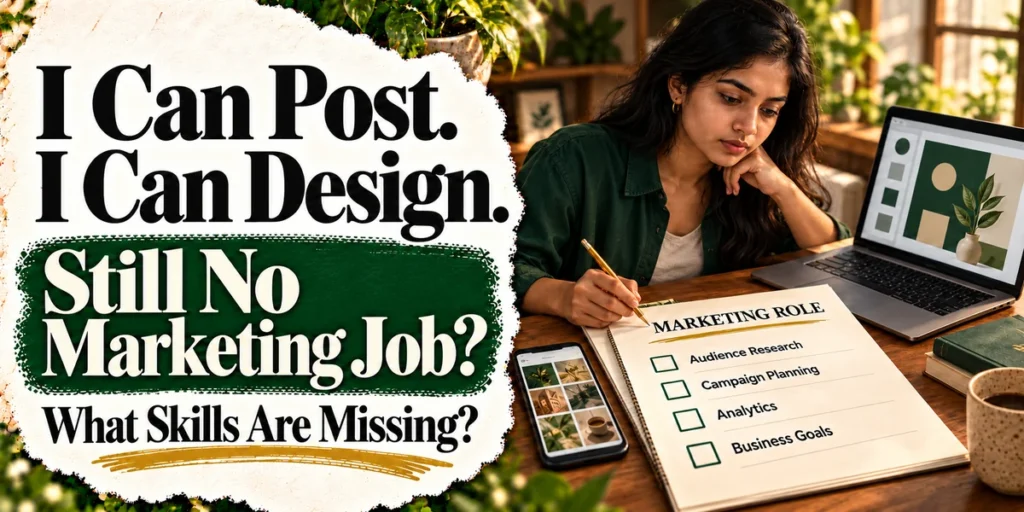
You can post on Instagram. You can make a clean Canva design. You have done it for your own page, maybe for a friend’s shop.
So why are marketing jobs not calling you back?
It is a frustrating question, and most advice does not answer it. “Improve your resume.” “Apply more.” “Network.”
Those are not wrong, but they miss the real gap. Posting and designing are skills. Marketing jobs ask for a few more, and most freshers never build them.
This post is about those gaps, honestly. Seven of them, and what to do about each.
The short answer
Instagram and Canva prove you can create content. Marketing jobs ask for something bigger. They ask whether you can run a campaign, read the numbers, and explain what worked.
Those are different skills. The good news is that they can be learned, and most of them are free to practise.
What you have, and what is missing
Let us be fair first. What you have is not nothing.
- You can create. You understand what looks good and what gets attention.
- You know the platform. You understand how Instagram content works in practice.
- You can design. Canva is a real tool, used in real jobs.
That is a start. But a marketing job asks for three more things.
- Campaign thinking. Can you plan a goal, a budget, and a measurement?
- Data reading. Can you open GA4 or Meta Ads Manager and explain what happened?
- Business context. Can you connect marketing to sales, cost, and results?
Those three are where most freshers stall.
The 7 gaps holding you back
Here is the honest list. Read each one and see if it applies to you.
1. You have content, but no campaign
A post is content. A campaign has a goal, an audience, a budget, and a result.
Recruiters want to see a campaign, even a small one. A boosted post with a clear goal and a measured result is stronger than twenty pretty designs.
What to do. Run one small campaign. A small budget, one clear goal, and a simple report on what happened.
2. You cannot read the numbers
Most freshers cannot explain a dashboard. They can post, but they cannot say what the post did.
Learn GA4 basics. Understand impressions, clicks, conversions, and cost per result. Learn what a drop in numbers means.
What to do. Open GA4 on any site you have access to. Spend twenty minutes a day reading it. Google’s own documentation is free.
3. You have no portfolio, only a feed
A feed is not a portfolio. A portfolio explains the problem, the action, and the result.
Even two project write-ups are better than a feed of designs. Recruiters want to see how you think, not just how you design.
What to do. Write two short project pages. Problem, action, result. Include screenshots.
4. You have not learned AI workflows
Marketing jobs increasingly expect AI use in drafting, reporting, and research. If you cannot explain where AI helps and where it fails, you look behind.
What to do. Use AI for one real task. Draft ad copy, then review it. Note what was wrong. That habit is what employers want.
5. Your resume speaks about skills, not results
“I know Canva and Instagram” is a skill list. “Ran a small campaign that got 40 saves and 12 enquiries” is a result.
Results, even small ones, tell a hiring manager more than a tool list.
What to do. Rewrite your resume with outcomes. Small numbers are fine. Honest numbers are better than big claims.
6. You apply widely instead of specifically
Applying to fifty roles with one resume is common. It is also why most applications are ignored.
A specific application, for one role, with a portfolio that matches, gets more replies. It takes longer, but it works.
What to do. Pick five roles a week. Tailor each application. Show how your work fits that role.
7. You have no interview practice
The interview will ask you to explain your work. If you have never practised out loud, you will freeze.
What to do. Practise a one-minute explanation for each project. Record yourself. It feels awkward. It works.
The marketing jobs quiz: what is the real gap?
Three short scenes. Pick your move before you scroll. Then read the answer.
Scene one. Your feed looks great, but no recruiter replies. What do you change?
A. Post more often.
B. Build two campaign projects with results and write them up.
C. Change your profile photo.
The smart move: B. A feed shows content. A campaign write-up shows thinking. A adds volume without proof. C changes nothing important.
Scene two. An interview asks, “How did your post perform?” You do not know. What do you do next time?
A. Avoid the question.
B. Learn GA4 basics and track one post properly.
C. Say social media is hard to measure.
The smart move: B. Reading numbers is a core marketing skill, and it is learnable. A avoids the gap. C is not true, and it sounds like an excuse.
Scene three. You use AI for captions but never check them. What is the risk?
A. None. AI is reliable.
B. AI output can be wrong, and unchecked work looks careless in a job.
C. AI will make you look too modern.
The smart move: B. Reviewing AI output is a skill employers value. A is risky. C is not a real risk.
Do you see the pattern? In every scene, the smart move is the same. Build proof, read numbers, and review your work.
A real story about the gap
A composite story, based on many real cases. A student, call her Tanya, had a clean Instagram page for her design work. She applied to thirty marketing roles. Two replies. No offers.
She assumed the market was broken. Then a friend, who worked at an agency, looked at her application.
The problem was clear. Her resume listed tools. Her portfolio was a feed. She had no campaign, no numbers, no project write-ups.
Tanya fixed three things. She ran one small campaign for a local shop. She learned GA4 basics. She wrote two project pages.
Six weeks later, she got two interviews and one offer.
She told me, “Mujhe laga kaam nahi hai. Asal mein proof nahi tha.” I thought there was no work. Actually, there was no proof.
That is the gap. It is not talent. It is proof.
What marketing jobs actually check
Here is what a hiring manager looks for in a fresher.
| What they check | Weak signal | Strong signal |
|---|---|---|
| Campaigns | “I post on Instagram” | One small campaign with results |
| Numbers | Cannot explain metrics | Reads GA4 or Ads Manager |
| Portfolio | A feed of designs | Two project write-ups |
| AI use | Never used it | Uses it with review |
| Resume | Skill list | Results, even small |
| Applications | Fifty generic ones | Five tailored ones |
| Interview | Freezes | Explains work in one minute |
Before you apply again, spend twenty minutes on Google’s Search Essentials and the GA4 documentation. Both are free. Both will help you speak the language hiring managers expect.
Common mistakes freshers make
- Treating a feed as a portfolio.
- Listing tools instead of results.
- Applying widely instead of specifically.
- Never learning to read a dashboard.
- Using AI output without review.
- Skipping interview practice.
What no application can promise
No application can promise a job. Hiring depends on your proof, your interview, and the market. But better proof improves your odds, and that part is in your hands.
Svidya’s numbers are examples, not guarantees. 200+ students taught. A highest package of 9.8 LPA. Three free demo classes. The highest package is one person’s result. It is not a forecast for you.
Your action checklist
Print this. Start this week.
- Run one small campaign with a clear goal.
- Write two project pages. Problem, action, result.
- Learn GA4 basics in twenty-minute sessions.
- Use AI for one task, then review every line.
- Rewrite your resume with results, not tools.
- Apply to five roles a week, tailored.
- Practise a one-minute explanation for each project.
- Book the demo. At Svidya you get three free demo classes for the AI-Powered Marketing Course. Attend all three before you decide.
- Ask for one piece of feedback on your portfolio before you apply again.
Final words and your next step
You can post on Instagram and use Canva. That is a start. But marketing jobs ask for proof, numbers, and clarity.
Close the seven gaps. Build one campaign. Read one dashboard. Write two project pages. Practise your pitch.
You do not have to guess. The gap is not talent. It is proof, and proof can be built.
If you are in Delhi and want structure with real projects and reviews, start with a free demo class at Svidya’s AI-Powered Marketing Course. Bring the checklist. Ask the awkward questions. Then decide, with proof in your hand and no pressure from anyone.
About the author
Shubhankar Vashist is the founder of SVidya, based in Delhi. He has 6+ years of marketing experience across healthcare, pharma, cosmetics, e-commerce and agencies. He teaches digital marketing by making students build real assets.
FAQ
Why am I not getting marketing jobs even though I can post on Instagram?
Because posting is only one skill. Marketing jobs also ask for campaign thinking, data reading, and a portfolio that explains results. Build one small campaign and learn to read a dashboard.
Do I need a portfolio for a marketing job?
Yes, even a small one. Two project write-ups with a problem, action, and result are stronger than a feed of designs. A portfolio shows how you think.
Is Canva enough for a marketing job?
Canva is useful, but it is one tool. Employers also expect familiarity with analytics and ads tools like GA4 and Meta Ads Manager, at least at a basic level.
How do I learn GA4 for free?
Google’s GA4 documentation is free and clear. Spend twenty minutes a day reading it and opening a real dashboard. Practice matters more than theory.
How many jobs should I apply to each week?
Five tailored applications are better than fifty generic ones. Match your portfolio to the role and show how your work fits. Quality gets replies.