
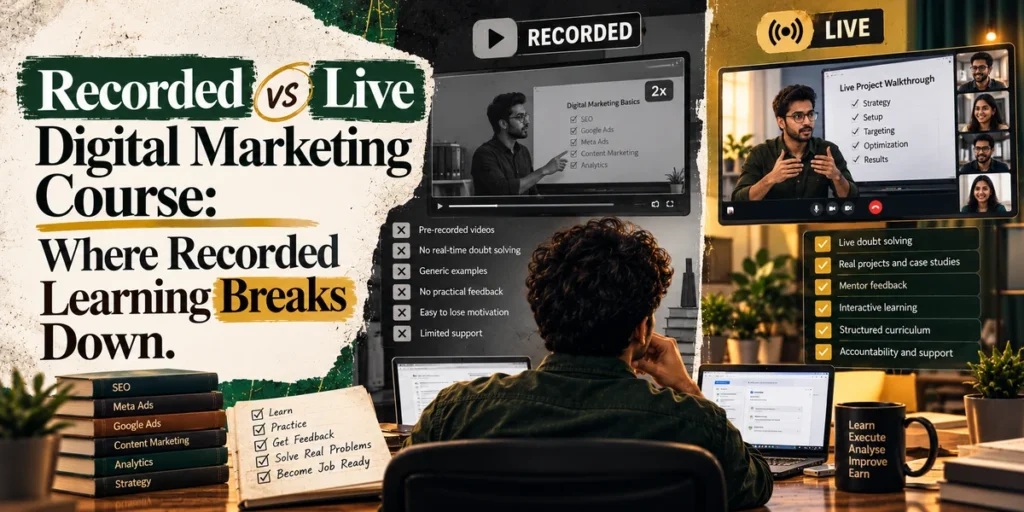
You bought a recorded digital marketing course. Or you are thinking about one. It is cheaper, flexible, and you can watch it whenever you want. What is not to like?
Plenty. Not because recorded content is bad. Because recorded learning breaks down in specific places. Places that matter more than the price difference.
I have learned from recorded content. I have also seen where it fails. Here is a plain look at where recorded digital marketing courses work, where they break, and how to decide for yourself.
Where Recorded Learning Works
Recorded content is genuinely good for three things.
Concepts. Theory, definitions, frameworks. You can pause, rewind, take notes, and revisit anytime. For understanding how SEO works or what a funnel is, recorded is fine.
Reference. Once you have learned something, recordings are great to re-check a step. You forget a setting in Ads Manager. You go back, rewatch the two-minute clip, and move on.
Low-stakes learning. If you are testing whether you even enjoy marketing, a recorded course is a cheap way to find out.
Used this way, recorded content is a tool. A good one.
Where Recorded Learning Breaks Down
It breaks in the places that actually build skill. Here are 7 places.
1. No Deadline
The video will wait. Tomorrow, next week, next month. There is nothing forcing you to watch it. Most people never finish recorded digital marketing courses. Not because the content is bad. Because nothing pushes them.
What to do instead: Give yourself a fake deadline. Set specific times each week when you will watch. Tell someone. Treat it like a live course, even if it is not.
2. No Live Doubt Clearing
You get stuck at minute 14. You cannot ask why. You rewind. You rewatch. You go to a forum. You wait two days for an answer, if you get one. The momentum dies.
What to do instead: Join a community where you can ask questions. Or find a peer learning the same thing. Two people asking each other questions move faster than one person stuck in silence.
3. No Feedback
You build a campaign. It looks right. But is it actually right? You have no senior to review it. You guess. You keep going with a mistake baked in.
What to do instead: Share your work publicly. Post it in a community. Ask for a review. You will get more feedback than you expect, and some of it will be useful.
4. No Pressure
Recorded learning removes all the discomfort that builds skill. No one waiting for your output. No fixed time. No stakes. Comfortable, and unproductive.
What to do instead: Create artificial pressure. Announce a deadline publicly. Commit to shipping something by a specific date. Public commitment replaces the pressure a live course provides.
5. No Real Community
A comment section is not a batch. You do not know who is learning alongside you. Nobody notices if you disappear. There is no accountability.
What to do instead: Find or start a small study group. Three to five people learning together beats a thousand people in a comment thread.
6. No Accountability Loop
Strong programs have a loop. You build, you submit, you get reviewed, you fix. Recorded courses skip the loop entirely. You watch, you close the tab, nothing changes.
What to do instead: Build the loop yourself. Every week, submit something to someone. Even a friend. The submission forces the work.
7. No Adaptation to Your Context
A recorded session was filmed for a general audience. It cannot answer your specific question. It cannot look at your business and tell you what applies to you and what does not.
What to do instead: After watching, write down the parts that apply to your situation. Ignore the rest. Adapt, do not absorb.
Why It Feels Like It Is Working
Here is the trap. Recorded learning feels productive.
You finish a module. You feel smarter. You take notes. You highlight a line. Your brain rewards you. You feel like you are making progress.
You are not. You are watching someone else do the work. Watching a chef does not make you a cook. Watching a course does not make you a marketer.
The feeling of progress is the most dangerous part of recorded learning. It keeps you coming back to watch more, while the actual skill sits untouched.
Where Live Learning Actually Wins
Live learning wins in four places.
Deadlines. Sessions happen at fixed times. You show up or you miss it. The pressure creates consistency.
Live doubt clearing. You get stuck, you ask, you get an answer in the same session. The momentum stays alive.
Feedback. A senior reviews your work. You know which choices were right and which were noise.
Batch accountability. You are learning with the same group every week. You notice each other. You do not want to be the one who disappears.
These are the exact things recorded content cannot give you. Not because recorded is bad. Because these things require other humans, in real time.
Comparison Table
| Factor | Recorded Course | Live Course |
|---|---|---|
| Cost | Usually lower | Usually higher |
| Flexibility | High, watch anytime | Fixed schedule |
| Deadline pressure | None | Fixed sessions |
| Doubt clearing | Delayed, unclear | Real time |
| Feedback on work | Usually none | Usually included |
| Accountability | None | Batch-based |
| Community | Comment section | Same group every week |
| Best for | Concept learning, reference, testing interest | Skill building, career change, portfolio |
| Risk | You never finish | Schedule clash if you cannot commit |
What I Actually Did
When I was learning, I had no budget for a live course. So I used recorded content and free resources. I learned a lot of concepts. I can still remember the frameworks.
But I did not build real skill until I took on small real projects. My first website project taught me more in three weeks than the previous three months of watching. Not because the content was better. Because someone was waiting for the output.
Years later, when I started teaching, I chose live sessions for one reason. I have watched too many people collect recorded courses and never build anything. The pattern is predictable. The fix is not more content. The fix is a schedule, a batch, and someone checking the work.
That is why the way I now teach runs on live sessions, small batches, and weekly reviewed output. Not because live is trendy. Because recorded learning alone does not move most people.
Mistakes to Avoid
Buying recorded because it is cheaper. Cheaper only helps if you actually finish it. Most people do not. The cheapest course you never finish is the most expensive one.
Assuming live is automatically better. A large live batch with no feedback is a broadcast, not a program. Live only wins if the batch is small and the work is reviewed.
Doing both at once and burning out. If you take a live program, do not stack another course on top. One at a time.
Using flexibility as an excuse. “I will watch it later” is the same as “I will never watch it”. Flexibility without discipline is procrastination with a nicer label.
Skipping the refund policy check. Both live and recorded programs should have a written refund window. If they do not, that is a red flag on its own.
Choosing based on hours of video. Two hundred hours of recorded content is not better than forty hours of live building. Hours are not the metric. Output is.
Checklist Before You Choose
- ☐ I know why I am choosing recorded vs live. Not just “it is cheaper” or “it sounds better”.
- ☐ If recorded, I have a real deadline and a real project planned.
- ☐ If live, I have confirmed batch size and how feedback works.
- ☐ I have checked the schedule against my week.
- ☐ I have a plan for what I will build in the first 30 days.
- ☐ I have asked what happens if I fall behind.
- ☐ I have seen the refund policy in writing.
- ☐ I am judging the program on output, not on hours of content.
FAQ
Q: Is a recorded course a waste of money?
A: Not always. It is a waste if you never finish it. It is useful if you are learning concepts, testing interest, or using it as reference after building.
Q: Why do most people not finish recorded courses?
A: No deadline, no accountability, and no one checking the work. Without external pressure, most people default to watching and never applying.
Q: Is live always better than recorded?
A: No. A large live batch with no feedback is not better than a good recorded course. Live only wins if the batch is small and assignments are reviewed.
Q: Can I learn digital marketing from recorded content alone?
A: Concepts, yes. Skill, rarely. You still need real projects with real stakes. Recorded content can support that, but it cannot replace it.
Q: How many hours of recorded content do I need?
A: Fewer than you think. You do not need two hundred hours. You need enough to understand the basics, then you need to build. More content often delays the building.
Q: What if I cannot commit to a live schedule?
A: Then a recorded course with your own imposed deadlines can work. But you have to treat it like a live course. Fixed times. Fixed outputs. Fixed review.
End CTA
If you want a route that runs on live sessions, small batches, and reviewed weekly output, the SVidya homepage explains how it works. Read it carefully and check whether your schedule actually allows it. If it does not, a recorded course with your own deadlines is a fine choice. The format matters less than what you build inside it.
Author Box
Shubhankar Vashist is the founder of SVidya, based in Delhi. He has 6+ years of marketing experience across healthcare, pharma, cosmetics, e-commerce and agencies. He teaches digital marketing by making students build real assets.